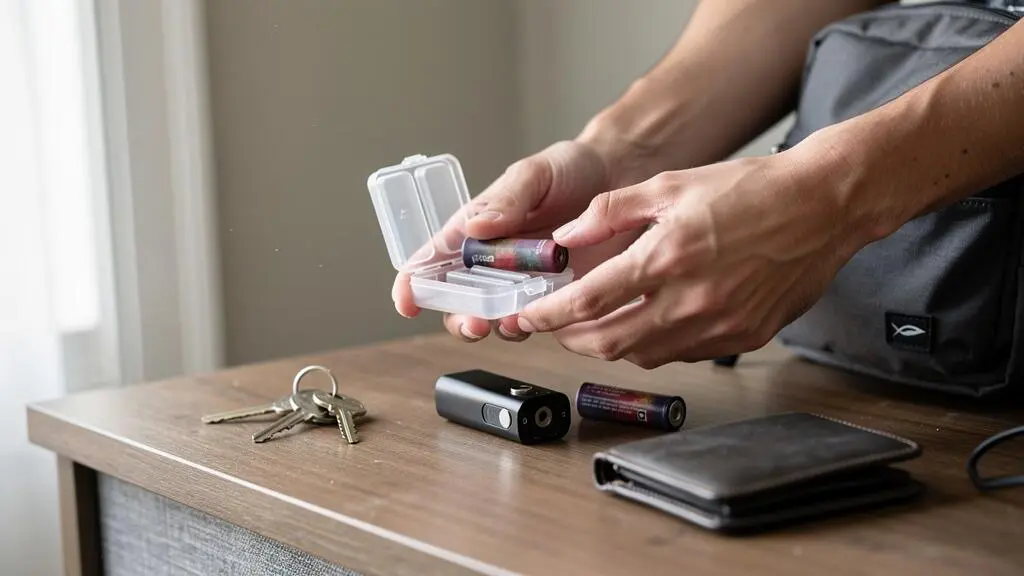
Vape batteries should be stored in a cool, dry place, protected from metal objects, physical damage and accidental activation. Removable lithium-ion cells need particular care: a spare battery carried loose alongside keys or coins can short-circuit even when it is not connected to a vaping device. A dedicated protective case provides a practical way to prevent this contact.
Safe storage also depends on whether a battery is used daily, left unused for several months or carried during a journey. A built-in battery and a removable 18650-style cell do not require identical handling. Temperature exposure, charge level and battery condition all influence the appropriate precautions.
For adults using removable-cell mods or rechargeable pod systems, the objective is straightforward: prevent avoidable electrical faults while preserving battery condition. This requires choosing suitable storage locations, protecting spare cells individually and recognising damage before reuse. Travelling adds another consideration, particularly when airline rules restrict where lithium batteries and vaping devices can be carried.
Vape battery storage: essential precautions
- Keep spare removable batteries in protective plastic cases, separated from keys, coins and other conductive objects.
- Avoid excessive heat, freezing conditions, moisture and locations where batteries could be crushed or accidentally activated.
- Inspect batteries before reuse, particularly after extended storage or potentially damaging exposure. Stop using cells showing physical damage or abnormal heating.
- Why Should Vape Batteries Be Stored Away From Metal Objects and Heat?
- How Do You Store Spare Vape Batteries Safely Between Uses?
- Daily or Long-Term Storage: What Changes for Vape Battery Care?
- Which Battery Storage Locations Should Vape Users Avoid?
- When Should a Stored Vape Battery Be Checked Before Reuse?
- Spare Batteries or USB Charging: Which Is More Practical for Long Days Away?
- How Do You Check a Vape Battery for Physical and Performance Problems?
- Which Habits Help Preserve Vape Battery Longevity?
Why Should Vape Batteries Be Stored Away From Metal Objects and Heat?
Vape batteries must be separated from metal objects because conductive materials can create an external short circuit, allowing a potentially dangerous current to flow. Heat presents a different hazard: it can accelerate battery deterioration and increase safety risks. A suitable storage location therefore needs to control electrical contact, temperature exposure and physical pressure simultaneously.
Removable lithium-ion batteries commonly used in vape mods can deliver substantial electrical current. If a coin, key or another conductive object connects the battery’s positive and negative terminals, electricity can flow through an unintended path. This external short circuit may produce rapid heating, damage the cell and potentially initiate a fire.
On many cylindrical cells, the metal casing forms part of the negative electrical connection. This makes the insulating wrap especially important: damage near the positive terminal can expose surfaces that must remain electrically isolated.
The UK government advice on e-cigarette battery safety, published by the Office for Product Safety and Standards, specifically recommends storing removable and spare batteries in plastic cases to prevent accidental contact.
Temperature introduces two related but distinct concerns. Leaving a cell on a sunny windowsill or near a radiator can accelerate chemical ageing. Leaving a complete vape mod inside a hot car adds the possibility of heat exposure affecting a battery that remains electrically connected to the device. Accidental activation or an existing fault could compound the situation.
A switched-off device is not automatically protected against every electrical fault. A damaged switch, inadequate locking mechanism or pressure against a firing button can create an unwanted discharge pathway. For extended storage, removing compatible removable cells provides an additional safeguard.
Before choosing a storage location, apply four questions:
- Temperature: Will the location remain free from excessive heat and freezing conditions?
- Moisture: Is it dry and protected against water exposure?
- Conductive contact: Are the battery terminals isolated from metal objects?
- Pressure: Can the device or battery remain protected from crushing and accidental activation?
If any condition is uncertain, choose a different location or improve the protective arrangement.
The central distinction is between a battery merely being out of use and being properly protected. Electrical isolation, stable temperatures and physical protection are separate requirements, and each needs attention.
How Do You Store Spare Vape Batteries Safely Between Uses?
Store removable spare vape batteries individually in a suitable non-conductive protective case, away from metal objects and physical pressure. A rigid plastic case with correctly sized compartments helps keep terminals isolated and prevents cells from moving freely. For extended storage, retain a partial charge rather than deliberately leaving the batteries completely full or depleted.
A dedicated battery case solves two practical problems. Its insulating material prevents loose conductive objects from touching exposed electrical contacts, while its fitted compartments reduce movement that could damage a battery wrap. Cases should close securely without squeezing or deforming the cells.
Simply wrapping batteries in cloth does not provide reliable protection against conductive objects moving inside a bag. Likewise, a loose cell should never be placed directly in a pocket containing keys or coins.
Appropriate terminal insulation can sometimes be used for transport under specific regulations. However, an improvised covering should not be assumed to offer the same resistance to impacts and crushing as a properly fitted case.
For everyday storage, separate the protective case from items likely to put pressure on it. In a backpack, use a stable compartment rather than leaving the case at the bottom beneath heavy objects. In clothing, a securely closed case is preferable to carrying an unprotected battery in a pocket.
Charge level becomes more relevant when a spare battery will remain unused for weeks or months. Lithium-ion cells generally tolerate extended storage better at a partial state of charge than at the extremes of their operating range. The correct approach depends on the cell chemistry and manufacturer instructions; no single percentage guarantees safe storage.
Before travelling, check whether stored cells have sufficient charge for the intended use. Do not attempt to restore a battery that has become abnormally depleted using improvised charging methods.
Users of devices with built-in batteries need a different routine. They should switch the device off, protect it from accidental activation and follow the manufacturer’s storage instructions. They should not attempt to remove a battery that was not designed to be user-removable.
Five actions for safer spare battery storage
- Identify each battery: Confirm that the cell is compatible with the device and check its identifying information against the manufacturer’s guidance.
- Inspect its condition: Check the casing, insulating wrap and terminals, leaving only undamaged cells ready for use.
- Protect each cell: Place every removable battery into an appropriately sized insulating case and verify that it closes securely.
- Choose the compartment: Put the closed case in a dry, stable location separated from keys, coins and heavy objects.
- Check before departure: Confirm the case is intact, the batteries have suitable charge and no loose cells remain in pockets or luggage.
Once suitable cases and storage compartments have been established, the remaining adjustments depend mainly on how frequently the batteries are used.
Daily or Long-Term Storage: What Changes for Vape Battery Care?
Daily vape battery storage primarily requires protection against heat, metal contact, damage and unintended activation. Long-term storage adds charge management, removal of user-removable cells where appropriate, and periodic condition checks. Batteries left unused for weeks or months should generally be kept partially charged in a cool, dry environment rather than stored indefinitely at full or empty charge.
The difference matters because immediate electrical safety and gradual battery ageing are not the same process. A battery can remain physically undamaged while losing usable capacity over time, particularly when exposed to elevated temperatures or stored at a high state of charge.
For a device used every day, the practical priorities are straightforward: switch it off or engage the manufacturer’s locking mechanism, prevent pressure on the firing control, and keep it away from unsuitable temperatures. Removable cells do not necessarily need to be taken out after every ordinary use when the manufacturer permits them to remain installed.
For extended periods without use, removing user-removable cells, storing them separately and checking their state of charge periodically becomes more relevant.
| Storage consideration | Daily storage | Long-term storage |
|---|---|---|
| Battery position | May remain installed where manufacturer guidance permits | Remove user-removable cells where appropriate |
| Charge level | Maintain enough charge for normal use | Prefer a partial charge and avoid prolonged deep discharge |
| Physical protection | Prevent metal contact, pressure and activation | Keep removable cells individually protected in suitable cases |
| Inspection | Check when handling or if behaviour changes | Check condition and charge periodically and before reuse |
| Environment | Cool, dry and protected | Cool, dry and stable for the storage period |
Battery University‘s technical guidance on battery storage explains how temperature and state of charge influence lithium-ion capacity retention. Its illustrative lithium-cobalt battery estimates show that cells stored fully charged can lose more capacity over time than comparable cells stored at partial charge.
96% versus 80%
Illustrative estimated capacity retained after one year at 25°C for lithium-cobalt cells stored at 40% and 100% charge respectively. These estimates are chemistry-specific, not guaranteed outcomes for vaping batteries.
Battery University, BU-702: How to Store Batteries, updated 27 October 2021.
The technical guidance describes approximately 40% charge as a useful reference for long-term lithium-ion storage, while making clear that achieving an exact percentage is not essential. Battery-specific instructions take precedence over this general illustration.
When returning a battery to service after several months, inspect it visually before charging. Use appropriate charging equipment and pay attention to unusual heat, inconsistent charging indications or failure to retain charge. Do not attempt to recover an abnormally discharged or damaged cell using improvised techniques.
Storage duration changes the maintenance routine, but not the basic environmental requirements. A location that is unsuitable for a battery overnight is unlikely to become appropriate simply because the battery will remain there longer.
Which Battery Storage Locations Should Vape Users Avoid?
Vape batteries should not be stored where they may encounter excessive heat, freezing conditions, water, metal objects or crushing pressure. Particularly unsuitable locations include hot cars, pockets containing keys, damp rooms, unprotected luggage compartments and bedding. A safe storage location must protect both the electrical terminals and the physical structure of the battery.
Different locations create different hazards. Recognising the mechanism behind each one is more useful than memorising a list of forbidden places.
- Cars exposed to heat: A glovebox, dashboard or parked vehicle interior can expose batteries and devices to excessive temperatures. Heat can accelerate deterioration, while an installed cell remains connected to the device’s electrical components.
- Pockets or bags containing metal: Keys, coins and conductive accessories can contact unprotected battery terminals. Movement also increases the chance of abrasion or impact.
- Bathrooms and damp kitchens: Moisture exposure, water splashes and changing temperatures make these less suitable than a stable, dry storage space.
- Floors, driveways and crowded storage areas: Batteries may be stepped on, crushed by furniture or damaged by heavy objects.
- Pillows, bedding and upholstered furniture: Soft materials can trap heat and place pressure on device controls. They are especially unsuitable for charging.
Cold environments deserve attention too. A garage that approaches freezing conditions or a vehicle parked outdoors in winter is not automatically safer than a warm room. Cold exposure and subsequent temperature changes may create operating problems or condensation, particularly when a cold device is brought into a warmer environment.
For the same reason, a refrigerator or freezer should not be treated as an improvised battery storage solution.
Travelling introduces less obvious storage hazards. A suitcase may be compressed, a backpack may contain sharp metal objects, and a glovebox can expose its contents to temperatures outside the user’s control.
Air travel also involves specific restrictions, not merely a choice of convenient storage. For flights, consult the relevant aviation authority and airline requirements before packing.
The United States Federal Aviation Administration states that vaping devices and spare lithium batteries must travel on the person or in cabin baggage rather than checked baggage. Its guidance also requires protection against accidental activation and short circuits. Other countries and airlines may impose additional requirements.
A practical storage-location test is to ask whether the battery could become hot, wet, electrically bridged, crushed or forgotten in an unsuitable environment. If any of these hazards is foreseeable and cannot be controlled, select another location.
Even careful storage cannot guarantee that a cell remains suitable for use indefinitely. A battery exposed to an adverse condition should be inspected before being returned to service.
When Should a Stored Vape Battery Be Checked Before Reuse?
Inspect a stored vape battery before reuse after extended inactivity, a fall, exposure to extreme temperatures or travel conditions that may have caused damage. An inspection is also necessary whenever charging or device performance changes unexpectedly. Look for damage to the wrap, dents, corrosion, leakage and unusual behaviour, and do not reuse a cell showing significant safety concerns.
A stored battery can deteriorate without obvious damage to the vaping device. Visual examination is therefore particularly important for removable cylindrical cells, whose insulating wrap and terminal components are part of their electrical protection.
Begin with the cell removed from the device, when removal is supported by the manufacturer. Examine it in good light, including its sides, ends and the seam of the insulating wrap. Look for tears, exposed metal, deformation, rust-like deposits or unusual residue.
A damaged wrap matters because the metal casing underneath can form part of the negative electrical connection. If exposed casing contacts a conductive surface near the positive terminal, an external short circuit becomes possible. Even a small tear near the battery’s upper insulating ring warrants attention.
Do not continue using a cell with exposed metal or rely on ordinary adhesive tape as a permanent wrap repair. A properly rated replacement wrap and intact insulating ring may be appropriate when the only defect is the outer insulation and competent servicing is available. Otherwise, replace the cell. A dented or structurally damaged battery is not made safe by rewrapping.
When assessing whether a stored battery can be reused, distinguish minor appearance changes from defects affecting electrical safety.
| Observation | Interpretation | Recommended response |
|---|---|---|
| Minor surface marking, intact wrap and normal operation | May be cosmetic | Inspect closely and continue monitoring condition |
| Torn wrap or damaged insulating ring | Electrical insulation may be compromised | Do not use until correctly repaired by a competent person or replaced |
| Dents, deformation or damaged terminals | Possible structural or electrical damage | Stop using and replace the cell |
| Unusual heating, swelling, leaking or hissing | Potentially serious battery failure | Stop use immediately and follow appropriate safety and disposal guidance |
| Unexpected charge loss or abnormal charging behaviour | Possible ageing or developing fault | Stop using until assessed; replace if malfunctioning |
A battery that becomes unusually hot, swells, leaks or makes a hissing sound should not be tested again to see whether the problem disappears. If safe to do so, disconnect charging equipment without touching an overheating battery, keep people away and follow emergency guidance if there is smoke, fire or immediate danger.
The inspection establishes whether a stored cell appears suitable for further assessment and use. It does not replace careful observation of charging and performance, which can reveal problems that are not visible externally.
Spare Batteries or USB Charging: Which Is More Practical for Long Days Away?
Spare batteries are often practical for long periods away from charging facilities when a vape device supports removable cells. USB charging or a compatible power bank may be more convenient when power is accessible or the battery is built in. The safest practical choice depends on device compatibility, available charging opportunities and the user’s ability to protect spare batteries during transport.
Carrying additional cells provides extra available energy without requiring immediate access to a socket. However, every spare battery introduces another item that must be protected against metal contact, impact and accidental short circuits.
USB charging removes the need to exchange removable cells but creates other dependencies. The charging port must work, a suitable cable must be available, and the device must support the intended charging arrangement. A power bank is useful only when it is compatible with the device and is itself carried and charged safely.
The comparison is therefore about practical constraints rather than one method being universally superior.
| Situation | More practical option | Main consideration |
|---|---|---|
| Short day with reliable charging access | Compatible USB charging | Carry the appropriate cable and follow charging instructions |
| Long day without reliable power access | Protected spare cells for compatible removable-battery devices | Each cell requires appropriate protection |
| Device with a built-in battery | Planned USB charging opportunities | Battery replacement is not a user operation |
| Journey involving air travel | Either, subject to transport rules | Check restrictions covering devices, spare cells and charging |
For users who carry several removable batteries, a consistent identification method helps avoid confusion. Keep charged and depleted cells in clearly differentiated, suitable cases or compartments, without placing markings over safety information or damaging the insulating wrap.
Battery orientation should follow the case design. Never rely on reversing an unprotected cell as a substitute for electrical insulation.
For flights governed by United States rules, the FAA PackSafe requirements for travelling with vaping devices specify that spare lithium batteries must be individually protected against short circuits and carried in the cabin. The FAA lists suitable protective arrangements, including battery cases, protective sleeves and appropriately secured terminal insulation.
Its guidance also prohibits recharging vaping devices and their batteries aboard the aircraft. These are US aviation requirements, not a statement that identical rules apply everywhere. UK and other international travellers should check the rules applicable to their itinerary and carrier.
Whatever the charging strategy, do not leave devices charging unattended for extended periods or on soft, easily ignited surfaces.
A workable travel arrangement is one that can be followed consistently. Extra battery capacity offers little practical benefit if the associated cells cannot be transported and handled safely.
How Do You Check a Vape Battery for Physical and Performance Problems?
Check vape batteries through two separate assessments: physical condition and operating behaviour. Physical checks identify damaged wraps, deformation, leakage or terminal problems. Performance checks identify unusual heating, reduced runtime, irregular charging and difficulty retaining charge. Serious physical damage requires immediate withdrawal from use, while gradual capacity loss may indicate ordinary ageing rather than an imminent failure.
The physical assessment begins with adequate lighting and a clear view of the removable cell. Rotate it carefully to examine the complete wrap, including its seam and the insulating ring around the positive terminal. Compare its condition with how it looked before storage or previous use.
Any dent, swelling, puncture or leakage should be treated as a reason not to use the cell. Swelling can reflect internal gas generation and deterioration within the battery. Rewrapping, charging or continuing to operate the device does not repair that internal condition.
The second assessment concerns behaviour. A battery may look normal while providing noticeably shorter runtime, losing charge unexpectedly or becoming excessively hot during charging or operation.
Reduced runtime alone does not prove that a cell is dangerous. Rechargeable lithium-ion batteries naturally lose capacity through use and ageing. What matters is whether the change is gradual and consistent, or whether it appears suddenly alongside other abnormalities.
For example, a battery that provides progressively shorter operating periods but remains physically intact and behaves normally while charging may simply be approaching replacement age. A battery that abruptly loses charge, produces unusual heat or repeatedly triggers charging problems requires a more cautious response.
Do not deliberately stress-test a questionable cell through repeated charging and discharging. If malfunction is suspected, withdraw it from use rather than attempting to determine its limits experimentally.
“If the battery gets unusually hot, starts to bulge or starts hissing, stop using it immediately.”
The London Fire Brigade advice on vaping and battery fire risks also identifies crushing, punctures, temperature extremes and water exposure as important hazards. Its recommendations support treating serious physical warning signs as reasons to stop use rather than merely increasing monitoring.
For batteries that remain in acceptable condition, recording significant changes in runtime or charging behaviour can help identify gradual deterioration. A simple written note of an unexpected symptom may be more useful than trying to estimate battery health from a single charge indicator.
Inspection is most effective when combined with storage and charging habits that minimise avoidable wear in the first place.
Key takeaways for everyday battery care
- Preventing repeated heat exposure and accidental damage is more practical than trying to recover battery performance afterwards.
- Charging routines should prioritise supervision, suitable equipment and surfaces that do not trap heat.
- A consistent spare-cell rotation method can make changes in battery condition easier to notice over time.
Which Habits Help Preserve Vape Battery Longevity?
Vape battery longevity is supported by avoiding repeated heat exposure, preventing physical damage, following manufacturer-approved charging practices and storing unused lithium-ion cells appropriately. Good routines cannot stop battery ageing, but they can reduce avoidable deterioration and make emerging problems easier to identify. Consistent handling also supports safer day-to-day use.
One of the most useful habits is controlling temperature exposure. A device left repeatedly in a warm car, near a heating appliance or in direct sunlight may experience accelerated battery ageing. The effect can accumulate even when no immediate failure occurs.
Develop a routine of moving devices and spare batteries to a more suitable location whenever their usual storage environment becomes excessively warm. This may mean removing a vape from a parked vehicle or selecting an indoor drawer away from radiators rather than leaving it in a sunny room.
Charging practices deserve equal attention. Use charging equipment compatible with the battery and vaping device, follow the manufacturer’s instructions, and avoid charging while asleep or away from the equipment for extended periods. Disconnect devices when charging is complete.
Charging should occur on a clean, flat, stable surface away from readily combustible materials. Bedding, sofas and covered or enclosed spaces are unsuitable because they can obstruct heat dissipation and increase the consequences of overheating.
Where removable cells are used, a simple rotation system can improve consistency. Keep compatible spare batteries identified and protected, use them in an orderly sequence, and note any cell whose performance differs noticeably from its previous behaviour.
For devices requiring multiple removable cells, follow the manufacturer’s instructions on paired or matched batteries. Do not mix cells of different specifications, ages or conditions within a configuration that requires matched cells.
Rotation does not guarantee equal battery lifespan. Cells can age differently because of their manufacturing characteristics, earlier use and storage history. Its practical value is in reducing confusion and helping users notice changes.
Finally, make replacement and disposal part of the routine. A battery that is damaged, leaking or malfunctioning should not remain in ordinary circulation or be placed in household rubbish. Follow local battery collection guidance, ensuring damaged cells are handled and transported according to the receiving service’s safety instructions.
Review the location where your batteries are kept, check that each removable spare has suitable protection, and inspect any cell that has been stored for an extended period. Maintaining those basic precautions is a practical starting point for safer battery care.
Can vape batteries be stored together in the same case?
Yes, if the case is designed for multiple cells and provides appropriate individual compartments and terminal protection. Batteries should fit securely without damaging their wraps. Do not place multiple unprotected cells loose inside a shared container where their terminals may contact one another.
Is it safe to keep a vape battery installed when the device is switched off?
It can be acceptable for ordinary daily storage when the manufacturer permits it, the device is undamaged and accidental activation is effectively prevented. For longer storage periods, removing user-removable cells and protecting them separately is a sensible precaution. Never attempt to remove a built-in battery that is not intended for user replacement.
Can a vape battery be stored fully charged for several months?
Prolonged storage at full charge can accelerate capacity loss in some lithium-ion chemistries, especially in warm conditions. A partial charge is generally preferable for extended storage, subject to the manufacturer’s instructions. Avoid deliberately storing batteries completely depleted, and check their condition before reuse.
Can spare vape batteries be packed in checked airline luggage?
Spare lithium batteries should be carried in cabin baggage or on the person, with their terminals protected against short circuits. The FAA explicitly prohibits spare lithium batteries from checked baggage under its applicable aviation requirements. Travellers should also consult the relevant national aviation guidance and airline restrictions, as rules may vary by jurisdiction and itinerary.
Where should damaged or worn-out vape batteries be disposed of?
In the UK, vape batteries and devices should not be discarded in ordinary household rubbish or recycling bins. Use an appropriate battery or electrical-waste collection service and follow its instructions, particularly for damaged or swollen cells. Keep terminals protected and avoid transporting a battery that is actively overheating, leaking or otherwise unstable; seek specialist safety guidance first.