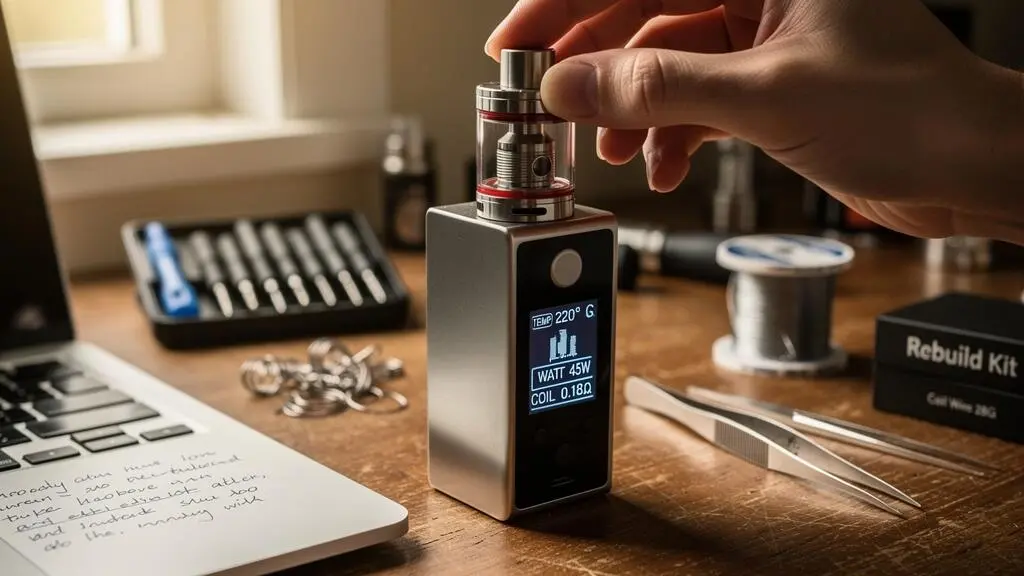
Temperature control (TC) can make a compatible vape mod more predictable when coil conditions change during a puff. Rather than maintaining a fixed electrical power output, the device adjusts power according to an estimated coil temperature. This can be useful when liquid supply becomes uneven or successive puffs leave the coil warmer than usual.
However, TC is not automatically better than wattage mode. Its performance depends on the heating-wire material, the accuracy of the resistance measurement, the selected material profile and the condition of the atomiser. A poorly configured TC system can produce weaker or less predictable vapour than a correctly operated wattage setup.
For experienced adult vapers in the UK and other English-speaking markets, the practical question is whether the additional configuration delivers a meaningful benefit with the hardware already available. Understanding the differences between temperature estimation, power limits and coil resistance makes that decision easier. Neither operating mode makes vaping risk-free, and a displayed temperature should not be treated as a guarantee of aerosol composition or safety.
Temperature control: the essential points
- TC estimates coil temperature from resistance changes and adjusts power, but its displayed temperature is not a direct measurement.
- Compatible materials, an appropriate device profile and an accurate cold-resistance reference are essential for reliable operation.
- Wattage mode remains a practical default for many coils; TC is most useful when its regulation addresses a specific consistency problem.
- Why Does Temperature Control Feel More Consistent Than Fixed Wattage for Some Coils?
- How Do You Set Up Temperature Control Without Using an Incompatible Coil?
- Temperature Control or Wattage Mode: Which Better Fits Consistent Daily Vaping?
- Which Temperature Control Mistakes Cause Erratic Power or Weak Vapour?
- When Should Temperature Control Resistance Be Rechecked or Relocked?
- Low or High Wattage: Which Range Better Suits Your Coil and Inhale Style?
- How Do You Set Up a Box Mod Without Exceeding the Coil’s Recommended Power Range?
- Who Are Rebuildable Dripping Atomizers Best Suited to?
Why Does Temperature Control Feel More Consistent Than Fixed Wattage for Some Coils?
Temperature control can feel more consistent because a compatible mod reduces or adjusts electrical power as the coil approaches its estimated temperature limit. Fixed wattage generally maintains the selected power despite changing coil conditions. The difference becomes most noticeable when the wick supplies liquid unevenly or the coil remains warm between closely spaced puffs.
TC relies on the electrical behaviour of the heating material. Nickel, titanium and certain stainless-steel alloys exhibit resistance changes that can be used to estimate temperature. The mod compares resistance during operation with a reference value and interprets the difference using a temperature coefficient of resistance (TCR).
The displayed temperature is an estimate, not a direct measurement. Its reliability depends on the correct material coefficient, stable electrical connections and the quality of the device’s regulation algorithm.
A PLOS ONE study on temperature-control accuracy in e-cigarettes illustrates the distinction. Researchers evaluated three commercially available device brands using Ni200 coils. At a selected temperature of 300 °C, directly measured coil temperatures ranged from 188 °C to 417 °C under the study’s experimental conditions. These results demonstrate variability in the tested equipment, not a universal error range for modern devices.
188–417 °C
Measured coil-temperature range at a 300 °C setting in a 2018 laboratory investigation of selected Ni200-based temperature-control devices. These figures are experimental observations, not recommended operating temperatures.
Dibaji and colleagues, PLOS ONE, 2018.
The potential benefit is clearest during extended or closely spaced puffs, when heating conditions vary. If the wick starts supplying less liquid, TC may reduce power rather than continuing to apply the same electrical input. This can moderate overheating, although it cannot guarantee the prevention of dry hits.
Sweetened liquids that leave deposits on a coil may change its performance over time. Temperature regulation cannot remove those deposits or restore degraded cotton. In some circumstances, declining power can make an emerging wicking problem less obvious, so a seemingly stable temperature reading should not replace physical inspection.
Kanthal and conventional nichrome coils are different. Their comparatively small resistance changes make them unsuitable for ordinary resistance-based TC operation. A user with these materials should not expect the same regulation behaviour as someone using compatible stainless steel, nickel or titanium.
TC is therefore most valuable when its feedback mechanism addresses a real operating variation. Establishing whether the installed coil supports that mechanism is the necessary next step.
How Do You Set Up Temperature Control Without Using an Incompatible Coil?
Safe and predictable TC configuration begins with identifying the coil material and confirming that the mod supports its resistance-temperature characteristics. Select the matching material profile, establish an accurate cold-resistance reference and start with conservative settings. If the material is unknown or incompatible, use an appropriate manufacturer-supported operating mode instead of attempting to force TC activation.
Coil resistance alone does not identify the heating material. Two coils can display similar resistance values while requiring completely different control profiles. Check the original packaging, manufacturer specifications or confirmed material markings before changing modes.
The Innokin Proton Mini support instructions identify stainless steel 316L, titanium, Ni200 and supported TCR materials as compatible with that particular device. The manufacturer also instructs users to select the correct coil material and increase the temperature gradually. Other mods may offer different material profiles and calibration procedures.
Cold resistance is the calculation’s starting reference. Depending on the device, this may be measured automatically when a new atomiser is detected or managed through a resistance-lock function. A resistance reference established while the coil is still hot can distort the temperature calculation.
Where the manufacturer provides a manual resistance-lock feature, use its documented procedure with the coil fully cooled to ambient temperature. Do not assume that every mod requires or supports the same locking method.
For initial adjustment, begin at the lower end of the manufacturer’s recommended temperature range and increase gradually only while operation remains normal. Avoid treating a particular Celsius setting as universally appropriate: coil geometry, material, airflow and liquid supply all influence the result.
Stainless steel provides an additional comparison opportunity because suitable grades may operate in both wattage and TC modes. With a verified compatible coil, the same liquid and unchanged airflow, an experienced user can compare the two modes within the manufacturer’s limits. This is an informal practical comparison, not a controlled scientific experiment.
Five checks before using temperature control
- Identify the coil material from reliable manufacturer information. Record the confirmed alloy or compatible coil specification.
- Verify that the mod supports that material. Record the matching TC profile or supported TCR configuration.
- Allow the installed coil to reach ambient temperature. Record its stable cold-resistance reading before following the device’s calibration procedure.
- Check the manufacturer’s operating limits and begin conservatively. Record the initial settings used.
- Observe device behaviour during normal operation. Note whether power regulation is stable or whether unexpected resistance warnings, weak output or overheating occur.
Once the installation is verified, the choice between TC and wattage becomes a comparison of operating priorities rather than a question of technical capability alone.
Temperature Control or Wattage Mode: Which Better Fits Consistent Daily Vaping?
Wattage mode generally suits users who prioritise straightforward settings and already obtain consistent performance from their coils. Temperature control may better suit compatible setups experiencing noticeable variation during longer or closely spaced puffs. Neither mode guarantees stable flavour, vapour output or battery life when the coil is worn, improperly installed or insufficiently supplied with liquid.
The operating distinction is important: wattage regulation targets electrical power, while TC adjusts power through feedback from estimated coil temperature. A 2019 experimental study, Physiological Reports research on vaping power and temperature settings, describes this difference when investigating how operating conditions and e-liquid constituents affect emitted particles.
That research does not establish which mode produces better flavour, throat hit or battery autonomy in everyday use. Those judgments require separating measurable device behaviour from individual preferences.
The practical differences can be organised around common operating conditions.
| Criterion | Temperature control | Wattage mode |
|---|---|---|
| Primary regulation | Adjusts power according to estimated coil temperature | Targets the selected electrical power |
| Compatible coils | Requires supported temperature-sensitive materials | Supports a broader range of appropriately rated coils |
| Longer puffs | May reduce power when the estimated limit is reached | Generally maintains selected power unless another protection intervenes |
| Uneven liquid supply | May reduce heating intensity, but cannot repair poor wicking | Does not directly regulate coil temperature |
| Setup complexity | Requires accurate material selection and resistance calibration | Usually requires a suitable power setting |
| Battery autonomy | Depends on the actual power profile and usage | Depends on selected power and usage |
| Ageing coil performance | Cannot reverse deposits or cotton degradation | Cannot reverse deposits or cotton degradation |
Liquid composition also matters. A rapidly fouling coil may become inconsistent regardless of operating mode. Likewise, a prolonged inhale can trigger TC power reduction without indicating that the wattage setting was inherently unsuitable.
For a meaningful informal comparison, suitable stainless-steel hardware offers the advantage of permitting both modes with the same coil. Keep the liquid and airflow unchanged, remain within manufacturer limits and note differences in warmth, output and interruptions. Allow the coil to cool before any resistance recalibration.
If both modes become progressively inconsistent, inspect the coil and wick before assuming that the control algorithm needs further adjustment. A deteriorating heating assembly introduces variables that neither mode can reliably eliminate.
For many users, properly configured wattage mode remains the simpler rational choice. Where TC offers a meaningful benefit, correct calibration must be maintained to preserve it.
Which Temperature Control Mistakes Cause Erratic Power or Weak Vapour?
Erratic power or weak vapour in temperature-control mode commonly points to an incorrect material profile, an inaccurate cold-resistance reference, an unsuitable temperature limit or unstable electrical connections. An incompatible coil can prevent meaningful temperature estimation altogether. The appropriate response is to verify compatibility and electrical stability before repeatedly increasing temperature or power settings.
Each configuration error affects the regulation calculation differently. A material profile with the wrong temperature coefficient causes the device to interpret resistance changes incorrectly. An incorrectly established resistance baseline can produce a similar effect even with the correct coil material.
In a simplified resistance-based temperature model, a cold-resistance reference that is too low can make the calculated temperature rise appear excessive, leading to early power reduction. A reference that is too high can make the calculated rise appear smaller than it actually is, potentially allowing more heating before regulation intervenes.
These are expected tendencies under the simplified model, not a guaranteed diagnosis for every chipset. Manufacturers implement different algorithms, safety limits and error handling.
| Possible mistake | Observable symptom | First verification |
|---|---|---|
| Incorrect material profile | Premature power reduction or inconsistent heating | Compare the selected profile with the confirmed wire alloy |
| Cold resistance recorded incorrectly | Unpredictable or premature temperature limiting | Cool the coil and verify the reference using device instructions |
| Temperature target unsuitable for the setup | Weak output or repeated temperature limiting | Review airflow, liquid supply and manufacturer-supported settings |
| Kanthal coil selected for TC | Temperature regulation unavailable or unreliable | Confirm material compatibility before selecting the operating mode |
| Loose, contaminated or oxidised contact | Resistance fluctuations and intermittent output | Inspect installation and connections with the device powered off |
Connection problems deserve particular attention. Liquid residue, condensation or debris around the 510 connection can disrupt electrical contact. A damaged or loose connector may produce resistance changes that resemble temperature-control errors.
If resistance readings fluctuate noticeably while the device is cool and stationary, repeatedly changing TC settings is unlikely to solve the underlying problem. Stop using the setup until the connection and atomiser have been checked according to the manufacturer’s guidance.
Rebuildable coils can introduce additional uncertainty through loose terminal screws, coil movement or changes following cleaning. A resistance shift should be investigated rather than automatically accepted as normal coil ageing.
A stable cold-resistance reading is the foundation of that diagnosis. Knowing when to recheck it is therefore as important as selecting the right temperature profile.
When Should Temperature Control Resistance Be Rechecked or Relocked?
Temperature-control resistance should be rechecked after installing a new coil, changing or servicing a rebuildable assembly, observing unexplained power variation or noticing a different cold-resistance reading between sessions. Significant ambient-temperature changes can also affect the reference. Relock only after the coil has fully cooled and the reading is stable, following the device manufacturer’s instructions.
Resistance-based TC compares operating resistance with a baseline associated with the coil’s starting temperature. If that baseline is inaccurate, the device’s estimated temperature can also be inaccurate.
The heating wire itself changes resistance reversibly as its temperature changes. Over time, an assembly may also experience lasting changes caused by mechanical movement, connection deterioration, deposits or material condition. Not every resistance change indicates ordinary ageing. A loose connection and a deteriorating coil can produce similar displayed values while requiring different corrective actions.
The need for resistance rechecking is especially relevant after rebuilding or cleaning an atomiser. Manipulating a coil, tightening its terminals or changing its position can alter the electrical path. The previous reference should not automatically be assumed valid.
A practical verification sequence is:
- Stop operating the device and allow the installed coil to cool completely to ambient temperature.
- Check the displayed resistance without heating the coil.
- Compare the reading with the previously recorded cold value and the manufacturer’s specifications where available.
- Inspect the installation and connections if the reading is unexpected or unstable.
- Use the manufacturer’s calibration or resistance-lock procedure only when the assembly is stable and correctly installed.
There is no universal resistance-drift percentage in the supplied evidence that establishes whether every coil remains suitable for TC. A small difference may be expected under changed conditions, but the acceptable range depends on the equipment and manufacturer guidance.
Prebuilt nickel coils warrant particular care because their low resistance and temperature-sensitive behaviour make accurate measurement important. If a newly installed coil produces unstable readings even after appropriate cooling and connection checks, repeated relocking is not a reliable remedy. Replace a suspect coil rather than attempting to compensate indefinitely through configuration.
Once that reference is dependable, wattage settings become the next consideration, including the role of power in both ordinary wattage operation and TC preheating.
Low or High Wattage: Which Range Better Suits Your Coil and Inhale Style?
The appropriate wattage range depends primarily on the coil manufacturer’s specifications, followed by the atomiser’s airflow and intended inhale style. Higher power is not inherently better, and lower power is not automatically suitable for every coil. In temperature-control mode, the power setting may serve as a preheat limit rather than the continuously delivered power.
Begin by locating the coil’s stated recommended wattage range on its packaging, product documentation or manufacturer specifications. This takes priority over general assumptions about resistance or inhale style.
Coils intended for tighter mouth-to-lung (MTL) inhalation commonly operate with more restricted airflow and lower power requirements than designs intended for airier direct-to-lung (DTL) use. However, the installed coil’s actual rating remains decisive. Resistance alone cannot establish a reliable wattage recommendation because wire material, surface area and construction also influence heating behaviour.
Operating consistently near the upper end of a coil’s recommended power range may increase thermal stress and make inadequate wicking more noticeable. With deposits accumulating over time, flavour and output may deteriorate. A higher setting should not be used to conceal a coil that needs inspection or replacement.
In wattage mode, the selected power generally governs electrical input during the puff, subject to device protections. TC can behave differently: the selected power may control the available heating or initial ramp-up, while the temperature algorithm reduces power as its estimated limit is approached.
TC power limits must still respect the coil’s electrical and thermal operating constraints. A temperature limit does not make excessive preheating harmless, particularly where regulation is inaccurate or the wick is poorly supplied.
For a practical baseline, an experienced user can start near the lower end of the manufacturer’s recommended wattage range and increase gradually within that range, monitoring normal operation. This creates a coil-specific reference rather than relying on a setting copied from another atomiser.
For a suitable TC coil, the equivalent evaluation should begin with the manufacturer’s supported temperature and power configuration. The displayed wattage cannot be interpreted in precisely the same way as a fixed-power setting because actual delivery may vary throughout the puff.
Those limits should guide every new installation. They also help determine whether a box mod has been configured appropriately before regular operation begins.
How Do You Set Up a Box Mod Without Exceeding the Coil’s Recommended Power Range?
Start by confirming the coil’s recommended power range and the box mod’s compatibility with its resistance and material. Install and prime the coil according to manufacturer instructions, begin with a conservative wattage and increase gradually within the stated limits. In TC mode, the selected preheat power must also remain suitable for the installed coil.
For a new replaceable coil, preparation begins before power is applied. Ensure that the coil is correctly fitted, the wick is adequately saturated using the manufacturer’s priming instructions, and the atomiser is properly assembled.
After priming, use a low initial power setting consistent with the coil documentation. Some manufacturers recommend beginning near the lower end of the specified range; an initial setting below that range should only be used where the manufacturer’s procedure permits it. Gradually increasing power is preferable to immediately selecting an aggressive setting.
Modern regulated box mods commonly incorporate electronic protections against conditions such as short circuits, excessive current or unsupported resistance. Their precise behaviour and limits differ by model.
These protections are not substitutes for respecting the coil’s operating range. A device may accept a power setting that exceeds what the wick or heating assembly can tolerate. Electrical protection does not guarantee that cotton will remain undamaged, that the atomiser will stay cool or that aerosol composition will be unaffected.
Rebuildable atomisers require additional judgement because a self-made coil generally lacks a printed manufacturer wattage range. Its measured resistance is necessary information but is not sufficient to determine a universally safe starting power. Wire material, coil geometry, build quality, airflow, liquid supply and mod specifications must all be considered.
An appropriate initial setting should therefore come from a validated build specification and the operating limits of the device and materials, rather than a simple resistance-to-wattage formula.
Temperature regulation adds another constraint. A compatible mod may reduce delivered power after reaching its estimated temperature limit, but the initial heating phase can still apply substantial power. TC should not be used to justify exceeding an atomiser’s known limits.
If a device becomes unusually hot, reports a fault or behaves unpredictably, discontinue use and investigate the cause rather than overriding warnings.
Users who want more control over coil construction may consider rebuildable dripping atomisers, although that flexibility also increases responsibility for electrical and material compatibility.
Key takeaways before considering rebuildable hardware
- More control over coil construction also means more responsibility for material identification, electrical stability and accurate reference measurements.
- A temperature-control feature cannot compensate for unsuitable builds, deteriorating wicks or unreliable atomiser connections.
- Rebuildable dripping hardware makes the most sense when the user values hands-on maintenance enough to accept its inconvenience.
Who Are Rebuildable Dripping Atomizers Best Suited to?
Rebuildable dripping atomisers (RDAs) are best suited to experienced adults who understand coil construction, electrical compatibility and regular wick maintenance. They offer direct control over heating materials and coil geometry but require more attention than replaceable-coil atomisers. They are less practical for users prioritising portability, low maintenance or straightforward daily operation.
An RDA generally uses a rebuildable deck rather than a conventional enclosed replaceable-coil assembly. Users install their own heating coils and wicking material, with liquid supplied directly to the wick rather than primarily through a conventional tank reservoir.
This configuration allows experienced builders to examine how coil material and construction influence electrical behaviour. It also introduces recurring tasks: checking terminal security, inspecting cotton, maintaining liquid supply and monitoring changes in cold resistance.
When TC is a priority, a rebuildable setup can provide a useful way to understand resistance-based regulation. Compatible nickel, titanium or stainless-steel materials may be used only where both the mod and the intended build support them. Material identification and installation quality are especially important because the device’s temperature calculation depends on predictable resistance changes.
Stainless steel can be particularly useful for understanding the difference between wattage and TC operation, provided the exact alloy is supported by the mod. A correctly configured build may allow an experienced user to examine both control approaches without changing the heating material.
RDAs also impose practical limits. Their wicks require frequent attention, and insufficient liquid supply can become an immediate problem during operation. Temperature regulation may reduce electrical input under some conditions, but it does not eliminate the need to maintain adequate wicking.
For commuting, travelling or situations where maintenance is inconvenient, a conventional replaceable-coil atomiser is often more practical. An RDA may also be a poor fit where available time, working space or the cost of supporting tools is constrained. Low-frequency users may find that the maintenance commitment outweighs any benefit from customisation.
Rebuildability is not evidence of superior temperature accuracy. A well-maintained, compatible factory coil can be more predictable than a poorly installed custom build. Equally, an RDA can offer meaningful technical flexibility when the operator already has the skills to maintain it.
The sensible next step is to review the mod’s technical documentation and the existing atomiser’s specifications before changing hardware. If the current coil is compatible and operating reliably, comparing the available modes within manufacturer limits is more informative than assuming that a rebuildable device will provide an automatic improvement.
Does temperature control measure the actual temperature of the vape coil?
Usually not. Resistance-based TC estimates temperature using the heating material’s electrical resistance, a reference resistance and a material-specific temperature coefficient. The displayed value can differ from actual coil temperature, and temperature may vary across the coil itself. Accuracy depends on the device, atomiser and configuration.
Can a stainless-steel vape coil work in both temperature control and wattage mode?
Yes, certain stainless-steel heating-wire grades can operate in both modes. TC requires the mod to support the particular alloy and use an appropriate resistance-temperature profile. Always confirm the coil manufacturer’s specifications rather than assuming that every stainless-steel-labelled product has identical characteristics.
Does using temperature control reduce exposure to harmful aerosol chemicals?
TC changes how electrical power is delivered, but it does not guarantee reduced exposure to harmful substances. A PLOS ONE systematic review of e-cigarette design and aerosol toxicants identified relationships between operating power, device characteristics, liquid composition and potentially harmful aerosol constituents. Those findings do not establish that selecting TC consistently reduces exposure across devices or makes vaping safe.
Why does a mod sometimes display a different resistance after the atomiser has been removed?
A different reading may result from temperature differences, contact conditions, installation movement or the device’s measurement behaviour. Allow the coil to cool and check that it is securely installed. Persistent or unexplained instability warrants inspection rather than repeated recalibration. Follow the manufacturer’s instructions for recognising a new atomiser or updating the resistance reference.
Is a higher temperature setting necessary for a larger vape coil?
Not necessarily. Coil size alone does not establish the appropriate TC temperature. Heating material, coil geometry, airflow, liquid supply and the mod’s calibration all influence performance. Use the manufacturer’s supported operating range and adjust conservatively. An unexpectedly weak or inconsistent result should prompt a configuration and hardware check rather than an automatic increase in temperature.