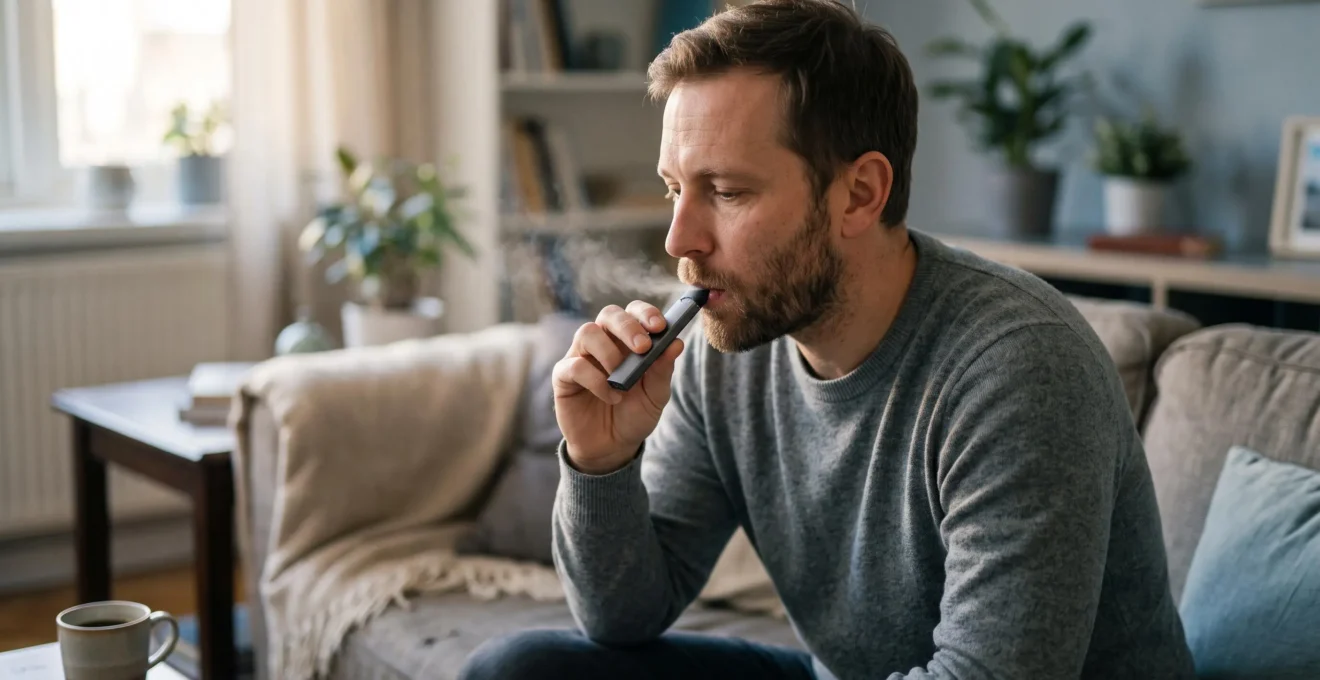
A mouth-to-lung (MTL) vaping technique works best when the draw is slow, controlled and matched to a device designed for restricted airflow. Instead of inhaling vapour directly into the lungs, draw it gently into the mouth first, then inhale. The movement resembles taking a measured sip through a straw rather than pulling forcefully against the pod.
For adult smokers switching from cigarettes, this two-stage method can feel more familiar than direct-to-lung inhalation. However, tighter airflow does not mean that stronger suction produces better results. An overly forceful draw can make an unsuitable or poorly maintained setup more uncomfortable, while a longer puff may increase nicotine exposure even when it feels gentle.
The practical aim is to find a comfortable inhalation pattern, recognise when gurgling or coughing indicates a problem, and check that the device and nicotine strength are compatible. Vaping is less harmful than smoking for adults who switch completely, but it is not risk-free. People who do not smoke should not start vaping.
MTL vaping: the essentials
- Draw vapour gently into your mouth, then inhale. Avoid compensating for tight airflow with extra suction.
- Match your inhalation style to the device: restricted pods generally suit MTL, while more open systems may support RDL or DTL.
- When coughing, gurgling or weak vapour appears, check nicotine strength, coil condition and setup before changing your draw.
- Why Does Mouth-to-Lung Vaping Feel More Familiar to Many Former Smokers?
- How Do You Take a Proper MTL Draw Without Pulling Too Hard on the Pod?
- MTL or DTL: Which Inhale Style Better Matches a Tighter-Draw Device?
- Which MTL Mistakes Can Cause Coughing, Gurgling or Weak Vapour?
- When Should You Stop Using an MTL Draw After Switching to a High-Airflow Device?
- DTL or MTL: Which Inhale Style Better Fits Your Device and Nicotine Level?
- How Do You Set Up a Simple Vape Pen Without Flooding or Burning the Coil?
- Are Nicotine Salts Suitable for Adults Switching From Cigarettes?
Why Does Mouth-to-Lung Vaping Feel More Familiar to Many Former Smokers?
Mouth-to-lung vaping often feels familiar to former smokers because it follows a similar two-stage inhalation pattern: vapour enters the mouth before being inhaled into the lungs. A restricted-airflow pod also reproduces some of the resistance associated with a cigarette draw. Familiarity comes from the movement and sensation, not from vaping being identical to smoking.
With a cigarette, many smokers first draw smoke into the mouth before inhaling. MTL vaping uses the same broad sequence without burning tobacco. This can reduce the amount of attention required to learn a different inhalation movement while adjusting to a new device.
The NHS guidance on vaping to quit smoking identifies the familiar hand-to-mouth routine and throat sensation as factors that may help adults move away from cigarettes. It also emphasises choosing suitable equipment and nicotine strength.
Three characteristics explain why a tighter-draw device may suit that transition:
- Airflow resistance: a narrow airflow path creates a more deliberate draw, closer to the resistance some smokers expect.
- Nicotine delivery: certain low-power MTL systems are designed to work with relatively concentrated nicotine liquids, although actual delivery depends on the device, liquid and puffing behaviour.
- Vapour characteristics: lower-power devices often produce less aerosol per puff than high-power systems, which may feel less overwhelming to someone accustomed to cigarette-sized draws.
One expectation needs adjusting. A vaping device does not necessarily reproduce the immediate throat sensation of a cigarette. A softer throat hit may reflect differences in nicotine formulation, airflow, aerosol temperature or power rather than a malfunction.
Research published in Tobacco Control found that nicotine form, concentration, aerosol temperature and inhalation behaviour all influence throat sensation. The study focused on direct-to-lung conditions, so it does not establish an ideal MTL technique, but it illustrates why drawing harder is not a reliable way to reproduce cigarette harshness.
Familiarity is not proof that MTL is universally better. It is useful when the inhalation pattern and airflow suit the equipment and the adult smoker’s preferences.
The next consideration is practical: keeping that familiar movement controlled without turning a restricted draw into a forceful inhale.
How Do You Take a Proper MTL Draw Without Pulling Too Hard on the Pod?
To take a controlled MTL draw, place the mouthpiece comfortably between your lips and pull gently until vapour collects in your mouth. Then inhale naturally rather than trying to draw the aerosol straight into your lungs. The sensation should resemble sipping through a straw, without pronounced cheek strain or the need to fight the device’s airflow.
A useful starting method is to keep the draw slow and steady, with a duration broadly comparable to a familiar cigarette drag. This is a practical cue rather than a medically validated puff length. There is no universal duration or suction strength that suits every MTL pod.
- Hold the pod comfortably and check that its airflow openings are unobstructed.
- Seal your lips around the mouthpiece without biting or squeezing it.
- Take a gentle, steady draw into your mouth. Avoid sharp suction.
- Stop drawing, then inhale the collected vapour naturally if comfortable.
- Exhale and assess whether the airflow, throat sensation and vapour production feel comfortable.
A comfortable MTL draw may produce a modest amount of vapour initially. There is no need to create a large visible cloud to confirm that the technique is working. If the device feels excessively restrictive, check its design and condition instead of increasing suction indefinitely.
Draw duration and draw intensity are different variables. A short, forceful pull creates a different airflow pattern from a long, gentle pull. Both can influence the vaping experience, but they should not be treated as interchangeable.
Experimental research indexed in PubMed found that longer puff durations and higher nicotine concentrations were significantly associated with increased nicotine delivery in relatively low-power electronic cigarettes. The study does not establish an optimal duration for every modern device.
Consequently, extending a gentle draw is not automatically a harmless way to obtain more vapour or nicotine. If satisfaction is inadequate, nicotine strength and device suitability deserve consideration rather than repeated, increasingly long puffs.
Excessive suction may contribute to liquid-handling problems in some pod designs, but it is not scientifically established as the direct cause of every flooded coil. Gurgling can also reflect condensation, overfilling, a worn seal or excess liquid around the coil.
Where the hardware allows adjustments, consider these controls:
- Airflow: a slightly more open setting may reduce uncomfortable resistance.
- Wattage: adjustable power should remain within the coil manufacturer’s specified operating range.
- E-liquid composition: higher-VG liquids can be more viscous and may wick poorly in some small-coil systems.
If these features are fixed, the realistic options may be maintenance, a compatible cartridge or a different device rather than changing the inhalation method.
Five checks for a controlled MTL draw
- Identify the device: check its instructions and record whether it is designed for MTL or another inhalation style.
- Check airflow: inspect the openings and record whether the draw feels restricted but comfortable.
- Practise a gentle draw: use a steady mouth-first movement and note whether pronounced suction is necessary.
- Separate time from force: compare the comfort of shorter and longer gentle draws without exceeding the manufacturer’s guidance, noting any irritation.
- Inspect the result: record whether gurgling, leaks, weak vapour or coughing occurs, then check the relevant hardware or nicotine setting rather than simply pulling harder.
Once the movement feels natural, the next step is verifying that MTL is actually the inhalation style the hardware was designed to support.
MTL or DTL: Which Inhale Style Better Matches a Tighter-Draw Device?
MTL generally matches a tighter-draw device better than direct-to-lung (DTL) inhalation because restricted airflow is intended for a slower, mouth-first draw. DTL devices usually provide more open airflow and produce greater aerosol volumes. Restricted direct-to-lung (RDL) equipment occupies the middle ground, offering a moderately open draw without requiring fully unrestricted inhalation.
The fundamental difference is the route taken by the aerosol. MTL collects vapour in the mouth before inhalation, while DTL draws aerosol towards the lungs in one continuous breath. RDL is a more restricted version of the direct-lung approach.
The following comparison describes common device tendencies rather than universal specifications.
| Criterion | MTL | DTL |
|---|---|---|
| Airflow resistance | Restricted, cigarette-like draw | Open, less restrictive draw |
| Inhalation pattern | Mouth first, then lungs | Direct continuous inhale |
| Nicotine concentration | Often compatible with higher-strength liquids in suitable low-power systems | Usually paired with lower-strength liquids because aerosol output can be greater |
| Vapour temperature | Often comparatively cool at lower power | Varies with power, airflow and coil design |
| Throat sensation | Depends on nicotine form, strength and settings | Depends on the same factors and the volume inhaled |
| Coil resistance | Frequently higher-resistance coils, including those around or above 1 ohm | Frequently lower-resistance coils, often below 1 ohm |
| Typical hardware | Restricted pod or MTL tank | Open-airflow tank or compatible high-output system |
Coil resistance is only a clue. Some modern pods support MTL with coils below 1 ohm, and resistance alone cannot establish the correct inhalation style. Airflow design, recommended power and manufacturer instructions are more informative together.
Trying to use DTL on a highly restricted pod may require uncomfortable suction and create an unsatisfactory airflow pattern. It does not necessarily damage the coil or cause flooding, but persistent gurgling or liquid in the mouthpiece should prompt a hardware check.
Conversely, trying to reproduce a tight cigarette draw on a fully open device may feel unusually airy. Closing adjustable airflow beyond the manufacturer’s intended operating conditions is not an appropriate solution.
RDL offers an intermediate option. A device designed for semi-restricted airflow can suit someone who finds MTL too tight but does not want the volume or breathing pattern of full DTL.
Correctly matching the device reduces avoidable frustration, but coughing, gurgling and poor vapour production still require separate troubleshooting.
Which MTL Mistakes Can Cause Coughing, Gurgling or Weak Vapour?
Coughing during MTL vaping may result from nicotine strength, throat irritation or an uncomfortable inhalation pattern. Gurgling usually indicates excess liquid or condensation in the airflow path, while weak vapour may reflect battery charge, coil condition, liquid composition or airflow restrictions. These symptoms have different causes, so pulling harder is rarely a useful first response.
The NHS identifies coughing, dry mouth, throat irritation, headaches and shortness of breath among possible vaping-related adverse effects. Such symptoms should not automatically be attributed to poor technique or dismissed as something that must be tolerated.
A practical diagnosis begins by identifying the symptom before changing the setup.
| Symptom | Possible explanation | What to check |
|---|---|---|
| Coughing or harsh throat sensation | Nicotine strength, aerosol irritation, inhalation pattern or individual sensitivity | Stop if uncomfortable; review nicotine strength and seek advice if symptoms persist |
| Gurgling | Condensation, excess liquid near the coil, overfilling or a cartridge problem | Inspect liquid level, seals and the manufacturer’s cleaning guidance |
| Spitting or liquid reaching the mouth | Excess liquid in the airflow path or inappropriate operation | Stop using the device until the liquid-handling problem is resolved |
| Weak vapour | Low battery, ageing coil, restricted airflow or unsuitable liquid | Check charge, airflow, cartridge condition and liquid compatibility |
| Burnt or acrid taste | Dry wick, excessive power or damaged coil | Stop firing the device and inspect or replace the coil as directed |
Nicotine formulation matters, but throat discomfort cannot be diagnosed from strength alone. Freebase nicotine may produce greater perceived harshness at certain concentrations, while some nicotine salt formulations feel smoother. A smoother sensation does not guarantee lower nicotine exposure.
The CDC information on e-cigarettes and nicotine salts explains that nicotine salts can permit inhalation of higher nicotine concentrations with less harshness. It also warns that e-cigarette aerosol can contain potentially harmful substances and that nicotine is highly addictive.
A separate problem can arise during the first use of a replaceable coil. If its cotton wick is not sufficiently saturated, operating the heating element can scorch the material. Once damaged, the wick may continue producing an unpleasant burnt taste even after more liquid is added.
Replacing a damaged coil is more appropriate than trying to overcome that taste with stronger draws. Similarly, repeatedly inhaling harder through a gurgling cartridge can worsen the experience without identifying the source of the excess liquid.
Persistent coughing, breathlessness, chest pain or other concerning symptoms warrant stopping use and seeking appropriate medical advice. Severe breathing difficulty or chest pain requires urgent assessment.
Some recurring problems also indicate that the inhalation style no longer suits the device, particularly after moving from a restricted pod to substantially more open hardware.
When Should You Stop Using an MTL Draw After Switching to a High-Airflow Device?
Stop trying to reproduce a tight MTL draw when a new high-airflow device is designed primarily for direct-lung inhalation and the technique feels uncomfortable or inconsistent. Open-airflow hardware may produce substantially more aerosol per puff, so familiar nicotine strengths and draw durations may no longer be suitable. Device instructions and signs of excessive nicotine exposure should guide reassessment.
Changing hardware does not automatically require changing inhalation styles. Some adjustable devices support MTL, RDL and DTL through compatible coils and airflow settings. The decisive factor is the configuration actually installed, not the device’s appearance.
Several signs suggest that the previous technique needs reconsideration:
- The device remains unusually airy even at its recommended restricted setting.
- Obtaining a comfortable draw requires excessive effort or unnatural inhalation.
- Aerosol output feels unexpectedly intense compared with the previous device.
- Dry or burnt hits occur repeatedly despite correct priming and compatible liquid.
- Dizziness, headache or nausea appears after use, suggesting possible excessive nicotine exposure or another adverse reaction.
Nicotine concentration deserves particular attention. A low-power restricted pod and a higher-output open-airflow system can deliver different amounts of aerosol during a puff. Using the same liquid concentration in both does not guarantee comparable nicotine exposure.
Research on nicotine delivery in relatively low-power devices has linked longer puff duration and higher liquid nicotine concentration with increased delivery. Those findings do not quantify the change produced by every high-airflow device, but they reinforce the need to consider more than the number printed on the e-liquid bottle.
A gradual reassessment is preferable to forcing an unsuitable technique. First, identify which inhalation mode the manufacturer supports. Then check that the coil, liquid and power setting are appropriate.
For an adult smoker who chooses to move to a compatible higher-output device, a lower nicotine concentration may be appropriate. Avoid assuming that increasing puff duration will compensate safely for any discomfort or perceived reduction in nicotine satisfaction. If a new device causes dizziness or nausea, stop using it rather than attempting to build tolerance.
RDL equipment may provide a less dramatic transition where a moderate airflow pattern is preferred. Remaining with a suitable MTL pod is also reasonable; greater vapour production is not an inherent improvement.
The best choice depends on the interaction between airflow, nicotine formulation and the user’s previous smoking pattern, rather than inhalation style alone.
DTL or MTL: Which Inhale Style Better Fits Your Device and Nicotine Level?
Choose between DTL and MTL by considering three factors together: the device’s supported airflow, the nicotine concentration and formulation in the e-liquid, and the amount of nicotine needed to manage cigarette withdrawal without discomfort. Restricted low-output devices commonly suit MTL, while higher-output open-airflow systems generally require more caution with nicotine concentration.
Unlike a purely technical comparison, this decision starts with the equipment and liquid already in use. An adult who previously smoked frequently may have different nicotine needs from someone who smoked occasionally, but cigarette consumption alone cannot determine an exact vaping dose.
Begin with airflow. If the manufacturer describes the cartridge or tank as MTL, the design is intended for mouth-first inhalation. If it specifies DTL, using a restricted cigarette-like technique may feel inappropriate. RDL equipment provides a third possibility.
Then assess the liquid. Nicotine is available in freebase and salt formulations, with different sensations at comparable concentrations. A smoother salt formulation may make a higher concentration feel less harsh, but it does not make that concentration physiologically insignificant.
The following matching framework is qualitative because there is no universally validated nicotine-strength range for each inhalation style.
| Device and liquid combination | Practical assessment | Next consideration |
|---|---|---|
| Restricted low-power pod with manufacturer-approved nicotine liquid | Usually consistent with MTL | Assess comfort and whether cigarette cravings are adequately managed |
| Moderate airflow and compatible coil | May support RDL or an adjustable inhalation style | Follow device guidance and review nicotine exposure |
| High-airflow, higher-output device with low-strength liquid | May suit DTL if the hardware is designed for it | Check aerosol intensity and tolerability |
| High-strength nicotine liquid with high-output DTL hardware | Potentially unsuitable combination with a risk of excessive nicotine exposure | Stop and reassess the liquid and device pairing |
For UK readers, nicotine-containing consumer e-liquids are subject to a legal concentration ceiling of 20 mg/ml. This is a regulatory maximum, not a recommended starting strength, and other English-speaking countries have different product rules.
A higher nicotine concentration is not automatically better for a heavier former smoker. Delivery depends on the device, puffing pattern and individual use. Insufficient nicotine can leave cigarette cravings uncontrolled, while excessive exposure can produce uncomfortable symptoms.
When uncertainty remains, an NHS Stop Smoking Service or qualified healthcare professional can help an adult smoker assess nicotine needs and smoking-cessation options.
For someone wanting more airflow than a conventional MTL pod but less vapour than a fully open DTL tank, compatible moderate-output RDL equipment may be worth considering rather than forcing either extreme.
Even a well-matched device and liquid can produce poor results if a new coil is installed or filled incorrectly, making setup the next important step.
How Do You Set Up a Simple Vape Pen Without Flooding or Burning the Coil?
Set up a refillable vape pen by checking the manufacturer’s instructions, preparing the coil as specified, filling the tank without exceeding its limit and allowing the wick to become saturated before use. If adjustable, operate the device only within the recommended power range. Correct preparation helps prevent dry, burnt hits and reduces avoidable liquid-handling problems.
Setup requirements differ between sealed cartridges, refillable pods and tanks with replaceable coils. A sealed pod should not be opened or modified unless its manufacturer explicitly provides for that operation.
For a compatible refillable tank with an accessible replaceable coil, the usual preparation sequence is:
- Inspect the device, coil, seals and tank for visible damage or incorrect assembly.
- If the coil manufacturer recommends priming, apply the specified amount of compatible e-liquid to accessible wick material without flooding the airflow channel.
- Install the coil securely and fill the tank through the designated filling port, respecting its maximum fill level.
- Close the system and allow the wick to saturate for the period specified in the instructions.
- Where wattage is adjustable, select a setting within the coil’s recommended range before testing airflow and vapour production.
Not every coil permits direct priming, and adding liquid to inappropriate openings can create a leak or flooding. The manufacturer’s preparation instructions take priority over generic advice to add a particular number of drops.
The two most recognisable preparation failures require different responses. Flooding means excess liquid has entered the coil or airflow path, often producing gurgling, leaks or spit-back. A dry or burnt hit occurs when the wick cannot supply enough liquid to the heated coil, potentially damaging its cotton.
Adding more liquid is not an appropriate fix for a flooded cartridge, while repeatedly firing an inadequately saturated coil can make burning worse. Distinguishing these symptoms matters before attempting any correction.
For a first-session check, begin with a visual inspection of the liquid level and assembled parts. Confirm that the airflow feels unobstructed without activating the device, where the design permits. Then take a brief test puff as directed by the manufacturer, stopping immediately if the vapour tastes burnt, liquid enters the mouth or unusual heating occurs.
A persistent burnt taste after proper saturation may indicate irreversible wick damage and a need for replacement. Recurrent leaks may indicate a damaged seal or unsuitable cartridge rather than a problem with suction technique.
Correct setup supports a controlled MTL draw, but it cannot transform hardware designed for another airflow pattern into a suitable restricted pod.
Once the device operates comfortably, nicotine formulation becomes the final consideration for adults trying to replace cigarettes rather than simply generate more vapour.
Key takeaways before choosing nicotine salts
- Start with a device and inhalation style that work together; nicotine formulation cannot correct unsuitable airflow or a damaged coil.
- Judge nicotine needs by cigarette withdrawal, actual device performance and adverse effects rather than throat sensation alone.
- Reduced harshness does not mean reduced exposure. High-strength liquids require particular caution with higher-output equipment.
Are Nicotine Salts Suitable for Adults Switching From Cigarettes?
Nicotine salts can be suitable for adult smokers switching to vaping, particularly when used in compatible lower-power devices and at an appropriately selected concentration. Their formulations can feel less harsh than comparable freebase nicotine liquids, which may make cigarette withdrawal easier to manage for some users. Suitability depends on the device, nicotine needs and individual tolerance.
Nicotine salts are produced by combining nicotine with an acid to form protonated nicotine. Benzoic acid is used in some formulations, but it is not present in every nicotine salt product. Formulation and acidity can influence the sensation of inhaled aerosol.
Reduced harshness can be useful for adults who find conventional freebase nicotine uncomfortable at concentrations that adequately manage withdrawal. However, the underlying chemistry does not establish that every salt formulation enters the bloodstream faster than every freebase formulation.
Nicotine absorption depends on multiple variables, including concentration, device power, aerosol characteristics and puffing behaviour. Comparisons with cigarette nicotine delivery therefore need to account for the complete system rather than the label « nicotine salts » alone.
A practical decision begins with previous cigarette consumption. Someone who previously smoked frequently may require more nicotine support than an occasional smoker, but this is only an initial consideration. The appropriate liquid concentration should also reflect how often the device is used and whether withdrawal symptoms or excessive nicotine effects occur.
Three observations can help guide reassessment:
- Persistent cigarette cravings: nicotine delivery may be insufficient, or the device and usage pattern may not suit the individual.
- Throat irritation or coughing: concentration, formulation and inhalation conditions may need review; persistent symptoms require medical advice.
- Dizziness, headache or nausea: stop using the device and assess possible excessive nicotine exposure or another adverse reaction.
The lower perceived harshness of nicotine salts creates a specific concern with high-output devices. A liquid that feels comfortable in a small MTL pod may not be appropriate for a device producing a much larger amount of aerosol per puff.
High nicotine concentrations combined with large-volume inhalation should be treated as a configuration requiring reassessment, not as a challenge to overcome through tolerance. The same precaution applies when a device is used more frequently or for longer puffs than expected.
For adult smokers in the UK, selecting nicotine strength can be discussed with an NHS Stop Smoking Service or an appropriately trained healthcare professional. Persistent strong cravings despite correct device use may justify reviewing nicotine delivery and cessation support; increasing liquid strength is not automatically the right solution.
For smoking cessation, the wider objective is to replace cigarette smoking completely rather than continue smoking alongside vaping indefinitely. Vaping remains less harmful than combustible cigarettes but is not harmless, and its long-term effects are not fully established.
The practical next step is to check the device’s recommended inhalation style and liquid compatibility, review current nicotine needs, and seek smoking-cessation advice if cigarette cravings or adverse effects persist. The goal is a manageable transition away from smoking without forcing a stronger draw, higher nicotine exposure or an unsuitable device.
Does a tighter vape draw mean the pod is faulty?
No. MTL pods are often designed to restrict airflow. However, an unusually tight or suddenly obstructed draw can indicate blocked airflow openings, condensation, incorrect cartridge installation or another maintenance issue. Check the manufacturer’s instructions rather than compensating with more suction.
Can a long, gentle puff deliver more nicotine than a short one?
Yes, depending on the device and liquid. Experimental research involving relatively low-power e-cigarettes found an association between longer puff duration and increased nicotine delivery. Gentle suction should not be confused with negligible nicotine exposure, and the findings do not establish an ideal puff length for every device.
Should a new coil be used immediately after filling the tank?
Only when the manufacturer’s preparation requirements have been met. Many replaceable coils need time for the wick to become saturated before activation. Operating a dry wick can scorch the material and cause a persistent burnt taste. Sealed and prefilled cartridges may require different preparation.
Can mouth-to-lung vaping be used with nicotine-free e-liquid?
Yes, provided the e-liquid is compatible with the device. MTL describes the inhalation method, not a required nicotine concentration. However, nicotine-free liquid will not replace nicotine exposure for an adult experiencing cigarette withdrawal, and inhaling nicotine-free vaping aerosol is not necessarily harmless.
When is professional advice preferable to adjusting the vape?
Seek advice when cigarette cravings remain difficult to control, nicotine strength is uncertain or side effects persist. Stop vaping if concerning symptoms develop, and seek urgent medical assessment for chest pain or severe breathing difficulty. In the UK, NHS smoking-cessation services can help adults assess suitable support for quitting cigarettes.