E-Liquids & Flavors
E-liquids sit at the heart of every vaping experience. Whether someone is switching from traditional cigarettes or simply curious about how electronic cigarettes work, understanding what goes into a bottle of vape juice is the first step toward making informed choices. The flavor, throat sensation, vapor production, and nicotine delivery all depend on the liquid you choose and how well it matches your device.
This category page brings together the essential concepts behind e-liquids and flavors: what they contain, how nicotine strength works, which flavor families exist, and how to select a juice that suits both your taste and your equipment. The goal is simple: demystify the topic so you can navigate shelves and online catalogs with confidence.
What Is an E-Liquid?
An e-liquid, sometimes called vape juice or e-juice, is the fluid vaporized by an electronic cigarette. Despite the sometimes intimidating ingredient lists, the formula is remarkably simple. Nearly every bottle on the market contains the same four building blocks:
- Propylene glycol (PG): a thin, odorless liquid that carries flavor well and produces a stronger throat hit, often compared to the sensation of smoking a cigarette.
- Vegetable glycerin (VG): a thicker, slightly sweet liquid responsible for dense vapor clouds, with a smoother feel on the throat.
- Food-grade flavorings: concentrated flavoring agents, many of the same type used in food and confectionery products.
- Nicotine (optional): present in varying strengths, or entirely absent in zero-nicotine formulas.
The ratio between PG and VG, often displayed as something like 50/50 or 70/30 VG/PG, shapes the overall experience. A balanced 50/50 blend suits small pod systems and delivers clear flavor, while a high-VG liquid produces larger clouds and is generally reserved for more powerful devices. A helpful analogy: think of PG as the paint and VG as the canvas. One carries the detail, the other gives the experience its body.
Understanding Nicotine Strengths
Nicotine is the element most beginners worry about, and rightly so, since choosing the wrong strength is one of the most common early mistakes. Nicotine concentrations are usually expressed in milligrams per milliliter (mg/mL), ranging from 0 up to around 20 mg/mL in regions following tobacco and vaping regulations, such as the United Kingdom and European Union. In the United States, higher strengths have traditionally been available, particularly in the form of nicotine salts.
As a general reference point:
- 0 mg/mL: no nicotine at all, purely for flavor and the habit of vaping.
- 3 to 6 mg/mL: light smokers or occasional vapers using sub-ohm devices.
- 6 to 12 mg/mL: moderate smokers transitioning to vaping.
- 12 to 20 mg/mL: heavier smokers, usually paired with low-power pod systems.
Two distinct forms of nicotine exist. Traditional freebase nicotine delivers a sharper throat hit and works well at lower concentrations. Nicotine salts, on the other hand, are smoother at higher strengths, which makes them popular in compact pod devices among former smokers who need a stronger, cigarette-like delivery. Someone who smoked a pack a day, for example, often finds that a 10 to 20 mg/mL nicotine salt in a low-power pod satisfies cravings in a way a 3 mg freebase liquid in a large cloud-chasing device simply cannot.
A practical tip: if you feel dizzy, nauseous, or get headaches, your nicotine strength is likely too high. If you find yourself vaping constantly without satisfaction, it is probably too low. Adjust gradually rather than in large jumps.
The Main Flavor Families
Flavor is where vaping becomes personal. The market offers thousands of options, but they cluster into a handful of recognizable families, each with its own character and typical audience:
- Tobacco: designed to resemble cigarettes, cigars, or pipe tobacco. Often the starting point for recent ex-smokers seeking familiarity.
- Fruit: the largest and most popular category, ranging from single fruits like strawberry or mango to complex blends mixing berries, citrus, and tropical notes.
- Dessert and bakery: custards, cakes, pastries, and creamy profiles. These tend to be rich, sweet, and heavier on coils.
- Menthol and mint: from pure icy menthol to combinations with fruit or tobacco, appealing to former menthol cigarette smokers.
- Beverage: sodas, energy drinks, coffee, and cocktail-inspired profiles.
- Candy: gummies, hard candies, and nostalgic sweets that dominate among younger-tasting palates.
Taste in vaping differs from taste in food. Because vapor bypasses much of what happens when you chew and swallow, flavors read differently. A strawberry e-liquid will not taste exactly like fresh strawberries; it may come closer to strawberry candy. Managing expectations here prevents disappointment. A common piece of advice given to former smokers: start with a tobacco or menthol flavor for the first few weeks, then branch out once the transition feels comfortable. Many long-term vapers eventually migrate entirely to fruit or dessert profiles.
Single Flavors Versus Complex Blends
Within each family, juices fall along a spectrum from minimalist to elaborate. A single-fruit liquid offers predictability: what you taste is what the label says. Complex blends layer several notes, and the dominant flavor can even shift as the liquid ages in the bottle, a phenomenon known as steeping. Beginners often appreciate starting with simpler profiles before exploring layered, chef-style creations.
Matching Your E-Liquid to Your Device
Perhaps no aspect of vaping is more overlooked than compatibility between liquid and hardware. The wrong pairing leads to burnt coils, leaking tanks, or a muted flavor. The core principle relates to coil resistance and wicking:
- High-resistance, low-power devices (pods, small starter kits): these wick slowly and perform best with thinner, high-PG or 50/50 liquids, including most nicotine salts.
- Sub-ohm tanks and powerful mods: these wick quickly and vaporize large volumes of liquid, so they need thicker, high-VG juices, usually 70 VG or more, and lower nicotine strengths.
- Refillable pod systems with replaceable coils: check the manufacturer’s recommended PG/VG ratio and resistance range before buying.
Imagine pouring pancake syrup through a coffee filter: it will flow eventually, but slowly and poorly. Thick high-VG liquid in a tiny pod coil behaves the same way, leading to dry hits. Conversely, thin high-PG liquid in a sub-ohm tank can flood the coil and cause gurgling or leaking. When in doubt, a 50/50 ratio is the safest universal choice for most everyday devices.
Quality, Safety, and Labeling
The vaping market includes everything from small artisan producers to large manufacturers, and quality varies. In most English-speaking countries, reputable products must comply with local regulations covering ingredient disclosure, nicotine limits, child-resistant packaging, and health warnings. Buying from established vendors, whether local vape shops or well-known online retailers, dramatically reduces the risk of counterfeit or poorly manufactured liquids.
When evaluating a product, a few checks are worth making:
- Verify that ingredients (PG/VG ratio, nicotine strength) are clearly labeled.
- Confirm the bottle has child-resistant caps and tamper-evident seals.
- Prefer brands that publish batch testing or comply with regional notification systems.
- Avoid unlabeled or homemade liquids from unverified sources.
Storage matters too. E-liquids should be kept away from direct sunlight and heat, tightly closed, and, crucially, out of reach of children and pets. Nicotine is toxic if ingested, and even pleasant-tasting liquids should always be treated with basic caution.
How to Choose Your First E-Liquid
With so much information, the first purchase can feel overwhelming. A short, structured approach removes most of the uncertainty:
- Identify your device type and note its recommended PG/VG ratio and coil resistance.
- Estimate your nicotine needs based on your previous smoking habits, or start at zero if you never smoked.
- Pick a flavor family that feels familiar or appealing, rather than the most exotic option on the shelf.
- Buy a small bottle first to test before committing to a large format.
- Adjust over time, tweaking strength and flavor as your preferences become clearer.
Most vapers refine their preferences within the first few weeks. What feels like trial and error at the beginning quickly becomes a shortlist of reliable favorites. Many experienced vapers keep two or three liquids on hand: an all-day fruity or dessert option, a minty refresher, and a tobacco backup for nostalgic moments.
Common Questions About E-Liquids
Do e-liquids expire?
They do, typically within one to two years when stored properly. Over time, flavor fades, color darkens, and nicotine can degrade. A bottle that smells off or tastes harsh should be discarded.
Why does the same flavor taste different over time?
Freshly made liquids can taste muted. Allowing the bottle to rest, known as steeping, lets the flavors blend and mature, often deepening the taste. Darker, dessert-style liquids benefit from this the most.
Can I mix flavors together?
Yes, mixing compatible liquids is common practice, especially combining complementary fruits or a fruit with a menthol base. Just keep the PG/VG ratios and nicotine strengths roughly similar for predictable results.
Does more vapor mean more nicotine?
Not necessarily. Large clouds come from high-VG liquids, which usually contain low nicotine. Nicotine delivery depends on strength, formulation, and device power combined, not cloud size alone.
E-liquids and flavors are ultimately about matching science with personal preference. Once you understand the role of PG and VG, how nicotine strengths translate into real-world satisfaction, and which flavor families resonate with you, choosing a vape juice stops being guesswork and becomes a matter of taste. The pages in this category dive deeper into each of these topics, from flavor profiles to nicotine formulations, so you can keep building that knowledge one step at a time.

How Does Propylene Glycol Affect the Feel of an E-Liquid?
Propylene glycol (PG) affects how an e-liquid feels in the throat, how clearly its flavour comes through and how readily it moves through a vape coil. Compared with vegetable glycerine (VG), PG is thinner and generally produces less visible aerosol….
Lire la suite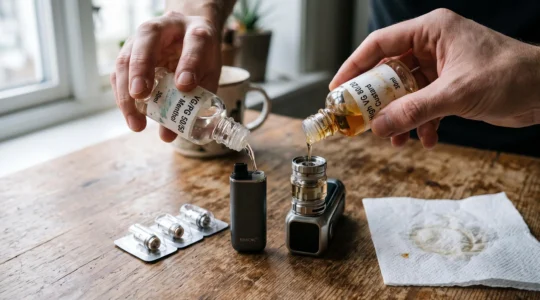
Which PG/VG Ratio Best Matches Your Vape Device and Inhale Style?
The right PG/VG ratio depends primarily on how your vape device feeds liquid to its coil, followed by your inhalation style and preferred balance of throat sensation, flavour and visible aerosol. A 50/50 blend is often compatible with smaller, lower-powered…
Lire la suite
Why Are Flavor Concentrates Different From Finished Vape Liquids?
Flavour concentrates and finished vape liquids may come in similar bottles, but they serve fundamentally different purposes. A concentrate is a flavouring ingredient intended for controlled incorporation into an e-liquid formulation. Finished e-liquid is the formulated product, containing its intended…
Lire la suite