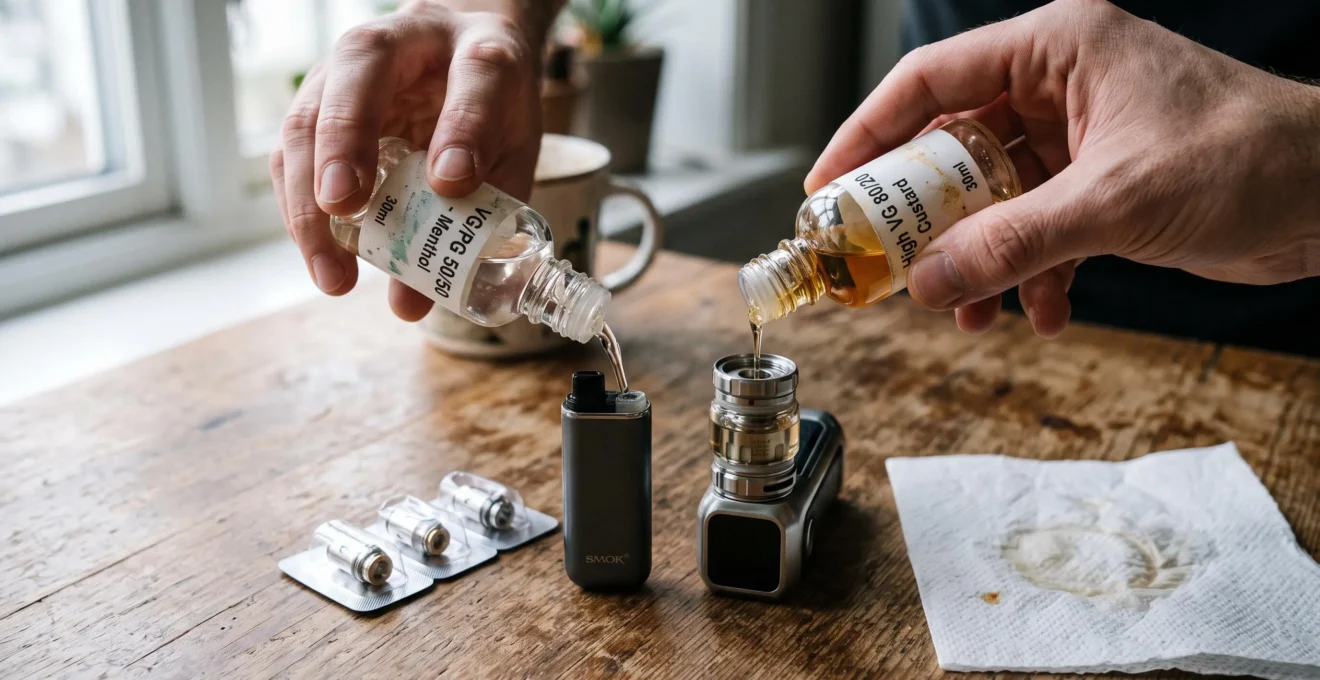
The right PG/VG ratio depends primarily on how your vape device feeds liquid to its coil, followed by your inhalation style and preferred balance of throat sensation, flavour and visible aerosol. A 50/50 blend is often compatible with smaller, lower-powered pod systems, while a higher-VG formulation may suit a suitably designed direct-to-lung tank. Neither ratio works universally.
PG stands for propylene glycol, a relatively thin carrier liquid. VG stands for vegetable glycerine, a thicker ingredient that influences aerosol visibility and mouthfeel. E-liquid labels commonly express their proportions as percentages, but the order matters: 30PG/70VG means 30% PG and 70% VG, not the reverse.
For adult vapers, especially those changing equipment, the practical question is whether the liquid can reach the heating element consistently. An unsuitable ratio can contribute to dry hits, gurgling or leakage even when the coil is otherwise functional. Understanding the manufacturer’s specifications is therefore more useful than choosing by cloud size alone.
PG/VG compatibility at a glance
- Match the liquid to the exact coil: smaller MTL systems commonly accept 50/50 blends, while some higher-powered DTL coils support more VG.
- Choose by sensation as well as hardware: PG can contribute to a sharper throat sensation, whereas VG generally produces a fuller-looking aerosol.
- Investigate dry hits and flooding before blaming the coil: viscosity, priming, power, seals and inhalation patterns can all affect performance.
- Why Does the PG/VG Ratio Change Both Vapour Density and Throat Feel?
- How Do You Match a PG/VG Ratio to Your Coil and Device Type?
- 50/50 or High-VG E-Liquid: Which Better Suits Your Everyday Setup?
- Which PG/VG Mismatch Can Cause Flooding or Dry Hits in Your Coil?
- When Should You Change PG/VG Ratio After Replacing Your Device or Tank?
- PG or VG: Which Matters More for Flavour Clarity Versus Vapour Volume?
- How Do You Use High-VG E-Liquid Without Starving the Coil?
- Which Standard Vape Tank Features Matter for Reliable Everyday Use?
Why Does the PG/VG Ratio Change Both Vapour Density and Throat Feel?
The PG/VG ratio changes the physical properties of e-liquid and the aerosol produced when it is heated. PG is less viscous and can contribute to a sharper throat sensation, while VG is thicker and generally produces more optically visible aerosol. The perceived result also depends on nicotine concentration, flavourings, coil design and power.
PG and VG behave differently because they have different physical properties. A PG-rich liquid generally travels through small liquid-feed openings more readily, while a VG-rich liquid flows more slowly. This difference becomes significant when the cotton wick must replenish liquid between successive inhalations.
VG also influences how light interacts with the aerosol. A scientific study on PG/VG composition and electronic cigarette aerosols found that aerosols generated from VG-containing liquids had light-scattering coefficients approximately an order of magnitude greater than those from PG liquids under the tested laboratory conditions.
This supports the relationship between composition and visible aerosol, but it does not mean every high-VG liquid creates an identically dense cloud. Device settings, inhalation behaviour and formulation also matter. Greater visibility should not be confused with lower exposure or improved safety.
Throat hit is not the same as warmth
A noticeable throat hit can result from irritation or sensory stimulation during inhalation. PG may contribute to this sensation, but nicotine and flavourings can change its intensity. By contrast, the impression of warmth or fullness can be influenced by aerosol temperature, volume and airflow.
A scientific study on nicotine and e-cigarette aerosol perception involving 19 established adult users found that increasing nicotine concentration increased perceived harshness and bitterness while reducing sweetness. All tested liquids had the same PG/VG composition, so the experiment isolated other influences rather than comparing different ratios.
This distinction matters when a user finds an otherwise compatible liquid uncomfortable. Changing the VG percentage alone may not resolve a sensation caused mainly by nicotine concentration or another ingredient.
The same interaction applies to flavour. PG is commonly used as a flavour carrier, whereas VG contributes a slightly sweet background. However, perceived flavour strength is not determined by composition alone.
Once these physical and sensory effects are separated, the next question is whether the chosen liquid can move through the particular coil efficiently.
How Do You Match a PG/VG Ratio to Your Coil and Device Type?
Match PG/VG ratio to the exact replacement coil’s manufacturer guidance, operating power and liquid-feed design rather than the device’s appearance. Many low-powered MTL coils suit relatively fluid blends, while certain higher-powered DTL coils accept thicker liquids. Resistance provides a useful starting clue, but it is not a universal compatibility rule.
The key component is the coil’s wicking system. E-liquid must pass through feed openings and saturate the absorbent material quickly enough to replace what evaporates during use. Larger openings and suitable wick construction can accommodate thicker formulations, whereas smaller liquid channels may restrict them.
For example, VAPORESSO‘s official GTX coil specifications provide model-specific operating ranges and PG/VG recommendations. The GTX 0.8-ohm MTL coil is listed at 12–16 W, while the GTX 0.15-ohm DTL coil is listed at 60–75 W. Those figures describe those particular products, not every coil with comparable resistance.
Its published GTX guidance also illustrates that some DTL configurations can support intermediate ratios rather than requiring extremely high VG. The exact recommendation may additionally depend on nicotine formulation.
Use the following comparison as a preliminary guide, subject to the individual coil’s instructions.
| Device or coil arrangement | Initial PG/VG consideration | What to verify |
|---|---|---|
| Compact, lower-powered MTL pod | 50PG/50VG or another manufacturer-approved relatively fluid blend | Coil compatibility, wick capacity and recommended liquid |
| Versatile or intermediate-power pod | 50/50 or an intermediate VG blend where specified | Recommendations for the exact installed coil |
| Higher-powered DTL or sub-ohm tank | Potentially 60VG or 70VG, where supported | Feed openings, power range and manufacturer-approved composition |
Start by locating the resistance marking and recommended wattage on the coil or packaging. Then consult the product manual or manufacturer’s compatibility table. If no PG/VG recommendation is available, do not infer that a thick liquid is suitable simply because the device is marketed as sub-ohm.
For adjustable or hybrid kits, the installed coil matters more than the kit’s marketing category. Changing airflow or wattage may alter the experience, but it cannot necessarily overcome insufficient liquid-feed capacity. Keep power within the manufacturer’s specified range.
Five checks before filling a replacement coil
- Read the resistance marking and record the exact coil model in a short equipment note.
- Find the manufacturer’s operating range and write down its minimum and maximum wattage.
- Check the recommended liquid composition and record the approved PG/VG range, if provided.
- Read your bottle’s ratio label and compare it with that guidance; mark the pairing compatible, incompatible or unconfirmed.
- Confirm that the selected power and inhalation configuration match the coil instructions before filling; retain a completed compatibility note.
With the hardware requirement established, choosing between a balanced blend and higher VG becomes a practical decision instead of a guess.
50/50 or High-VG E-Liquid: Which Better Suits Your Everyday Setup?
A 50/50 e-liquid is often the more practical choice for compatible low-powered pods and MTL setups because it flows more readily through restricted wicking systems. High-VG liquid may suit suitable DTL hardware and users who prefer fuller visible aerosol. The best everyday option is the one supported by the coil and comfortable for the user.
In an MTL setup, the user typically draws aerosol into the mouth before inhaling. These devices often operate at lower power and use relatively restricted airflow. A compatible 50/50 blend can provide steady liquid delivery without relying on a large, powerful heating system.
DTL devices are generally designed for direct inhalation with more open airflow. Some support thicker liquids, allowing a user to prioritise visible aerosol and a fuller-feeling draw. However, DTL does not automatically mean 80VG or even 70VG is appropriate.
| Decision factor | 50PG/50VG | High-VG, such as 30PG/70VG |
|---|---|---|
| Typical device fit | Many compatible lower-powered pods and MTL coils | Some suitably designed DTL and sub-ohm coils |
| Liquid flow | Relatively fluid | Relatively viscous |
| Inhalation preference | Commonly associated with restricted MTL draws | Commonly associated with more open DTL draws |
| Visible aerosol | Generally less emphasis on dense clouds | Often greater optical visibility under suitable conditions |
| Main compatibility concern | Possible flooding in equipment designed for thicker liquid | Possible insufficient wicking in restricted coils |
A balanced liquid may be convenient for someone using several devices, but only when each device approves that composition. Similarly, choosing 60VG instead of 70VG may be a reasonable intermediate option where the manufacturer’s specifications permit it.
The choice also affects ongoing use. A thicker formulation may require more attention to coil saturation and the interval between draws. Coil lifespan, meanwhile, depends on several factors, including sweeteners, flavouring residues, operating conditions and the liquid formulation. High VG alone does not establish that a coil will necessarily wear out faster.
Liquid consumption should not be predicted from the ratio alone. Higher-powered equipment, longer draws and usage frequency can substantially alter the amount consumed, making direct comparisons between different devices unreliable.
For an adult switching from cigarettes, a preferred throat sensation should also be considered separately from nicotine needs. Changing liquid composition or moving to a more powerful device can change nicotine delivery, so the ratios should not be treated as interchangeable without considering the whole setup.
Even a reasonable starting choice needs reassessment if the coil begins showing symptoms of flooding or insufficient liquid supply.
Which PG/VG Mismatch Can Cause Flooding or Dry Hits in Your Coil?
A liquid that is too thick for the coil’s wicking system can contribute to dry hits, while an excessively thin liquid may contribute to flooding or leakage in some configurations. Burnt taste, gurgling and seepage are useful diagnostic clues, but they are not conclusive evidence of a PG/VG mismatch because several mechanical and operational faults produce similar symptoms.
A dry hit occurs when the heated wick does not contain enough liquid. A user may notice a harsh, burnt taste, reduced aerosol output or an abrupt change in flavour. With a thick liquid, insufficient replenishment between draws is one possible mechanism.
However, a first-use dry hit may arise because a new coil was never properly saturated. This is a priming problem, not necessarily a viscosity problem. Increasing the PG percentage will not repair cotton that has already been damaged by heating while inadequately wetted.
Flooding involves more liquid entering the coil region than the system can manage. Signs can include bubbling or gurgling, liquid at the mouthpiece and leakage from airflow openings.
JAC Vapour‘s tank leakage and flooding troubleshooting article identifies excess liquid entering the coil as a possible cause of gurgling. It also notes that thin, high-PG liquids can occasionally contribute to flooding in direct-lung setups, while identifying other potential causes such as seals, storage and usage patterns.
Because flooding has multiple potential causes, compare the symptoms with the equipment’s condition before changing liquid composition.
| Observed symptom | Possible explanation | Initial check |
|---|---|---|
| Burnt taste immediately after installing a coil | Insufficient initial saturation | Review priming instructions; replace damaged cotton coils |
| Burnt taste developing during repeated draws | Insufficient liquid replenishment or unsuitable operating conditions | Check liquid compatibility, power and refill level |
| Gurgling with liquid near the airflow | Flooding, sealing issue or other liquid-management problem | Inspect seals, coil seating and approved liquid type |
| Reduced aerosol output | Several possibilities, including coil deterioration or liquid-supply problems | Inspect the coil and verify the operating settings |
Stop using a coil that produces a persistent burnt taste. Once its cotton has been scorched, changing the ratio or allowing more soaking time may not restore it.
Likewise, recurring leakage should prompt an inspection of seals, connections and coil installation rather than an automatic switch to thicker liquid. If liquid enters the device’s electronics or battery compartment, stop using the equipment and follow the manufacturer’s safety instructions.
If problems begin immediately after replacing the tank or coil, the change in hardware may be the most useful diagnostic clue.
When Should You Change PG/VG Ratio After Replacing Your Device or Tank?
Reassess PG/VG ratio whenever a replacement device, tank or coil has different liquid compatibility requirements. Moving from a restricted MTL pod to a suitable higher-powered DTL system may allow more VG, while moving in the opposite direction may require a thinner blend. Changing hardware does not automatically require changing liquid if the existing ratio remains approved.
A new tank can look similar to the previous one yet feed liquid differently. Coil construction, liquid ports, wick materials and operating power may all have changed. Compatibility should therefore be checked whenever the atomising component changes, even if the battery device remains the same.
Three common transition situations deserve particular attention:
- MTL pod to DTL tank: review whether the new coil supports higher VG rather than assuming it requires it.
- DTL tank to compact pod: check whether the existing thick liquid is compatible with the smaller wicking system.
- Different coil in the same device: consult the specifications for the replacement coil, because compatibility may differ within one product family.
When changing ratio, first establish whether the existing liquid remains compatible with the new device. If it does, there may be no technical reason to discard it. If it does not, keep it for another compatible device rather than forcing it through unsuitable equipment.
For a clear comparison between formulations, use a clean tank and a properly primed coil in accordance with the manufacturer’s instructions. Avoid casually combining unidentified or incompatible liquids to reach an estimated ratio.
Diluting a finished nicotine-containing e-liquid or adding boosters also changes other aspects of its formulation, including nicotine and flavour concentrations. It should not be treated as a straightforward way to correct hardware compatibility. In the UK, nicotine-containing products and ingredients must also be handled with attention to applicable product requirements and manufacturer instructions.
After switching, assess performance only once the wick is adequately saturated and the settings have been checked. Several normal uses may provide a more representative impression of flavour than the first draw, but persistent leakage, burning or irritation is a reason to stop and investigate rather than continue testing.
Stock management matters as well. Before purchasing a large quantity of any formulation, verify that it works with the equipment intended for regular use. Store liquids securely, especially away from children and pets, and do not pass nicotine products to minors.
Once the replacement setup operates reliably, flavour clarity and aerosol volume become reasonable secondary considerations.
PG or VG: Which Matters More for Flavour Clarity Versus Vapour Volume?
PG is commonly associated with carrying flavourings and providing a more pronounced throat sensation, while VG contributes viscosity, slight sweetness and greater visible aerosol under suitable conditions. Neither ingredient independently determines flavour quality. Coil temperature, airflow, nicotine formulation and the flavouring blend can be just as important to the perceived result.
PG is widely used as a solvent for flavour ingredients. A relatively PG-rich formulation can therefore be associated with clear flavour delivery, although the actual sensory result depends on the particular recipe and device.
VG has its own mildly sweet character and changes the physical composition of the aerosol. A higher VG fraction may soften the perceived profile of some formulations, but it is not accurate to claim that every high-VG liquid tastes weaker or that every PG-rich liquid tastes sharper.
The distinction becomes clearer when considering three different user priorities:
- Flavour-focused user: a manufacturer-compatible 50/50 or intermediate blend may be a useful starting point, with coil and airflow selection determining the final result.
- Visible-aerosol-focused user: a higher-VG option may be relevant when using hardware specifically approved for it.
- Balanced user: an approved intermediate ratio, such as 40PG/60VG, may offer a practical compromise without guaranteeing any particular sensory outcome.
These are decision frameworks, not experimentally established universal ranges. A liquid formulated for a particular PG/VG composition should not be assumed to reproduce the same flavour when its ingredients are reformulated at a different ratio.
Complex tobacco-style, dessert or menthol formulations may also react differently to changes in heating conditions. Rather than assuming a higher PG percentage will always improve a delicate flavour, compare compatible formulations using the same coil type and approved settings wherever practical.
Power deserves particular attention. Increasing it can alter aerosol temperature, liquid consumption and sensory intensity. A stronger flavour impression at one setting does not necessarily mean the PG/VG ratio is better. Avoid operating outside the coil manufacturer’s range in pursuit of greater intensity.
When evaluating two formulations, change as few variables as possible. Comparing different devices, flavours, nicotine strengths and power levels simultaneously makes it difficult to attribute the result to PG or VG.
For users who settle on a higher-VG blend, maintaining adequate wicking is more important than maximising cloud production.
How Do You Use High-VG E-Liquid Without Starving the Coil?
High-VG e-liquid requires a coil capable of replenishing relatively thick liquid between draws. Use only a manufacturer-compatible formulation, prime a new wick correctly, remain within the approved power range and avoid repeated inhalations that outpace liquid absorption. Cold conditions can further reduce liquid flow, making an otherwise marginal pairing less reliable.
Priming allows the absorbent material to become wetted before heating. Follow the coil manufacturer’s instructions, which may involve filling the tank and allowing a specified saturation period. Some replaceable coils permit direct application of liquid to exposed cotton, but this should only be done when supported by their design and instructions.
There is no universally reliable soaking time for every high-VG liquid. Wick structure, temperature and coil geometry all affect absorption, so an arbitrary waiting period should not replace model-specific guidance.
Once primed, check that the device is operating within its permitted power range. Where adjustable settings are provided, follow the manufacturer’s recommended procedure rather than immediately using the highest available setting.
In normal use, leave sufficient time between inhalations for the wick to replenish. If flavour becomes burnt or aerosol output suddenly deteriorates, stop and inspect the system. Continuing to heat an inadequately saturated coil can cause further damage.
Airflow adjustment can change draw resistance and cooling, but opening the airflow is not a universal solution to liquid starvation. It cannot compensate reliably for feed channels that are physically unsuitable for a thick formulation.
High-VG compatibility is influenced by several hardware details:
- Liquid-feed openings that can supply the required formulation.
- Wick construction appropriate for the manufacturer’s intended operating range.
- Coil geometry and heating characteristics, including mesh designs where specified.
- A tank and coil combination explicitly approved for the liquid composition.
A mesh heating element may distribute heat differently from a conventional wire, but mesh alone does not establish suitability for high VG. The entire coil assembly matters.
Temperature is another consideration. VG-rich liquids tend to become more viscous in cooler surroundings, potentially slowing replenishment. A setup that performs acceptably indoors may therefore behave differently after exposure to cold conditions.
Keep the equipment and liquid within the manufacturer’s recommended storage and operating conditions. Do not apply direct heat to a bottle, tank or battery to force a thick liquid to flow more quickly.
Reliable liquid supply also depends on the tank’s seals, refill mechanism and overall condition, making equipment maintenance the final part of the compatibility assessment.
Key takeaways before choosing a tank
- Prioritise a tank that accepts a coil explicitly compatible with the liquid you intend to use.
- Evaluate liquid-feed design and sealing quality before cosmetic features or advertised vapour performance.
- Check whether replacement coils and seals can be obtained, because maintenance affects long-term reliability.
Which Standard Vape Tank Features Matter for Reliable Everyday Use?
A reliable everyday vape tank should offer compatible replacement coils, effective liquid feeding, secure seals and a manageable refill system. Adjustable airflow can improve suitability for a preferred draw style, but it does not replace coil compatibility. For PG/VG selection, functional specifications matter more than appearance, tank size or claims about vapour production.
The first priority is the coil platform. A tank is only as compatible with a liquid as the installed coil and its wicking arrangement allow. Before buying, identify the exact replacement coil model and read the manufacturer’s liquid and power recommendations.
Next, consider how the tank manages liquid. Feeding openings should be appropriate for the supported formulation, while seals and connections should reduce unintended leakage during normal operation.
Top-fill systems may make routine refilling more convenient, but top filling alone does not make a tank suitable for high VG. The design of the coil and its liquid pathways remains decisive.
Airflow adjustment is useful for adapting draw resistance and the sensory experience. However, changing airflow cannot turn a coil designed for one liquid range into an unrestricted universal system.
| Feature | Why it matters | What to check |
|---|---|---|
| Replacement coil compatibility | Determines approved liquid and power combinations | Exact coil models and manufacturer recommendations |
| Wicking and liquid-feed design | Controls replenishment of the heated wick | Compatibility information for the intended formulation |
| Seals and connections | Help prevent unintended liquid escape | Condition, correct installation and spare-part availability |
| Refill mechanism | Affects convenience and the likelihood of filling errors | Clear instructions, accessible opening and secure closure |
| Airflow control | Changes draw characteristics and cooling | Adjustment range appropriate to the intended inhalation style |
Routine maintenance should follow the manufacturer’s instructions. Inspect seals for deformation or damage, clean accessible tank components as directed, and replace worn coils when performance deteriorates. Avoid washing or immersing electronic or battery components unless explicitly permitted.
Persistent gurgling, recurring leakage or reduced output despite a correctly installed replacement coil can indicate a problem beyond the PG/VG ratio. Check the refill assembly, sealing components, coil seating and specified operating conditions before changing formulation.
Visible residue or deposits can also build up through use, but the amount and rate depend on liquid ingredients and operating conditions. VG percentage alone does not establish that seals will thicken or that a tank will become obstructed.
For UK adult users, product compliance and clear manufacturer documentation should form part of the purchasing assessment. Reliable replacement parts and accessible instructions are more useful long-term considerations than an unsupported claim that a tank works with every liquid.
For the next refill or equipment change, record the installed coil model, its approved power range and the liquid composition it supports. Use that information to choose a compatible PG/VG ratio, then evaluate throat sensation and vapour volume without pushing the equipment beyond its design limits.
Does the PG/VG ratio change nicotine strength?
PG/VG ratio and nicotine concentration are separate formulation characteristics. Two bottles can have the same labelled nicotine concentration but different PG/VG proportions. However, the amount of nicotine delivered during use can also depend on device operation, liquid composition and inhalation behaviour. A ratio change should therefore not be assumed to leave the actual nicotine experience unchanged.
Can a 70VG e-liquid be used in a 1.0-ohm coil?
Resistance alone is insufficient to establish compatibility. A 1.0-ohm coil may have restricted liquid-feed openings or a wick design that is unsuitable for relatively thick liquid. Check the exact manufacturer’s PG/VG recommendations. If 70VG is not supported, do not assume it will work simply because the resistance appears suitable.
Does changing PG/VG ratio require replacing the coil?
Not automatically. If the existing coil is in good condition and both liquids fall within its approved compatibility range, a replacement may not be necessary. A fresh coil can make comparisons easier when changing flavour, but a damaged or burnt cotton coil should be replaced rather than reused.
Why might the same e-liquid work indoors but cause dry hits in cold weather?
Liquid viscosity changes with temperature, and VG-rich formulations can flow more slowly when cold. This may expose limited wicking capacity in a marginally compatible setup. Temperature is only one possible cause, however. Check the coil’s condition, power settings and liquid compatibility, and avoid heating the bottle or device directly.
Is high-VG e-liquid safer than high-PG e-liquid?
A higher VG percentage does not establish that an e-liquid is safer. PG/VG composition influences aerosol characteristics, but overall exposure also depends on ingredients, heating conditions, device design and use. Neither formulation should be considered harmless, and visible aerosol density is not a measure of safety. People who do not already smoke or vape should not start vaping.