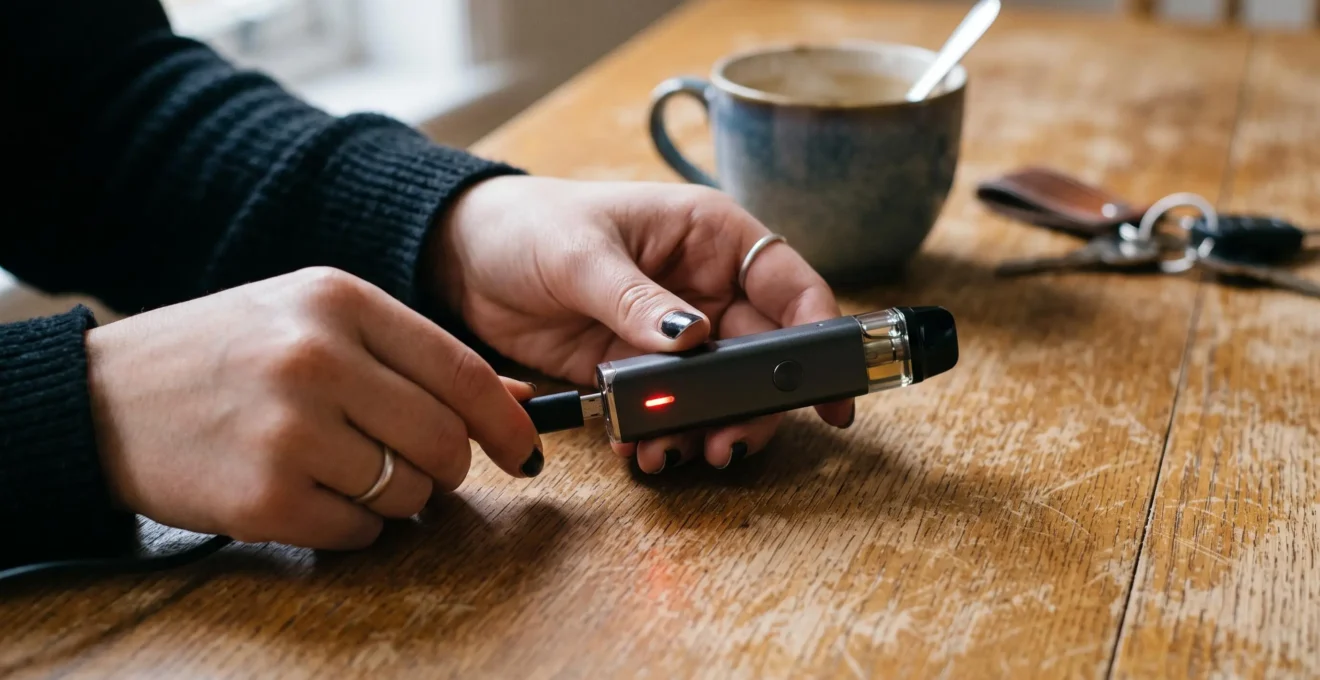
Over-discharging a vape battery can shorten its useful life, reduce the power it delivers and, in severe cases, leave the cell unsuitable for further use. Rechargeable vaping devices commonly rely on lithium-ion batteries, which perform best when operated within the voltage limits specified by their manufacturers.
However, a vape switching off at its normal low-battery cutoff does not automatically mean its battery has been dangerously over-discharged. Regulated devices generally include protection designed to stop operation before the cell reaches an excessively low voltage. The distinction matters: regularly using most of the available charge can contribute to gradual battery wear, while discharging below a cell’s permitted minimum presents a more serious problem.
For adult users of rechargeable vaping devices, the practical approach is straightforward: recharge before the battery is consistently exhausted, respect the device’s protection features and inspect batteries for damage. These habits help preserve capacity without requiring constant voltage measurements or complicated charging routines.
Vape battery over-discharge: the essentials
- Repeated deep discharge cycles can accelerate lithium-ion capacity loss, although reaching a regulated cutoff is not necessarily unsafe.
- Recharge when the battery indicator enters its lower range rather than routinely waiting for the device to stop working.
- Never bypass battery protection, attempt to revive an excessively discharged cell or continue using a damaged or overheating battery.
- Why Can Repeatedly Draining a Vape Battery Too Low Reduce Its Lifespan?
- How Do You Avoid Over-Discharging a Vape Battery During Daily Use?
- Regulated Cutoff or Manual Monitoring: Which Better Prevents Excessive Discharge?
- Which Signs Suggest a Vape Battery Has Been Stressed by Deep Discharge?
- When Should You Recharge Instead of Running a Vape Battery Until Cutoff?
- Built-In or Removable Battery: Which Is Easier to Maintain Long Term?
- How Do You Check a Vape Battery for Physical and Performance Problems?
- Is an External Battery Charger Better for Removable Vape Batteries?
Why Can Repeatedly Draining a Vape Battery Too Low Reduce Its Lifespan?
Repeatedly draining a lithium-ion vape battery towards the bottom of its permitted charge range can accelerate capacity loss because deeper discharge cycles generally impose more stress on the cell than shallower ones. Discharging below the manufacturer’s specified minimum voltage is more serious and may cause irreversible internal damage. The effects depend on battery chemistry, operating conditions and the protection circuitry.
During discharge, lithium ions move between the battery’s electrodes while the cell supplies electrical energy. Normal operation gradually changes the internal materials, contributing to ageing. The extent of this degradation depends partly on how deeply the battery is cycled, alongside temperature, charging conditions and time.
When a cell is discharged below its permitted voltage, undesirable internal reactions may occur. Under sufficiently severe conditions, components of the electrode system can deteriorate, potentially compromising the battery’s ability to operate or recharge safely. Such damage cannot be reversed simply by restoring the displayed charge level.
Less extreme but repeated deep cycling contributes to cumulative wear. According to Battery University‘s analysis of lithium-ion battery lifespan, partial discharge generally reduces cycling stress compared with repeatedly using the full available capacity.
300 versus 1,000 cycles
Battery University’s illustrative NMC comparison estimates approximately 300 cycles at 100% depth of discharge and 1,000 at 40% depth of discharge, using a 70% capacity-retention endpoint. These figures are chemistry-specific estimates, not measured lifespans or guaranteed cycle counts for vape batteries. Different discharge depths also deliver different amounts of energy per cycle.
Battery University, BU-808: How to Prolong Lithium-based Batteries.
The consequences become noticeable as usable capacity declines. A battery may require charging more frequently, while increasing internal resistance can make it less capable of supplying the current demanded by a vaping device under load.
Nevertheless, one ordinary discharge to a regulated cutoff is not proof of battery damage. Properly functioning cutoff protection is intended to prevent the cell from being driven beyond its specified operating limits. Repeated deep cycling and genuinely excessive discharge must not be treated as identical events.
The practical objective is to reduce unnecessary discharge stress over time, rather than assume that one low-battery warning has permanently damaged an otherwise healthy cell.
How Do You Avoid Over-Discharging a Vape Battery During Daily Use?
To avoid over-discharging a vape battery, establish a habit of recharging before the device regularly reaches its automatic cutoff. For devices with percentage displays, the lower third of the indicator can serve as a convenient reminder rather than a universal technical threshold. For simpler devices, follow the manufacturer’s explanation of low-battery lights and warnings.
A lithium-ion battery does not need to be exhausted before recharging. Partial charging is compatible with its chemistry, and users can recharge during ordinary breaks without waiting for the device to stop producing vapour.
The easiest approach depends on the information the device provides:
- Percentage display: Consider recharging when the indicator approaches roughly 30%, provided the manufacturer does not specify a different routine. The displayed percentage is an estimate, not a direct measurement of cell health.
- Coloured LED: Learn what each colour means for that particular model. A red light may indicate a low charge on one device but a different condition on another.
- Blinking indicator: Check whether the flashing pattern signals low battery, an electrical fault or another operating status before assuming the cell is depleted.
Daily habits matter, particularly when a device is used away from home. Someone carrying a vape throughout a working day might regularly reach cutoff simply because charging is inconvenient. A compatible charging cable, access to a suitable power source or a second properly maintained device can reduce the temptation to exhaust the remaining charge repeatedly.
Portable charging equipment must also be used according to the manufacturer’s instructions. Avoid damaged cables, unsuitable power supplies and charging arrangements that leave the device exposed to excessive heat.
Storage introduces another consideration. Do not leave a rechargeable device fully depleted for an extended period. Lithium-ion cells undergo self-discharge, and a battery already close to its lower operating limit may fall further during storage.
For longer periods without use, follow the manufacturer’s storage-charge guidance and check the device periodically if recommended. Do not assume an unused battery will retain its charge indefinitely.
Recharging early enough to avoid habitual exhaustion reduces one source of battery stress while keeping ordinary device use convenient. The next consideration is how much protection the device itself provides.
Regulated Cutoff or Manual Monitoring: Which Better Prevents Excessive Discharge?
A properly designed regulated cutoff is the primary protection against excessive discharge in a compatible vaping device. It stops operation when the control circuitry detects its defined low-voltage condition. Manual monitoring can help users recharge earlier, particularly with removable batteries, but it is not an equivalent replacement for reliable electronic protection.
Regulated vaping devices monitor electrical conditions and may stop firing when the battery reaches a preset limit. This helps keep the cell within its intended discharge range, although specific thresholds vary by battery chemistry, device design and operating load.
Battery University’s explanation of discharge limits describes how protective cutoffs prevent batteries from operating beyond their specified end-of-discharge conditions.
Importantly, the protective cutoff and an ideal recharging habit serve different purposes. The former helps prevent excessive discharge; the latter can reduce the frequency of deeper cycles and associated long-term wear.
Users of removable batteries may see voltage information on a compatible charger or measuring instrument. Such readings can provide additional information, but they require interpretation. Cell voltage changes under load and may recover after the load is removed. It also does not translate into an identical charge percentage across all cell chemistries.
The practical differences can be summarised as follows.
| Criterion | Regulated cutoff | Manual monitoring |
|---|---|---|
| Main function | Automatically limits operation under defined electrical conditions. | Helps the user decide when to recharge. |
| User effort | Normally minimal when the device functions correctly. | Requires attention to indicators or compatible measuring equipment. |
| Limitations | Does not guarantee maximum battery lifespan. | Cannot replace automatic protection against unsafe operating conditions. |
| Most appropriate application | Essential protection for ordinary regulated-device use. | Supplementary charge management, especially with removable cells. |
For a casual user with a regulated pod system, following low-battery indicators and manufacturer instructions is generally more practical than attempting to interpret raw cell voltages.
Heavy users with removable batteries may benefit from observing charge behaviour more closely. However, the advantage is better planning, not permission to operate outside the cell’s electrical specifications.
Mechanical or poorly regulated devices present additional risks because protective circuitry may be absent or limited. Manual voltage checks do not provide equivalent real-time safety protection, especially under changing loads. Choosing an appropriately protected device is safer than relying on observation alone.
A sound maintenance routine uses electronic protection as a safeguard and sensible charging habits to limit unnecessary wear. Neither approach makes a damaged or unsuitable battery safe to use.
Which Signs Suggest a Vape Battery Has Been Stressed by Deep Discharge?
A battery that delivers noticeably less runtime, reaches low-battery cutoff earlier or struggles to maintain consistent power may have lost usable capacity through ageing or repeated deep cycling. However, these symptoms are not specific to over-discharge. Changes in power settings, coil condition and usage intensity can produce similar effects, so performance history matters more than one isolated symptom.
Reduced runtime is often the easiest change to recognise. A device that previously lasted most of the day may begin requiring another charge well before evening, even though the user’s habits appear unchanged.
Other potential indicators include:
- More frequent low-battery warnings at otherwise unchanged settings.
- Earlier shutdown during demanding use, potentially associated with voltage sag under load.
- Inconsistent firing or reduced ability to maintain the selected power output.
- A shorter interval between charges despite comparable usage.
These observations can indicate declining battery performance, but they do not establish the cause. A higher wattage setting increases electrical demand, while a worn coil can change the perceived quality of vapour production. Battery-indicator estimates can also vary under different loads.
To evaluate a possible change, compare device performance across several ordinary charging and usage periods. Record the approximate time between charges while keeping the power setting and vaping pattern as consistent as practical.
For example, if the same device consistently requires recharging much sooner than it previously did, the observation supports further investigation. It does not prove that over-discharge caused the decline, because calendar ageing, temperature exposure and other factors also affect lithium-ion batteries.
Usage history can strengthen the interpretation. A battery repeatedly taken to cutoff and then left depleted for prolonged periods has experienced conditions less favourable to long-term capacity retention than one routinely recharged earlier.
Physical abnormalities require a different response. Unusual heat, swelling, leakage or visible damage should not be treated as ordinary capacity fade. Stop using the affected battery or device and follow appropriate safety and replacement guidance.
Performance comparison is useful for identifying deterioration, but it cannot certify internal battery safety. Where persistent problems remain unexplained, manufacturer support or battery replacement is preferable to experimenting with a suspect cell.
When Should You Recharge Instead of Running a Vape Battery Until Cutoff?
Recharge a vape battery when its indicator enters the lower charge range, ideally before automatic cutoff becomes a daily occurrence. Roughly one-third remaining can be a convenient reminder on devices with percentage displays, but it is not a scientifically established universal threshold. Follow the manufacturer’s guidance whenever it specifies a different charging or storage routine.
Lithium-ion batteries do not need regular full discharge to preserve their capacity. The practice of deliberately running a battery flat is often associated with older rechargeable technologies and does not offer a routine maintenance benefit for modern lithium-ion vape cells.
Instead, partial discharge and recharge cycles can help reduce the stress associated with repeatedly using the full available charge range.
There is no need to treat a particular displayed percentage as an absolute boundary. Battery indicators are estimates, their calibration varies and the relationship between displayed charge and cell voltage depends on the device’s electronics.
Occasionally reaching the normal cutoff while away from a charger is not, by itself, evidence of damage. A correctly functioning regulated device should interrupt operation according to its protective design. The concern is making exhaustive discharge a routine habit or storing the device in a depleted state.
A practical charging decision can therefore account for three circumstances:
- Normal daily use: Recharge during a convenient break once the battery reaches its lower indicated range.
- Unexpected low battery: Respect the device’s cutoff and avoid repeatedly attempting to fire or bypass its warning.
- Prolonged storage: Follow the recommended storage-charge procedure rather than leaving the battery exhausted.
Battery age also affects the decision. If a cell already shows substantial loss of capacity, persistent malfunction or other replacement indicators, changing its charging schedule cannot restore its original condition.
That does not mean an ageing battery should be deliberately discharged further. Any damaged, overheating or malfunctioning cell still requires prompt attention, regardless of its remaining expected service life.
Once a reliable charging habit is established, the next long-term consideration is whether the device allows its battery to be replaced independently.
Built-In or Removable Battery: Which Is Easier to Maintain Long Term?
Removable batteries generally offer greater long-term maintenance flexibility because a worn cell can be replaced without discarding an otherwise functional device. Built-in batteries simplify everyday handling and may benefit from integrated charge management, but replacement options are usually more limited. Neither design automatically guarantees better battery lifespan or safety.
A built-in battery is housed within the device and is not intended to be removed by the ordinary user. This arrangement can reduce routine handling of exposed cells and allows manufacturers to integrate charging and protective electronics into a compact product.
However, when the battery loses substantial capacity, the entire device may need replacing unless the manufacturer offers an authorised battery replacement service.
Removable-battery devices offer a different maintenance model. A compatible cell can be replaced when it reaches the end of its useful life, potentially allowing the main device to remain in service longer.
Charging is also more flexible: a removable cell can be charged separately in a suitable external charger while another approved battery is available for use.
These advantages introduce additional responsibilities. Users must choose batteries with the correct specifications, inspect their insulation and contacts, and prevent accidental short circuits during transport or storage.
The maintenance trade-offs are as follows.
| Maintenance factor | Built-in battery | Removable battery |
|---|---|---|
| Replacing an aged cell | May require professional servicing or replacement of the device. | Usually possible with a compatible replacement cell. |
| Charging flexibility | Generally charged through the device. | Can use a compatible external charger. |
| Battery handling | Less routine user handling of individual cells. | Requires careful handling, storage and inspection. |
| Long-term cost | Depends on device lifespan and available repair options. | May reduce replacement costs if the device remains serviceable. |
It would be misleading to claim that removable batteries always cost less over time. Cell prices, replacement frequency, charger quality, device durability and repair availability all influence the actual outcome.
Similarly, built-in protection cannot reverse chemical degradation caused by repeated deep cycling. Battery management reduces certain risks but does not make a cell immune to ageing.
Users seeking minimal battery handling may prefer integrated designs, while those comfortable with appropriate cell maintenance may value removability. In both cases, regular inspection remains essential.
How Do You Check a Vape Battery for Physical and Performance Problems?
Check a vape battery by inspecting its visible condition, observing normal charging behaviour and comparing its performance during ordinary use. Swelling, leakage, damaged insulation, corrosion, unusual heat or persistent malfunction are reasons to stop using the affected battery. Performance changes can justify further investigation, but a visual inspection cannot establish that a lithium-ion cell is internally safe.
Begin with the exterior of the device. Look for unexpected deformation, damaged charging connections, leaking material or evidence of overheating. If the enclosure is distorted or no longer sits as intended, do not attempt to force it back into shape.
For removable cells, inspect the cylindrical wrapper and the insulation surrounding the positive terminal. Tears, exposed metal in places that should be insulated, dents or damaged contacts can create electrical hazards.
The UK government e-cigarette battery safety guidance advises regular inspections, replacement of damaged or malfunctioning batteries and protective storage of spare cells.
Check performance without deliberately stressing the battery. Note whether normal charging completes as expected, whether the device becomes unusually hot and whether power delivery remains consistent at familiar settings.
If a removable-battery device operates inconsistently, comparing its behaviour with a known-good, manufacturer-approved cell may help identify whether the original battery is responsible. Only perform an ordinary replacement where the device is designed for user-replaceable batteries. Never dismantle a sealed battery pack or bypass protection circuits.
Persistent excessive heat, unexplained rapid discharge or abnormal charging behaviour should lead to discontinuing use rather than repeated testing. A severely depleted cell that a compatible charger refuses to charge must not be revived through improvised electrical methods.
Five checks for safer vape battery maintenance
- Inspect the device housing. Record whether there is any visible swelling, deformation, leakage or heat damage; stop using it if an abnormality is found.
- Examine removable-cell insulation. Confirm that the wrapper, terminal insulation and contacts are intact, or identify the battery for replacement if damaged.
- Review recent runtime. Make a short note of approximate charging intervals and power settings to identify persistent changes.
- Observe normal charging. Confirm that the approved charging equipment operates as expected without unusual heat or fault warnings; discontinue charging if problems appear.
- Decide whether to retain or retire the battery. Record any unresolved symptoms and arrange suitable replacement and battery recycling when necessary.
Used lithium-ion cells should not be placed in ordinary household rubbish. In the UK, use an appropriate battery collection or recycling service and follow its instructions for damaged batteries. Protect exposed terminals against accidental contact during handling and transport.
Inspection should guide maintenance and replacement decisions, not become an attempt to prove a suspect battery safe. Charging equipment is the final part of this routine, particularly for removable cells.
Key takeaways before choosing a charger
- A charger must match the cell’s chemistry, permitted charging conditions and physical format; convenience alone is not enough.
- Independent charging channels and clear indicators can make removable-cell maintenance easier, but charger quality matters more than the number of features.
- Charging precautions remain necessary even when a battery appears healthy and the equipment includes automatic charge termination.
Is an External Battery Charger Better for Removable Vape Batteries?
A suitable external charger can offer practical advantages for removable vape batteries, including independent charging slots, clearer charge-state information and the ability to charge cells outside the device. However, it is not automatically safer or better for battery lifespan than a properly designed integrated charging system. Compatibility, electrical protection, product quality and correct use determine whether it is appropriate.
A dedicated charger separates battery charging from the vaping device. For users who manage more than one compatible removable cell, this can simplify maintaining charged replacements without leaving the device connected to a cable.
Some chargers provide independent channels, allowing individual cells to be monitored and charged according to their condition. Depending on the model, displays may show charging status or battery voltage.
These features are useful only when the charger is designed for the relevant battery chemistry and size. An unsuitable charger can create risks regardless of how informative its display appears.
Charging through a mod is more convenient when supported by the manufacturer. It avoids routine removal of the cell and may be entirely appropriate for ordinary use. However, the result depends on the charging circuit’s design and condition.
For devices using multiple removable batteries, users should follow the manufacturer’s requirements concerning matched cells and charging arrangements. Do not mix batteries of different ages, types or charge levels where the device manufacturer prohibits it.
Safety considerations apply equally to external and integrated charging. The charging equipment should terminate charging appropriately, and batteries should remain within the electrical conditions specified by their manufacturers.
The US Food and Drug Administration recommends using batteries approved for the device, following manufacturer instructions and charging on a clean, flat surface away from combustible materials. Its advice addresses vape battery fire prevention rather than demonstrating that one charging configuration provides longer battery life.
A sensible charger selection process therefore considers:
- Compatibility: Confirm support for the exact lithium-ion cell chemistry, size and manufacturer specifications.
- Charge management: Choose equipment with appropriate charge termination and protective functions.
- Independent channels: Consider them when charging multiple removable cells, particularly when individual monitoring is valuable.
- Product reliability: Prefer identifiable manufacturers with clear technical specifications and instructions rather than unbranded equipment with unverifiable protection features.
- Safe placement: Charge on a stable, clean, non-flammable surface away from combustible objects, following the equipment manufacturer’s instructions.
Do not leave batteries charging unattended or overnight, and do not use damaged chargers or cells. Avoid charging in extreme temperatures, placing charging equipment on bedding or carrying loose removable cells alongside keys or coins. Spare batteries should be stored and transported in suitable protective cases.
An external charger cannot repair a cell damaged by excessive discharge. If a charger rejects a battery because of abnormally low voltage or another fault, do not override the protection or attempt improvised recovery. Follow the manufacturer’s advice and arrange safe disposal where appropriate.
For the next charging cycle, check the device and battery manufacturer’s instructions, confirm that the charger is compatible and adopt a habit of recharging before routine cutoff. Replace any battery showing damage, abnormal heat or persistent malfunction rather than trying to extend its life through further cycling.
Can a vape battery recover after being completely drained?
A battery that has simply reached the normal cutoff of a functioning regulated device may recharge normally using the approved equipment. This differs from a cell discharged below its permitted minimum voltage. If a battery is unusually depleted, damaged or rejected by its charger, do not attempt to revive it through improvised methods. Seek manufacturer guidance or replace it safely.
Does charging a vape battery before it is empty cause a memory effect?
No. Lithium-ion batteries do not require routine full discharge to prevent the memory effect associated with some older rechargeable battery technologies. Partial discharge and recharge cycles are generally compatible with maintaining battery condition, although temperature, charging voltage and normal ageing still influence lifespan.
Is a vape battery percentage display completely accurate?
Not necessarily. A displayed percentage is an estimate generated by the device’s battery monitoring system. Accuracy varies with electronics, calibration, battery ageing and operating conditions. The indicator is useful for deciding when to recharge, but it should not be treated as a precise measurement of cell voltage or internal battery health.
Can leaving an unused vape with an empty battery damage it?
Potentially. Lithium-ion cells gradually self-discharge, even when not actively powering a device. If a battery is stored near its lower voltage limit, additional discharge may take it into an excessively depleted condition. Follow the manufacturer’s storage-charge guidance and avoid prolonged storage with the device fully discharged.
Should a vape battery that becomes unusually hot be recharged again?
Not until the cause has been assessed and the battery or device is confirmed suitable for use. Unusual heat during charging or operation can indicate an electrical or battery problem. Stop using and charging the affected equipment, avoid handling a dangerously hot or visibly damaged cell, and follow manufacturer or local fire-safety guidance. A damaged or malfunctioning battery should be replaced and disposed of through an appropriate collection service.