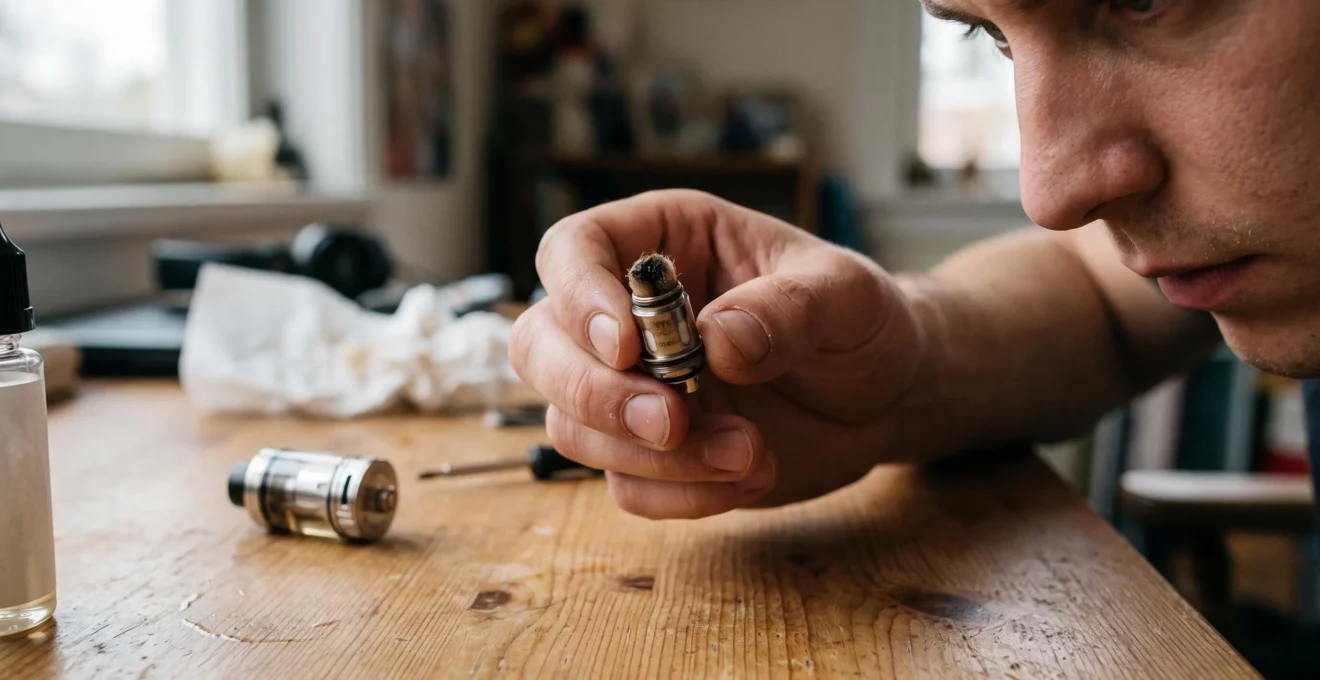
A vape dry hit happens when the heating coil becomes too hot for the amount of e-liquid reaching its wick. Instead of producing the expected flavour and vapour, the device delivers a harsh, unpleasant inhalation that may taste burnt. The problem can develop even when the tank or pod still contains plenty of liquid.
The immediate response is to stop firing the device. Check whether the coil is properly saturated, whether the wattage suits the installed coil, and whether the e-liquid can move through its wicking channels quickly enough. If the cotton has already scorched, simply adding more liquid will not repair the damaged fibres.
Understanding the difference between temporary liquid starvation and permanent wick damage helps avoid unnecessary coil replacements while reducing repeated overheating. It also matters for exposure: laboratory research has identified changes in aerosol chemistry and increased cellular toxicity under certain dry-hit conditions. These findings do not quantify the health risk of an individual puff, but they provide a reason not to continue using a device that tastes burnt.
Vape dry hits: the essentials
- Check liquid supply first: a full tank cannot prevent dry hits if the cotton around the coil is locally dry.
- Separate power problems from wicking problems: allow the coil to saturate and check its rated wattage before deciding what needs changing.
- Replace genuinely burnt cotton: persistent scorching, visible charring or a burnt taste after re-saturation indicates that a disposable coil is no longer suitable for use.
- Why Does a Vape Coil Give a Dry Hit Even When the Tank Still Contains E-Liquid?
- How Do You Fix Repeated Dry Hits Without Immediately Replacing the Coil?
- High Wattage or Poor Wicking: Which Is Causing Your Dry Hits?
- When Does a Dry Hit Mean the Coil Wick Has Already Been Damaged?
- When Should You Increase the Time Between Puffs to Prevent Dry Hits?
- Pod Coil or Tank Coil: Which Usually Needs More Time to Saturate?
- How Do You Match a PG/VG Ratio to Your Coil and Device Type?
- When Should You Replace a Vape Coil Instead of Continuing to Use It?
Why Does a Vape Coil Give a Dry Hit Even When the Tank Still Contains E-Liquid?
A vape can produce a dry hit with e-liquid still in its tank because the coil depends on liquid reaching its cotton wick, not simply being present in the reservoir. Thick liquid, restricted wicking channels, unfavourable device orientation or insufficient liquid covering the intake openings can leave the cotton locally dry while the tank looks adequately filled.
Inside a typical replaceable coil, e-liquid travels through openings in the coil housing and into porous cotton surrounding the heating element. Electrical power heats that element, causing liquid near its surface to vaporise. The wick must continually replace the liquid consumed during each puff.
The physical relationship is important: liquid delivery must keep pace with evaporation. A Scientific Reports study on e-cigarette wick evaporation investigated how electrical power, e-liquid composition and wick porosity influence this process. Its modelling and experimental work illustrate why changes in heating and capillary transport can affect atomisation. The results, obtained using a limited experimental configuration, should not be treated as universal performance measurements for commercial devices.
Several situations can interrupt this balance even when the reservoir contains liquid:
- High-VG liquid: its greater viscosity can slow movement through narrow cotton channels.
- Restricted wick ports: accumulated residue or compressed cotton can limit liquid delivery.
- Low liquid around the ports: a tank may contain liquid without keeping every intake opening adequately covered.
- Device orientation: tilting or storing certain designs horizontally may temporarily expose their wicking openings to air.
- Insufficient saturation: recently installed or refilled coils may not yet have absorbed enough liquid throughout the cotton.
The sensation can provide an initial clue. A temporarily under-saturated wick may produce a harsh, unusually weak or flavourless puff. An acrid, distinctly burnt taste raises concern that the cotton has overheated or scorched. However, taste alone cannot reliably establish the exact condition of the wick, and a suspected burnt hit should not be repeatedly reproduced for diagnosis.
Once that distinction is clear, troubleshooting can focus on restoring proper saturation rather than automatically assuming the tank needs more liquid.
How Do You Fix Repeated Dry Hits Without Immediately Replacing the Coil?
To address repeated dry hits without immediately replacing the coil, stop using the device, check that the wick is adequately supplied with e-liquid, and allow it to saturate fully. If the manufacturer permits it, prime an accessible replaceable coil before reassembly. Check the operating wattage before resuming normal use. A persistent burnt taste calls for replacement rather than continued recovery attempts.
Start with the least invasive checks. Confirm that the correct e-liquid is present, that the tank or pod is assembled properly, and that the coil’s intake openings are not exposed above the liquid level. Keep the device upright where its design requires this.
Gently moving or tilting the reservoir may help liquid reach the intake openings, provided the manufacturer’s instructions permit it. Some manually operated devices also allow draws without activating the heating element, sometimes called unpowered priming draws. This is not appropriate for every product, especially auto-draw pods, and excessive suction can cause flooding or leaks.
If the removable coil has exposed cotton and its instructions explicitly allow manual priming, a small amount of compatible e-liquid can be applied to that cotton before the tank is reassembled. Do not force liquid into sealed pods, electrical contacts or inaccessible parts.
The manufacturer’s priming instructions take precedence over general techniques. For example, the Innokin Z FORCE technical support instructions recommend applying liquid to the wick, filling the tank, waiting at least five minutes and starting near the lower end of the specified power range. That waiting period is specific to the documented equipment, not a universal rule for pods or tanks.
Five checks before deciding to replace the coil
- Check the liquid level: confirm that the wicking openings remain covered and note whether the reservoir needs refilling.
- Inspect the accessible wick: look for visible charring, obstruction or unusual discolouration and record whether damage is apparent.
- Verify the coil rating: compare the selected wattage with the manufacturer’s specified range and identify any mismatch.
- Allow proper saturation: follow the device’s priming and waiting instructions, then confirm that the coil has received sufficient liquid.
- Make a replacement decision: if there is persistent burnt flavour or visible damage, discontinue use of that coil; otherwise correct the identified liquid-supply or power issue.
Rebuildable devices require a separate distinction. Experienced users can replace the cotton in compatible rebuildable atomisers according to their equipment’s safety instructions. Prebuilt disposable coils with scorched cotton cannot be genuinely restored merely by soaking them in water or alcohol. Such cleaning can leave contamination or residues and is not a substitute for replacement.
If a properly saturated coil still delivers a burnt sensation, stop using it rather than repeatedly testing it. If the problem disappears after correcting liquid supply, the next step is to identify why saturation was falling behind in the first place.
High Wattage or Poor Wicking: Which Is Causing Your Dry Hits?
High wattage is a likely contributor when dry hits appear after increasing power or taking consecutive puffs, particularly if the coil otherwise operates normally. Poor wicking is more likely when problems persist at appropriate lower settings despite adequate saturation time. The causes overlap: even a correctly rated power level can exceed the liquid supply capacity of a restricted or ageing wick.
Increasing wattage delivers more electrical energy to the coil. Under suitable conditions, more e-liquid can be vaporised, but the cotton must replace that liquid quickly enough. If the wick cannot keep up, local overheating becomes more likely.
A useful starting point is to compare the device setting with the recommended wattage printed on the coil or provided by its manufacturer. A setting above that range is an obvious reason to stop and correct the mismatch. A setting within the range does not guarantee satisfactory liquid delivery if the cotton is clogged or insufficiently saturated.
The most useful distinction comes from the circumstances surrounding the first unpleasant puff:
| Diagnostic clue | Power-related problem | Wicking-related problem |
|---|---|---|
| When the problem started | After a wattage increase | After a liquid change, refill or extended coil use |
| Typical pattern | More likely at higher permitted settings or with repeated puffs | Can occur even at modest power |
| Relevant check | Compare selected power with the coil rating | Inspect liquid viscosity, ports, saturation and residue |
| Appropriate correction | Use a manufacturer-approved power setting | Restore liquid supply or replace an obstructed or damaged coil |
A lower setting may reduce the demand placed on the wick, but this does not prove that excessive wattage was the original problem. It can simply disguise poor liquid transport. Conversely, a dry hit that occurs at low power does not conclusively eliminate power-related faults or a damaged heating element.
In a 2015 experiment published in Addiction, researchers examined two atomiser configurations at several power settings. The Addiction study on aldehyde emissions during dry-puff conditions found that dry puffs emerged at higher tested powers in one configuration but not in the other. This demonstrated the importance of the interaction between atomiser design and heating, rather than establishing a universal wattage threshold.
30–250 times
The range of increased aldehyde measurements reported under dry-puff conditions in the specific 2015 experimental setup. These values are not general emission multipliers for all modern coils, nor estimates of an individual user’s health risk.
Original experimental research published in Addiction, 2015.
For a coil that is not yet burnt, examine liquid viscosity, the condition of the wick ports and the manufacturer’s operating range before concluding that a permanent power reduction is necessary.
If the power setting and liquid supply both appear appropriate but a burnt sensation persists, the next concern is whether previous overheating has already damaged the cotton.
When Does a Dry Hit Mean the Coil Wick Has Already Been Damaged?
A dry hit suggests lasting wick damage when an acrid burnt taste persists after the coil has been properly saturated, or when accessible cotton shows visible scorching, brittleness or charring. Dark residue alone is not definitive because ordinary deposits can also discolour a coil. When persistent burnt flavour follows overheating, replacing disposable cotton-based coils is the prudent choice.
Temporary liquid starvation and thermal damage are different conditions. A wick that has merely dried can absorb e-liquid again. Cotton that has thermally decomposed has undergone physical and chemical changes that liquid cannot reverse.
That distinction is supported by a 2024 investigation published in Toxicology. The Toxicology study on the effects of dry-hit aerosol reported thermal decomposition of cotton observed through microscopy after dry-hit conditions. The researchers also identified chemical changes in the aerosol and increased cytotoxicity in cultured lung cells exposed to the experimentally generated dry-hit aerosol.
These observations support avoiding repeated overheating. However, the study used a specific experimental e-liquid and cell-based testing. It does not establish that every burnt puff causes identical wick damage or determine a person’s clinical risk from a single exposure.
There are several practical warning signs worth checking, without intentionally producing another dry hit:
- A persistent burnt or charred flavour despite proper liquid saturation.
- Visible blackened, scorched or hardened cotton where inspection is possible.
- Noticeable flavour deterioration accompanied by repeated overheating symptoms.
- Heavy residue that appears to restrict liquid entering the wick.
Do not rely on a deliberate burnt-taste test to prove that a coil is permanently damaged. Repeatedly firing a suspicious coil may prolong exposure to overheating byproducts. Where flavour is persistently burnt, a new compatible coil is a more reasonable diagnostic and maintenance step.
Darkened e-liquid emerging from an old wick can support suspicion of accumulated residue, but it is not a specific test for burnt cotton. Similarly, an ordinary change in colour does not establish the chemical composition of the material involved.
Once a coil shows convincing signs of scorching, additional soaking, power changes or longer pauses are not a substitute for replacement. For an undamaged wick, however, puff frequency may still be the cause of repeated temporary dryness.
When Should You Increase the Time Between Puffs to Prevent Dry Hits?
Increase the interval between puffs when consecutive draws appear to consume e-liquid faster than the wick can replace it. This is more likely with high-viscosity liquids, higher power, restricted wicking channels or small pod systems. There is no universal safe interval: the necessary recovery time depends on the device, coil, liquid and operating conditions.
During a puff, the heating element vaporises liquid held near its surface. When the heating stops, more liquid moves through the cotton towards that area. If the next puff begins before sufficient liquid has returned, the wick may become progressively less saturated.
This can explain why the first draw tastes normal but later draws become dry or harsh. Rapid consecutive vaping can make a marginal liquid-supply problem noticeable even when the coil initially appears compatible with the device.
Rather than deliberately chain-vaping until a burnt hit occurs, observe whether discomfort previously followed several closely spaced draws. If it did, stop the device, allow complete re-saturation and follow the manufacturer’s recommendations for puff frequency. A longer pause is a reasonable precaution only when the coil has not already been damaged.
After installing a new coil, its initial saturation period is especially important. A freshly filled tank may also need additional time if the wick was allowed to dry previously. Liquid that has moved away from the coil’s intake openings during storage or tilting must be given the opportunity to reach them again.
More frequent pauses are not a complete solution if:
- The coil tastes burnt even after adequate resting time.
- The liquid is incompatible with the coil’s wicking design.
- Residue is obstructing the cotton or its inlet openings.
- The wattage exceeds the manufacturer’s permitted range.
- The coil has reached the end of its usable life.
Longer spacing should therefore be understood as a way of respecting the device’s liquid-supply limits, not a method for compensating indefinitely for unsuitable hardware.
When changing between pod and tank systems, the optimal pacing may also change because the two designs can manage cotton saturation differently.
Pod Coil or Tank Coil: Which Usually Needs More Time to Saturate?
Neither pod coils nor tank coils universally require more saturation time. Many compact pods use narrow liquid channels, while larger sub-ohm tank coils may contain more cotton and have broader intake openings. The pod may fill more slowly through its restricted ports, but the larger coil may need longer to wet its entire cotton mass. Manufacturer instructions are the reliable reference.
Pod systems are often designed for compact dimensions and relatively low-power operation. Depending on the design, the liquid enters through small openings around an integrated coil. Limited space can restrict how quickly the cotton replenishes liquid after repeated use.
Sub-ohm tanks commonly use larger removable coils, sometimes with generous wick ports. Their greater liquid capacity can support higher evaporation rates, although their cotton mass and internal construction affect how long initial saturation takes.
The difference is therefore not simply a matter of one coil being physically larger. Port geometry, cotton density and liquid viscosity determine the speed at which liquid reaches the heating surface.
Before using either design with a new coil, consult its specific priming instructions. For compatible removable coils, the manufacturer may recommend applying liquid directly to exposed cotton before installation. Sealed and integrated pod coils generally require the filling and waiting process specified for that model, without disassembly or improvised access to the wick.
A person switching from a familiar sub-ohm tank to a compact pod may experience dry hits if they assume identical liquid compatibility, initial waiting time and puff frequency. That does not necessarily mean the pod is defective.
Some pods also stop feeding effectively before the reservoir looks empty, particularly if the liquid level falls below the relevant intake openings. Refilling earlier may help prevent that specific problem.
Once the coil type is established, the next compatibility question is whether the e-liquid itself can move through its wick at the required rate.
How Do You Match a PG/VG Ratio to Your Coil and Device Type?
Match e-liquid composition to the coil’s intended operating conditions and liquid-feed design. Higher-VG mixtures are generally more viscous and can be harder for narrow wicking channels to absorb. Higher-PG mixtures tend to flow more readily, making them more compatible with many compact, low-power systems. Neither ratio should be selected independently of the manufacturer’s device guidance.
PG stands for propylene glycol, while VG stands for vegetable glycerine. Both form part of the liquid base, but their different physical properties affect how e-liquid moves through the cotton.
A high-VG formulation can work effectively with a coil designed for a thicker liquid and adequate liquid delivery. The same formulation may struggle in a compact pod with narrow intake channels. Conversely, a thinner liquid may travel too freely through some equipment, contributing to flooding or leakage rather than improving performance.
Compatibility is a relationship between liquid and hardware, not a universal ranking of one PG/VG ratio above another.
| Factor | Compact pod or low-power coil | Larger sub-ohm tank coil |
|---|---|---|
| Typical liquid-feed design | Often narrow intake channels | Often larger wicking openings |
| Liquid compatibility | May favour thinner, manufacturer-approved mixtures | May support thicker high-VG mixtures |
| Main dry-hit consideration | Restricted liquid delivery | Liquid consumption at higher power |
| Best selection method | Check pod and coil instructions | Check coil instructions and operating range |
As a device-specific example, Innokin states that its Z FORCE configuration is intended for liquids containing at least 70% VG. This is useful evidence that some coils are deliberately designed around thicker formulations, but it does not mean every sub-ohm coil requires that percentage.
Sweeteners introduce another consideration. Strongly sweetened e-liquids can contribute to deposits on the heating surface and cotton, progressively affecting flavour and liquid delivery. The Innokin support guidance cited earlier also notes that additional artificial sweeteners may require more frequent coil replacement.
Before changing liquid, check the coil’s documented compatibility, its intended power range and whether the current wick is still in good condition. Switching to a thinner liquid cannot repair cotton that is already burnt.
Even a well-matched coil and liquid combination deteriorates with use. Recognising when maintenance has become replacement is the final part of preventing recurring dry hits.
Key takeaways before replacing a coil
- Temporary dryness may improve when liquid supply, initial saturation or an incorrect power setting is corrected.
- Persistent burnt flavour or visible scorching is a reason to stop using the affected disposable coil, not to keep attempting recovery.
- Matching the e-liquid to the coil and respecting the manufacturer’s operating instructions helps prevent avoidable replacement.
When Should You Replace a Vape Coil Instead of Continuing to Use It?
Replace a disposable vape coil when it continues to taste burnt after adequate saturation, shows visible scorching, or repeatedly performs poorly despite correct liquid compatibility and power settings. Significant flavour deterioration and heavy residue are also practical replacement indicators. A temporarily dry but otherwise undamaged wick may recover; scorched cotton cannot be returned to its original condition.
Coil replacement should be based on condition rather than an arbitrary number of days. Two coils of the same design can age differently because of liquid composition, power setting, puff frequency and maintenance habits.
In particular, deposits can gradually reduce effective liquid flow and make dry hits more frequent. A coil may initially appear to function normally but become progressively less consistent as residue accumulates.
Consider replacement when one or more of the following remains true after ordinary, manufacturer-approved checks:
- Persistent burnt taste: the unpleasant flavour does not disappear after the coil has been properly supplied with liquid.
- Visible wick damage: accessible cotton shows convincing signs of charring or thermal degradation.
- Substantial flavour deterioration: flavour remains noticeably muted or unpleasant despite using the correct liquid and settings.
- Repeated dry hits: liquid-feed problems recur even when the coil is correctly installed, saturated and operated within its rated range.
- Heavy contamination: deposits appear to interfere with liquid delivery or consistent operation.
Replacing a coil at the first significant sign of deterioration can avoid the habit of compensating for poor performance with progressively lower power or increasingly long pauses. These adjustments may reduce symptoms temporarily without resolving the underlying restriction.
The opposite situation also deserves attention. A recently fitted coil that was inadequately primed does not necessarily need immediate replacement if no scorching has occurred. Correct installation and adequate initial saturation may resolve the problem.
Coil longevity can be improved by following the manufacturer’s priming process, starting new coils within the lower portion of their approved power range where recommended, selecting compatible e-liquid and avoiding repeated operation when the wick may be under-saturated.
When installing a replacement, check that its resistance, design and compatibility match the device. If the new coil develops the same symptoms immediately, investigate the liquid, installation and device settings rather than assuming that successive coils are defective.
If the coil has persistent burnt flavour or visible damage, stop using it and fit a compatible replacement according to the manufacturer. If overheating continues with a correctly installed new coil and suitable liquid, discontinue use of the device and seek qualified technical support rather than repeatedly exposing yourself to dry hits.
Can a single dry hit permanently ruin a vape coil?
A single dry hit can potentially damage a cotton wick if overheating is severe enough, but not every unpleasant puff establishes permanent damage. A temporarily under-saturated wick may recover. Persistent burnt flavour or visible scorching after an overheating incident indicates that a disposable coil should be replaced. There is no validated number of dry hits that reliably separates recoverable dryness from irreversible damage.
Why does a new vape coil taste burnt immediately?
A new coil may taste burnt because it was activated before its cotton had absorbed enough e-liquid, because the selected power exceeds its rated range, or because the liquid cannot reach its heating surface effectively. Check the manufacturer’s priming instructions and compatibility requirements. If the new coil already tastes persistently scorched, stop using it and replace it rather than attempting to burn off the flavour.
Can cold weather make vape dry hits more likely?
Lower temperatures can increase the viscosity of e-liquid, potentially slowing its movement through cotton wicks. This may aggravate an existing liquid-feed limitation, particularly with thicker formulations. Allow the device to return naturally to an appropriate operating temperature according to its instructions. Do not use direct heat, boiling water or improvised heating methods on a vape device or battery.
Are dry hits more harmful than normal vape puffs?
Experimental studies have found increased emissions of certain aldehydes and greater cell-based toxicity under specific dry-hit conditions compared with the saturated conditions tested. These results indicate a potential additional hazard from overheating, but they do not quantify the health effects of an individual dry hit. Normal vaping is not risk-free either. The practical precaution is to stop using a device that produces burnt or overheating-related inhalations.
Can you clean a burnt vape coil instead of replacing it?
Cleaning may remove some deposits from components designed for maintenance, but it cannot reverse thermal damage to burnt cotton. Disposable prebuilt coils with scorched wicks should be replaced. Rebuildable atomisers may allow the wick to be replaced separately by users familiar with the relevant equipment and safety requirements. Alcohol soaking and improvised cleaning treatments are not reliable methods for restoring damaged disposable coils.