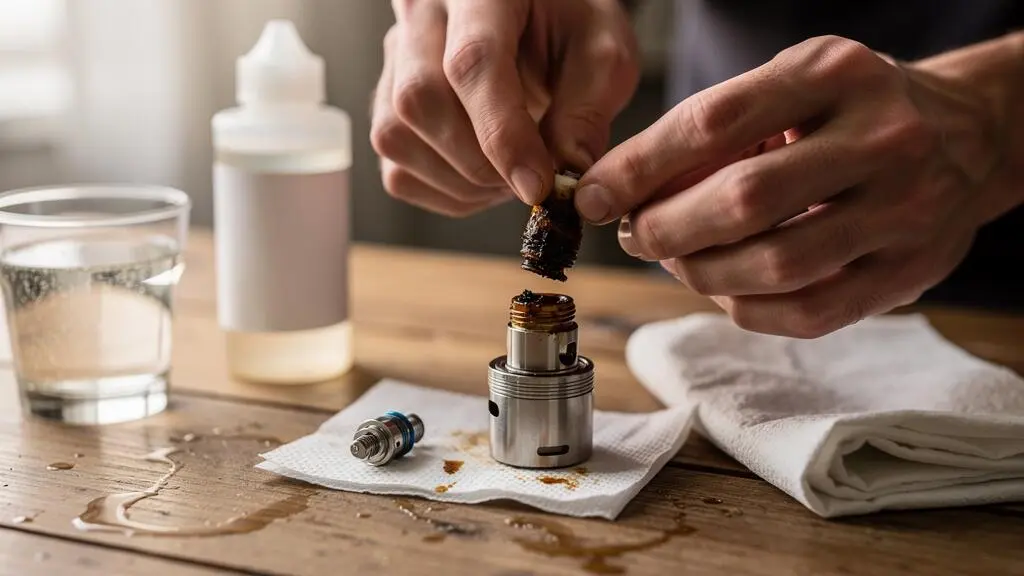
Changing e-liquid does not always mean changing flavour immediately. A mint liquid may leave a cooling sensation behind when the tank is filled with strawberry, while a rich dessert blend can make a lighter fruit flavour taste unusually sweet. This persistent carryover is known as flavor ghosting, or flavour ghosting in UK English.
The main reason is that emptying a vape tank removes the bulk of the old liquid, not every trace of it. E-liquid can remain inside the coil’s wicking material, around seals, in the mouthpiece and along the tank’s internal surfaces. When the next liquid is added, those remnants can influence what the user tastes.
The solution depends on where the residue remains and how strongly it affects the new flavour. A warm-water rinse may be sufficient for a mild transition, but a saturated or deteriorated coil can require replacement. Identifying the likely source before cleaning avoids unnecessary work and premature coil changes.
Flavor ghosting: the essential fixes
- Check the coil first: cotton wicks can retain previous e-liquids even after the tank has been emptied and rinsed.
- Match cleaning to the switch: similar flavours may tolerate mild carryover, while contrasting flavours often benefit from a thoroughly cleaned tank and fresh coil.
- Replace rather than repeatedly flush: persistent unwanted taste, visible coil deposits or scorched cotton are reasons to inspect and potentially replace the coil.
- Why Do Menthol, Tobacco and Sweet Flavours Linger Longer in Some Vape Setups?
- How Do You Remove Flavor Ghosting Before Switching to a Very Different E-Liquid?
- Clean the Tank or Change the Coil: Which Fixes Flavor Ghosting Better?
- Which Flavour-Switching Habits Make Ghosting Harder to Remove?
- When Does Flavor Ghosting Mean the Coil Needs Replacing?
- Quick Rinse or Deep Clean: Which Does Your Vape Tank Actually Need?
- How Do You Replace a Vape Coil Without Causing Leaks or a Burnt Start?
- What Should You Do With Residual E-Liquid Left in a Vape Tank?
Why Do Menthol, Tobacco and Sweet Flavours Linger Longer in Some Vape Setups?
Menthol, tobacco and sweet e-liquids can produce particularly noticeable flavour carryover because their distinctive flavour compounds or accumulated residues may remain detectable after a refill. The extent of ghosting depends on the formulation, the condition of the coil and wick, and the device’s construction. No flavour family is universally more persistent in every setup.
There are two related mechanisms. The first is liquid retention: cotton and other absorbent wicking materials hold e-liquid within their structure. Emptying the reservoir does not remove that absorbed liquid, so the next refill can initially vaporise a mixture of old and new formulations.
The second mechanism involves deposits produced during repeated heating. Some sweetened formulations contribute to visible build-up and changes in heating-element surfaces. This does not mean that every sweet liquid caramelises in the same way, or that all dark deposits consist of caramelised sugar.
A 2024 study published in Frontiers in Physiology examined sucralose- and neotame-containing e-liquids under specified experimental conditions. The researchers observed changes to tested metal heating elements and differences in metal release. The experimental research on sucralose and e-cigarette heating elements supports the importance of liquid composition, but it did not measure flavour ghosting or establish which flavours linger longest. The researchers were affiliated with an e-cigarette technology company.
Menthol presents a different practical challenge: a small remaining amount can still produce a recognisable cooling sensation. Tobacco-style and dessert liquids may contain several flavouring components, making the resulting taste more complex when mixed with a replacement liquid. These are practical observations rather than a scientifically established persistence ranking.
Hardware also matters. A cotton-wicked coil contains absorbent material that cannot usually be cleaned as thoroughly as removable glass or metal tank parts. A mesh heating element does not automatically prevent this problem, since many mesh coils also use cotton wicks. Similarly, a higher-VG formulation may behave differently during filling and wicking, but the available evidence does not establish that high-VG liquids always cause more ghosting than PG-dominant blends.
One informal diagnostic approach is to switch to a compatible unflavoured liquid and observe whether the previous taste remains. This can indicate residual flavour somewhere in the liquid path, although it cannot identify the coil as the sole source or distinguish it conclusively from remaining tank residue.
The important distinction is between a small quantity of old liquid that will gradually be displaced and deposits or contaminated wicking material that may not recover through ordinary use. That distinction determines how thoroughly to prepare for the next flavour.
How Do You Remove Flavor Ghosting Before Switching to a Very Different E-Liquid?
To minimise flavour ghosting before a major e-liquid change, empty the tank, remove the coil, wash compatible reusable components, dry everything thoroughly and assess whether the existing coil should be replaced. Switching from a rich dessert to menthol or from tobacco to a delicate fruit flavour is a good reason to consider a fresh coil.
The larger the perceived contrast between two flavours, the more distracting even a small amount of carryover may become. A remaining strawberry note in another berry liquid might be acceptable, whereas the same residue could interfere with a subtle tobacco blend.
This is a practical preference-based distinction, not a measured chemical scale of flavour similarity.
| Flavour transition | Suggested preparation | Coil decision |
|---|---|---|
| Berry to another berry flavour | Empty the tank and perform a basic rinse if needed. | Reuse if the wick is sound and mild mixing is acceptable. |
| Fruit to a dessert flavour | Clean the tank and inspect seals and mouthpiece. | Replace if the remaining fruit note disrupts the new liquid. |
| Sweet dessert to menthol | Thoroughly clean compatible removable parts. | A fresh coil offers the cleanest separation. |
| Menthol to a mild tobacco flavour | Clean the liquid-contact surfaces and check for residual menthol. | Consider replacement if cooling persists. |
A reliable pre-switch routine begins with removing the tank or pod from its power source where the device design permits. Drain the remaining liquid safely, then disassemble only the components that the manufacturer identifies as removable.
Wash compatible glass and metal components with warm water, inspect accessible seals and threads, and allow everything to dry completely. Do not submerge the battery, electronic components or a non-washable pod assembly.
For a replaceable cotton-wicked coil, rinsing is not equivalent to restoring the wick. It can leave moisture inside the cotton and may fail to remove absorbed flavour. Dry-burning such a coil is also unsuitable: firing a dry cotton wick can scorch it permanently.
Rebuildable systems require a different approach. Experienced users may clean a bare, compatible metal heating element after removing the old wick, following the atomiser manufacturer’s instructions. Dry-burning is not a universal cleaning method and should not be attempted with disposable coil heads, intact cotton or assemblies whose materials are not rated for it.
Using a third e-liquid as a flavour bridge is another option sometimes considered. However, an intermediate liquid is not a substitute for cleaning: it can simply introduce another taste into an already saturated wick.
Five checks before refilling with a contrasting flavour
- Empty the reservoir: confirm that no pool of the previous e-liquid remains in the tank.
- Inspect the coil: identify visible deposits, damaged wicking material or signs of scorching and record whether replacement is needed.
- Wash compatible components: check that the tank glass, drip tip, threads and accessible seals are free from visible liquid residue.
- Dry and reassemble: confirm that washable components are dry and that each seal is correctly seated.
- Prepare the new liquid path: install and prime a compatible fresh coil when appropriate, then verify that the new flavour is not being mixed with visibly remaining old liquid.
The objective is not to remove every possible trace at any cost. It is to clean accessible surfaces effectively and avoid retaining a coil whose old flavour would noticeably interfere with the next refill.
Clean the Tank or Change the Coil: Which Fixes Flavor Ghosting Better?
Cleaning the tank is usually sufficient when flavour carryover comes from residual liquid on accessible surfaces. Replacing the coil is generally more effective when the previous flavour remains trapped in an absorbent wick or when the coil is visibly deteriorated. For a pronounced flavour change, combining tank cleaning with a fresh coil provides the most complete practical reset.
The two interventions address different parts of the device. Glass, metal surfaces, the mouthpiece and accessible airflow passages can often be rinsed. A factory-made coil contains wicking material and internal spaces that cannot usually be cleaned or inspected completely.
According to VAPORESSO‘s vape tank cleaning instructions, residual liquid can remain on tank surfaces and inside the coil’s cotton. The manufacturer recommends cleaning compatible tank parts and using a new coil for a cleaner flavour transition. This is manufacturer maintenance guidance, not a controlled comparison of cleaning effectiveness.
| Consideration | Clean the tank | Replace the coil |
|---|---|---|
| Main target | Old e-liquid on accessible tank components | Absorbed liquid and residue in the coil assembly |
| Best suited to | Light carryover and routine maintenance | Stubborn taste, damaged wicks or major flavour changes |
| Main limitation | Cannot reliably remove flavour inside a cotton wick | Does not clean contaminated tank surfaces |
| Ongoing cost | Usually low when components are reusable | Requires a compatible replacement component |
| Practical outcome | Reduces accessible surface contamination | Removes the old coil as a source of carryover |
The timing of an unwanted taste can offer clues, but it is not a definitive test. If the old flavour is present immediately after refilling, the coil may still contain the previous liquid. However, residual liquid in the chimney or mouthpiece can produce the same result. A taste that becomes apparent later does not necessarily rule out the coil either.
Coil replacement also has a cost. Frequent flavour switchers may find it impractical to install a new coil whenever they change liquids, particularly if the existing coil is nearly new and performing normally.
In that situation, mild carryover may be tolerated while the new liquid gradually displaces what remains in the wick. This is a matter of flavour preference, not a guaranteed cleaning process. Continuing to use an unhealthy or scorched coil simply to avoid replacing it is not an equivalent option.
A useful middle ground is to maintain separate tanks or compatible pods for different flavour families. One might be reserved for menthol and another for fruit or dessert liquids. Each setup retains its own coil, reducing cross-contamination without requiring replacement at every switch.
When both components are involved, treating only one can leave the problem partly unresolved. Cleaning the reusable tank components and assessing the coil separately is therefore more useful than assuming one action fixes every type of ghosting.
Which Flavour-Switching Habits Make Ghosting Harder to Remove?
Repeatedly topping up a tank with different flavours, switching several times without cleaning and allowing the wick to run insufficiently saturated can make flavour carryover harder to manage. These habits increase mixing or contribute to coil deterioration. Long storage with liquid remaining in the device may also complicate maintenance, although it does not itself cause heat-driven caramelisation.
Top-up switching is one of the easiest ways to create an unwanted hybrid flavour. Adding a new liquid while the reservoir still contains the previous one creates an immediate mixture. The coil also retains liquid from earlier fills, so the resulting taste can be difficult to attribute to one formulation.
For example, consider a hypothetical sequence in which a tank is filled with vanilla custard, topped up with strawberry and then changed to menthol without cleaning. The final liquid may taste sweet, fruity and cooling at the same time. This does not prove that the flavours have chemically bonded; it simply reflects successive mixing and remaining liquid.
Repeated changes can also obscure the condition of the coil. A user may assume that a disappointing flavour comes from the latest e-liquid when deposits from earlier use or a deteriorating wick contribute to the result.
Storage introduces a separate consideration. A filled tank left unused for an extended period can retain liquid around seals and inside the wick. Exposure to air, light and previous heating may affect the formulation, depending on the liquid and storage conditions. However, sweetener deposits associated with heating should not be described as forming through caramelisation merely because the tank has been sitting unused.
Running a tank almost empty creates another avoidable problem. If the wick no longer receives enough liquid, firing the device can overheat or scorch the cotton. Once the wick is burnt, washing the tank or introducing a different flavour will not restore the damaged material.
Better switching habits are straightforward:
- Empty the previous liquid before introducing a different flavour rather than repeatedly mixing partial fills.
- Clean reusable parts periodically, particularly after strongly contrasting formulations.
- Avoid firing the device when the wick is inadequately supplied with liquid.
- Drain and prepare the tank when planning a substantial break from using it, following the device instructions.
- Keep different flavour families in separate compatible setups when frequent switching makes cleaning impractical.
These habits cannot stop normal coil ageing, but they make the source of unwanted flavour easier to identify. When a switch still produces persistent ghosting despite a clean tank, the condition of the coil becomes the next consideration.
When Does Flavor Ghosting Mean the Coil Needs Replacing?
Flavor ghosting is a reason to replace the coil when the unwanted taste remains unacceptable after the tank has been cleaned and the new liquid has had a reasonable opportunity to displace the old one. Visible deposits, scorched cotton, declining vapour production or a persistent burnt taste provide additional reasons to replace a compatible coil.
A small amount of previous flavour in a recently installed coil is not automatically evidence of failure. Cotton retains liquid, and a mild flavour change may gradually become less noticeable through ordinary use.
Replacement becomes more convincing when several warning signs appear together:
- The previous flavour remains clearly detectable after repeated use with the new liquid.
- The accessible wick or coil surfaces show substantial dark deposits.
- A burnt or unpleasant taste persists despite adequate liquid supply and appropriate power settings.
- Flavour delivery or vapour production has noticeably deteriorated compared with the coil’s earlier performance.
- Cleaning the reusable tank components has not resolved the unwanted taste.
There is no scientifically established number of puffs or refills that universally determines when flavour ghosting requires coil replacement. A taste persisting through a full reservoir is a useful practical reason to reassess the setup, not proof that the wick is irreversibly saturated.
Likewise, several refills do not guarantee that all old flavour will disappear. The result depends on the particular formulation, the condition of the coil and the amount of liquid held in its wick.
Sweetened liquids deserve attention because deposits and heating-element changes can be associated with certain formulations. However, it would be inaccurate to prescribe a mandatory replacement after every dessert-liquid change. The condition of the coil and the acceptability of the flavour transition remain more useful criteria.
For a nearly new coil with only faint carryover, replacement may be unnecessary. If the new flavour remains acceptable, the coil can continue to be used within its specified operating conditions. A compatible neutral liquid may dilute residual flavour, but it should not be treated as a proven way to clean deposits or restore damaged cotton.
If a coil is already scorched, additional flushing will not repair it. Replacing the coil, cleaning the tank and checking the device’s power settings is a more appropriate response than continuing to use it while waiting for the burnt taste to disappear.
After deciding whether to keep or replace the coil, the remaining question is how thoroughly to clean the reusable parts. A quick rinse and a full disassembly serve different purposes.
Quick Rinse or Deep Clean: Which Does Your Vape Tank Actually Need?
A quick rinse is appropriate for light residue on compatible removable tank components, especially when switching between similar flavours. A deeper clean is more suitable when visible deposits remain, the previous liquid was particularly noticeable or the new flavour is very different. Neither method reliably removes flavour absorbed into a used cotton-wicked coil.
The difference is the level of disassembly and attention given to areas where old liquid collects. A quick rinse generally focuses on emptying the tank and washing its accessible, water-compatible parts. A deeper clean reaches removable seals, the mouthpiece, threads and other accessible liquid-contact surfaces.
| Condition | Quick rinse | Deep clean |
|---|---|---|
| Light residue after a similar flavour | Usually appropriate | Often unnecessary |
| Sticky deposits on removable parts | May be insufficient | Preferred where materials permit |
| Residual taste around seals or mouthpiece | May miss trapped liquid | Allows more thorough access |
| Preparing for a contrasting flavour | May reduce surface residue | Offers a more complete tank reset |
| Flavour trapped in cotton | Does not reliably resolve it | Still requires separate coil assessment |
For a quick rinse, disconnect the tank from the power source, remove the coil if the design permits, empty the remaining liquid and rinse manufacturer-approved components under warm running water. Dry the washed parts fully before reassembly.
For a deeper clean, separate the removable components according to the manufacturer’s instructions. Pay particular attention to the drip tip, internal chimney, base threads and accessible airflow openings. Inspect removable O-rings and their seating positions so they can be reassembled correctly.
A small amount of mild, unscented washing-up liquid may help remove stubborn residue from compatible glass or metal parts. Every cleaned component must then be rinsed thoroughly. Scented products, aggressive solvents, boiling water and prolonged solvent soaking can create new contamination or damage unsuitable materials.
Drying is part of the cleaning process. Moisture trapped in an airflow passage or around a seal can contribute to gurgling, spitting or diluted flavour when the device is used again. Patting accessible surfaces with a clean, lint-free cloth can help, but inaccessible recesses should be allowed to air-dry.
Never assume that the whole pod or tank assembly can be immersed. Some systems incorporate electronics, fixed coils or materials that require different maintenance. The manufacturer instructions take priority over generic cleaning advice.
Once the tank is clean and dry, any replacement coil must be installed correctly. Poor priming, unsuitable power settings or displaced seals can introduce new problems that may initially be mistaken for flavour ghosting.
How Do You Replace a Vape Coil Without Causing Leaks or a Burnt Start?
To replace a vape coil without creating leaks or a burnt start, use a compatible coil, prepare its wick with the new e-liquid, install it with correctly positioned seals and allow sufficient saturation time before activating the device. On adjustable-power hardware, begin at the lower end of the coil’s recommended operating range.
A fresh coil removes one major potential source of flavour carryover, but installing it incorrectly can create problems unrelated to the previous liquid. Dry cotton can scorch when heated, while a poorly seated coil or damaged seal may allow e-liquid to escape.
For compatible replaceable-coil devices, Innokin‘s official coil-priming instructions recommend placing 2–3 drops of e-liquid onto the exposed wicking holes, assembling and filling the atomiser, and allowing 10 minutes for saturation. The manufacturer also recommends starting adjustable-power devices at the lower end of the coil’s specified range. These instructions are device-dependent rather than universal.
A practical replacement sequence is as follows:
- Check compatibility. Confirm that the replacement coil matches the tank or pod model and the relevant power specifications.
- Remove the old coil. Empty the tank and follow the manufacturer’s instructions for safely removing the used component.
- Prime the wick. Where the coil design and instructions permit, apply the specified amount of the new liquid to exposed wicking material without flooding the central airflow passage.
- Install and inspect. Seat the coil securely without excessive force and confirm that O-rings and other seals are in their correct positions.
- Fill and saturate. Keep within the device’s indicated fill limit and allow the recommended time for the wick to absorb liquid fully.
- Begin within the recommended settings. Use the specified operating range, starting low and adjusting gradually when the device supports wattage control.
Some users take gentle puffs without activating the device to encourage wicking. This is not a universally required priming step, and it should not replace the manufacturer’s specified saturation procedure. Excessive suction can also draw unwanted liquid into the airflow path on some designs.
Leak prevention depends on the complete assembly. A compatible coil must be properly seated, removable seals must remain undamaged and the tank should not be overfilled. An improperly assembled device can leak even with a brand-new coil.
There is also a distinction between flavour residue and coil break-in. A correctly primed new coil may initially deliver a slightly different flavour experience, but there is no established requirement that every coil needs several refills before the new liquid can be assessed. Persistent burnt taste from a new coil calls for checking saturation, compatibility and power settings rather than assuming it will disappear naturally.
A clean, correctly assembled device is only part of the switching process. The remaining liquid removed from the previous fill also needs to be handled safely, particularly when it contains nicotine.
Key takeaways before handling leftover e-liquid
- Emptying the tank is a cleaning step, but the removed liquid still requires an appropriate disposal or storage decision.
- Liquid that has been mixed, discoloured or exposed to contamination should not automatically be returned to its original bottle.
- Nicotine-containing residue presents handling and environmental concerns, so local disposal guidance matters as much as cleaning technique.
What Should You Do With Residual E-Liquid Left in a Vape Tank?
Residual e-liquid should be removed before a thorough flavour change or tank cleaning, then stored or disposed of according to its condition and local guidance. Do not pour nicotine-containing liquid down the sink or toilet. Avoid returning used, mixed or potentially contaminated liquid to a clean bottle, and keep all removed liquid away from children and pets.
The amount left in the reservoir may appear small, but it can still influence the next refill. Draining the tank before washing prevents old liquid from being diluted and spread into accessible threads, the chimney and airflow openings during cleaning.
The next decision is whether the liquid is suitable for reuse. An uncontaminated liquid that has remained in its original sealed bottle is different from liquid that has spent time inside a used tank. Tank residue may contain traces of previous formulations or material accumulated during use.
Returning liquid from a used tank to its original bottle can contaminate the remaining supply, even if no obvious colour change or unusual smell is present. A clean appearance alone is not proof that the liquid is unchanged. As a practical precaution, avoid pouring used tank contents back into the original bottle.
For storage, keep unused e-liquid in its intended, securely closed original container, following its labelling and storage instructions. A cool, dark location away from children and pets generally offers better control than leaving a partly filled tank exposed to changing temperatures, light and air. The available sources do not establish a universal rate at which e-liquid deteriorates inside a tank.
Disposal requires particular care with nicotine-containing products. The US EPA guidance on safe e-cigarette disposal identifies nicotine toxicity and battery-fire hazards and recommends appropriate hazardous-waste collection for discarded e-cigarette devices. It also warns about environmental harm from nicotine. Although this is US guidance, the hazards are relevant elsewhere; it does not establish disposal rules for the UK or every English-speaking country.
For UK users, the appropriate route for leftover nicotine-containing liquid should be checked with the local council or relevant waste service. Do not assume that liquid absorbed into kitchen paper or cat litter can safely go into ordinary household rubbish. Waste facilities may apply different acceptance rules to leftover liquid, refill containers and devices with integrated batteries.
When handling residue, avoid skin and eye contact, clean spills promptly using suitable protection, and wash hands afterwards. Nicotine-containing liquid must be kept securely away from children and animals. Batteries and electronic components should not be rinsed or discarded as though they were ordinary liquid containers.
Before the next refill, confirm that the old liquid has been handled appropriately, the compatible tank components are clean and dry, and the installed coil is suitable for use. These checks offer a practical way to reduce flavour carryover without replacing serviceable components unnecessarily.
Can flavour ghosting happen in a brand-new tank?
Yes, especially if a tank contains a previously used coil or pod that has already absorbed another e-liquid. A completely new, clean tank and unused coil should not contain residue from a previous flavour, although a new device may still produce an unexpected taste for other reasons. Check coil preparation, compatibility and manufacturer instructions before assuming the problem is ghosting.
Does nicotine strength determine how long a flavour lingers?
Nicotine strength alone is not an established predictor of flavour ghosting. The flavour formulation, remaining liquid, wick material and coil condition are more directly relevant to carryover. Differences in throat sensation may affect how a new liquid is perceived, but they do not demonstrate that a higher nicotine concentration causes more persistent flavour residue.
Can a sealed pod system be cleaned to remove ghosting?
It depends on the pod design. Some refillable pods have removable coils or washable components, while others contain fixed wicking assemblies that cannot be cleaned separately. Never immerse a pod containing electronics or wash a sealed assembly unless the manufacturer specifically permits it. For persistent unwanted flavour in a fixed-coil pod, replacing the compatible pod may be the practical solution.
Will leaving a cleaned tank overnight remove the remaining flavour?
Allowing washed parts to dry completely is important, but waiting overnight does not guarantee that flavour trapped inside a used coil will disappear. Drying can address remaining wash water on compatible components; it does not reverse scorched cotton or remove stubborn deposits inside an inaccessible wick. If the tank is clean but unwanted flavour persists, assess the coil separately.
Is flavour ghosting the same as a burnt or dry-hit taste?
No. Flavor ghosting refers to a recognisable taste from an earlier e-liquid remaining after a switch. A dry hit or burnt taste can result from inadequate wick saturation, inappropriate power settings or damaged cotton. Both problems may occur together, but adding another flavour does not repair a scorched wick. Persistent burning should prompt a check of the coil and device setup.