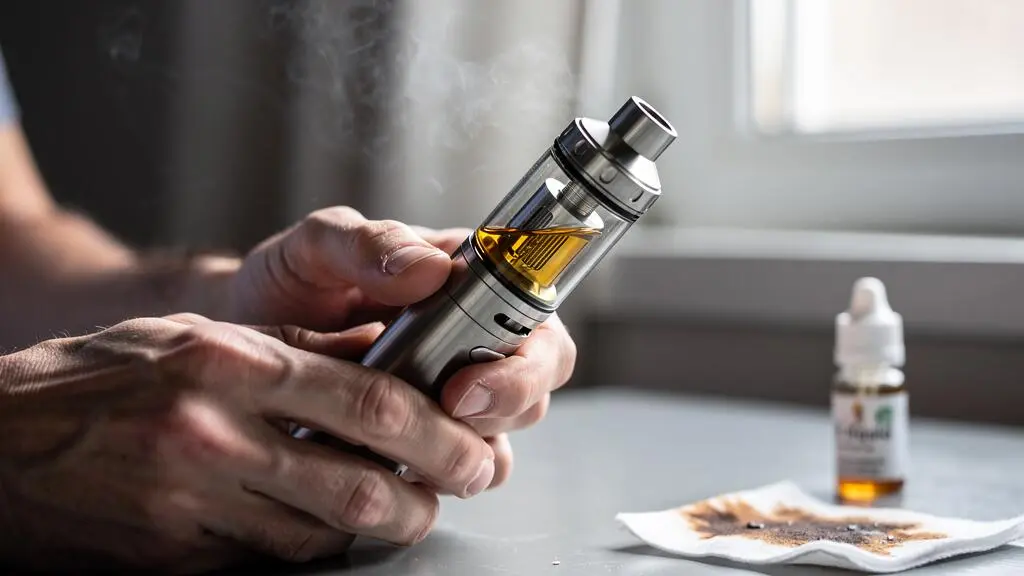
A degraded vape coil usually reveals itself through changes in flavour, vapour production or the consistency of each draw. E-liquid that previously tasted distinct may become muted, harsh or burnt. Vapour output can decline even when the battery is charged, while dark deposits may become visible around the coil’s wicking openings.
However, poor flavour does not automatically mean the coil needs replacing. Insufficient liquid saturation, excessive wattage, restricted airflow and battery problems can produce overlapping symptoms. A relatively new coil may deliver a dry hit because the cotton cannot replenish liquid quickly enough, whereas an older coil may struggle even under normal operating conditions.
The most useful approach is to compare how the problem develops, whether it improves after the device rests and what happens when other potential causes are eliminated. Persistent burning, visible scorching or electrical faults warrant stopping use rather than repeatedly testing the same coil.
Vape coil degradation: the essential signs
- Flavour deterioration: Gradually muted taste, persistent burnt notes or visible deposits can indicate a worn coil.
- Performance changes: Reduced vapour or inconsistent draws may reflect coil wear, but battery charge, airflow and liquid delivery should also be checked.
- Replacement decisions: A persistently burnt wick, visible charring, damaged seals or unresolved resistance faults are reasons to stop using the affected coil.
- Why Does a Worn Vape Coil Start Producing Muted or Burnt Flavour?
- How Do You Confirm a Coil Is Degraded Rather Than Simply Under-Saturated?
- Worn Coil or Weak Battery: Which Is Causing Poor Vape Performance?
- When Is a Degraded Coil Too Far Gone to Keep Using?
- When Do Early Signs of Coil Degradation Usually Become Noticeable?
- New Coil or Tank Cleaning: Which Should You Try First for Poor Flavour?
- How Do You Fix Repeated Dry Hits Without Immediately Replacing the Coil?
- How Do You Prime a Vape Coil Properly Before First Use?
Why Does a Worn Vape Coil Start Producing Muted or Burnt Flavour?
A worn vape coil develops muted or burnt flavour because deposits accumulate on its heating surface and the surrounding wick may deteriorate under repeated heating. These changes interfere with liquid delivery and heat transfer. Flavour can become progressively less distinct, while insufficient saturation may create localised overheating and an unpleasant burnt or ashy taste.
Most replaceable coils contain a metal heating element surrounded by absorbent material, commonly cotton. During normal operation, liquid moves through the wick towards the heated surface. Evaporation removes heat, helping to prevent excessive temperatures.
As a coil ages, deposits from e-liquid ingredients can accumulate on the heating element. Sweetened formulations may leave particularly noticeable residue. This buildup can interfere with heat transfer and contribute to uneven heating, so some flavour components may become less perceptible before the device stops producing vapour.
When liquid delivery becomes inadequate, exposed areas of the wick may overheat. An experimental study on dry hitting and cotton-wick degradation, published in Toxicology in 2024, observed greater cotton deterioration under dry-hit conditions than with a saturated wick. The experiment also identified chemical differences in the resulting aerosols and greater cytotoxicity in its laboratory cell model. These findings concern the tested conditions, not every naturally ageing commercial coil.
The timing and character of the flavour change can help narrow down the cause:
- Gradual flavour dulling: Increasing residue or deteriorating wick performance is plausible, particularly when the same e-liquid previously tasted stronger.
- Sudden burnt taste: A localised dry spot may have overheated because liquid delivery could not keep up with demand.
- Metallic or papery taste from first use: Inadequate priming is one possibility, but manufacturing residue, contamination or a defective component should also be considered.
A burnt note may briefly disappear after the tank rests. During that pause, liquid can move back into a previously dry section of cotton, improving cooling. This temporary recovery suggests a liquid-delivery problem, but does not by itself prove permanent coil damage or establish that the coil has recovered.
Visible darkening is another clue, although deposits alone do not establish that cotton has become carbonised. The stronger warning is a burnt flavour that persists despite adequate saturation and appropriate operating settings.
Because a dry wick can taste almost identical to a damaged one, confirming liquid saturation is the next step before deciding whether replacement is necessary.
How Do You Confirm a Coil Is Degraded Rather Than Simply Under-Saturated?
To distinguish coil degradation from temporary under-saturation, stop using the device, check the liquid level and allow the wick to absorb e-liquid fully. If the flavour recovers consistently under suitable settings, inadequate wicking is a possible explanation. If burning persists or rapidly returns despite adequate saturation, the coil may be damaged and should be replaced.
The distinction matters because a dry hit describes an operating condition, not necessarily the permanent state of the coil. Cotton can temporarily contain too little liquid without being irreversibly damaged. However, overheating may also deteriorate the wick, and a successful short recovery cannot reliably exclude that damage.
For a coil without visible scorching or persistent burning, begin with a basic saturation check:
- Stop activating the device and allow the heating assembly to cool.
- Check that the tank contains sufficient compatible e-liquid and that the wicking openings are submerged where the design requires it.
- Allow time for liquid to penetrate the cotton. Follow the manufacturer’s priming procedure for the specific coil.
- If the manufacturer permits it, take a few gentle draws without activating the heating element.
- Only if there are no signs of scorching or electrical faults, assess operation at the low end of the coil’s recommended power range. Stop immediately if burning returns.
Some devices allow the cotton condition to be inspected through the coil’s liquid openings. Pale cotton does not guarantee that the heating element is clean, while darker cotton may reflect staining rather than confirmed charring. Crumbling, visibly scorched or severely discoloured material is a stronger reason to replace the coil.
Liquid behaviour offers supplementary clues. Intermittent dryness can indicate restricted wicking, while gurgling or spit-back generally suggests excess liquid in the heating chamber. Neither symptom, however, provides a definitive test of cotton condition. A coil that consumes less liquid than expected might be operating at reduced power rather than suffering permanent degradation.
Where the device displays resistance, compare its reading with the coil’s marked ohm rating and the manufacturer’s permitted tolerance. A substantial or unstable deviation, especially alongside an atomiser error, may indicate a connection or electrical problem. Resistance is affected by several factors and cannot independently diagnose wick degradation.
Five checks to isolate the cause of poor coil performance
- Check the liquid supply: Confirm that the tank contains enough suitable e-liquid and record whether the wicking openings are adequately covered.
- Inspect the coil: Check accessible wick openings for scorching or damage and note whether either is visible.
- Check the settings: Compare the selected wattage with the coil’s printed range and record any mismatch.
- Assess saturation: Follow the manufacturer’s soaking guidance and note whether the initial dryness disappears, without continuing to use a persistently burnt coil.
- Check electrical status: Record any resistance warning or unstable reading and compare it with the equipment specifications.
If liquid supply and wick condition appear satisfactory but vapour output remains poor, the battery and power-delivery system become the next components to investigate.
Worn Coil or Weak Battery: Which Is Causing Poor Vape Performance?
A worn coil and a weak battery can both reduce vapour output, but they affect different parts of the device. Coil degradation primarily interferes with heating and liquid delivery, whereas inadequate battery output restricts the electrical power available to the heating element. Checking charge status, electrical warnings and coil condition helps distinguish the causes.
Battery behaviour depends on the device. A regulated vape may compensate for falling battery voltage until it reaches its operational limit, then display a low-battery warning or prevent activation. In other devices, reduced battery voltage can produce a more obvious decline in heating performance.
Coil wear may instead produce persistent flavour deterioration, uneven vapour generation or repeated dryness despite sufficient charge. However, the shape of a puff is not conclusive: a weak battery does not always cause slow heating, and a worn coil does not necessarily begin every puff at full output.
The following comparison identifies useful diagnostic patterns rather than absolute rules.
| Diagnostic clue | Possible coil problem | Possible battery problem |
|---|---|---|
| Flavour | Muted, harsh or persistently burnt | Often unchanged in character but weaker when heating is reduced |
| Vapour production | Can become thin or inconsistent | May decline as available power becomes insufficient |
| Device messages | Atomiser or resistance warning may appear | Low-charge or power-delivery warning may appear |
| Response to charging | Existing coil deposits remain | Performance may recover if charge was the limiting factor |
| Response to a compatible known-good coil | Improvement supports a coil-related cause | Persistent poor output suggests checking other components |
A useful diagnostic sequence is to fully charge the device using the manufacturer’s recommended equipment, check the operating settings and inspect the electrical contacts for visible contamination. Only clean accessible components as instructed by the manufacturer, with the device switched off.
If the device accepts user-replaceable coils, fitting a known-good, correctly specified replacement can help isolate the problem. The replacement must match the tank and the manufacturer’s electrical requirements.
Testing components across different devices is appropriate only where the manufacturer explicitly confirms compatibility. Do not interchange batteries or atomisers simply because their connections appear similar. A damaged, overheating or swollen battery must not be used for diagnostic testing.
High-VG or heavily sweetened liquids add uncertainty. A viscous liquid may replenish the wick slowly, especially during frequent use, while accumulated residue can change coil performance. If output improves after cooling, this suggests a temperature- or wicking-related factor but does not definitively identify which component is responsible.
When electrical delivery is normal and the coil still produces persistent burning, the decision shifts from identifying the cause to deciding whether continued operation is appropriate.
When Is a Degraded Coil Too Far Gone to Keep Using?
A degraded coil should no longer be used when its wick is visibly scorched, burnt flavour persists despite adequate saturation, or the assembly has damaged seals or unresolved electrical faults. These conditions indicate that normal performance cannot be reliably restored through priming or simple maintenance. Replacement is preferable to repeated operation of a failing component.
The clearest visual warning is scorched or charred cotton. Re-wetting damaged material cannot reverse its physical deterioration. Likewise, persistent acrid flavour after checking liquid supply and power settings is a practical reason to stop using the coil, even if the exact internal damage cannot be confirmed.
Electrical faults require particular care. A resistance reading that fluctuates unexpectedly, falls outside manufacturer specifications or triggers an atomiser warning can reflect damaged connections, an incorrectly installed coil or another electrical defect. The correct response is to stop activation and inspect the equipment according to its instructions, not to assume that changing wattage will resolve the fault.
Leaking also requires diagnosis. Liquid escaping through a damaged seal, cracked tank or improperly seated component may reach the airflow system or electrical contacts. Replacing the coil alone will not repair a damaged tank or battery housing.
The 2024 Toxicology experiment described earlier found that dry-hit conditions increased cotton-wick deterioration and produced aerosol with greater cytotoxicity in the tested lung-cell model. It does not quantify the health effects of continued use in people, but provides a scientific reason not to ignore repeated dry hits.
The economic decision is usually straightforward, although it depends on the device and consumable costs.
| Observed condition | Reasonable next step | Cost or maintenance implication |
|---|---|---|
| Temporary dryness without burnt flavour | Check saturation, liquid compatibility and settings | May avoid unnecessary replacement |
| Gradual flavour reduction without damage | Inspect the tank and coil for deposits | Cleaning reusable parts may remove residual flavours |
| Persistent burnt flavour or scorched wick | Replace the coil | Prevents further use of an unsuitable consumable |
| Damaged seals or electrical warnings | Stop using the affected assembly and inspect the fault | May require repair or replacement beyond the coil |
Attempting to extend the life of a badly degraded coil can also waste e-liquid without restoring acceptable performance. Residue remaining in the tank may affect a newly installed coil, making cleaning appropriate during replacement.
Never attempt to revive a disposable cotton-wick coil by dry-firing it or exposing it to excessive heat. These methods can damage the wick and are not equivalent to manufacturer-approved maintenance of rebuildable equipment.
For coils that have not yet reached these limits, recognising gradual changes early is more useful than waiting for a severe burnt hit.
When Do Early Signs of Coil Degradation Usually Become Noticeable?
Early coil degradation can become noticeable after repeated use, but there is no reliable universal number of days before symptoms appear. Wear depends on power settings, e-liquid composition, puff frequency, liquid viscosity and coil construction. The most useful indicator is a consistent change from the coil’s original performance under comparable conditions.
A coil used frequently with a heavily sweetened liquid may accumulate deposits sooner than one operated less often with a simpler formulation. High power can increase thermal demands, particularly when the wick cannot deliver liquid quickly enough. Long or closely spaced puffs reduce the opportunity for liquid redistribution and cooling.
A scientific review of e-cigarette chemistry and wicking efficiency published in Annual Review of Analytical Chemistry discusses the roles of liquid viscosity, heat transfer, coil condition and cooling intervals in overheating and thermal degradation. These relationships explain why two apparently similar coils can perform differently.
Some changes may appear progressively:
- Flavour loses definition: Distinctive notes become less noticeable despite using the same e-liquid and settings.
- Residue becomes visible: Deposits may develop around accessible portions of the heating assembly or wicking openings.
- Performance becomes inconsistent: Longer draws or repeated use may produce less satisfactory vapour or intermittent harshness.
- Dry hits become more frequent: Liquid delivery may no longer keep pace with the operating conditions.
- Persistent burnt flavour develops: The coil may have reached a point where replacement is necessary.
This is a possible progression, not a validated universal sequence. Some coils produce a burnt taste without preceding visible residue, and other coils show deposits while remaining functional. Vapour becoming visibly darker is not an established general indicator of normal coil ageing.
Darkening of the e-liquid near the coil can sometimes accompany residue accumulation or liquid contamination, but it is not proof of permanent wick damage. Liquid colour can also depend on formulation and storage conditions.
A simple personal usage record provides more useful context than a fixed replacement calendar. Note the installation date, e-liquid formulation, typical power setting and first noticeable performance change. Comparing several replacement cycles may help identify patterns specific to the equipment.
Symptoms should still take priority over elapsed time. A recently installed coil showing persistent burning deserves inspection immediately, while an older coil without operational problems should be assessed according to its actual condition and manufacturer guidance.
When the first warning is poor flavour rather than a dry hit, examining the tank itself can prevent an unnecessary or incomplete repair.
New Coil or Tank Cleaning: Which Should You Try First for Poor Flavour?
Clean the reusable tank components first when lingering e-liquid residue or flavour contamination is the likely problem and the coil shows no signs of damage. Replace the coil when its wick is scorched or burnt flavour persists despite adequate saturation. If both components contain significant residue, cleaning the tank during coil replacement is the more complete solution.
A refillable tank contains several surfaces that can retain liquid and deposits, including the glass reservoir, chimney, drip tip and accessible airflow passages. Changing the coil does not automatically remove residual liquid from these areas.
For example, switching between substantially different flavours without cleaning the tank can produce an unwanted mixture, even when the new coil is functioning normally. Conversely, washing a tank will not reverse deterioration inside a sealed, disposable cotton-wick coil.
Symptom history helps guide the first intervention. Gradual flavour loss accompanied by visible tank residue justifies inspecting both the tank and the coil. A sudden burnt hit may instead indicate temporary dryness or overheating; if burning persists, coil replacement takes priority. A heavily used coil with obvious charring should not be reused simply because the tank has been cleaned.
Innokin’s official atomizer-cleaning instructions recommend disassembling the atomiser, rinsing the washable components while excluding the coil, allowing the parts to dry and priming a newly installed coil.
For a compatible user-serviceable tank, the basic cleaning sequence is:
- Switch off the device and remove the tank according to its instructions.
- Disassemble the tank, removing the disposable coil before washing.
- Rinse only manufacturer-approved washable components with water, using a suitable temperature for their materials.
- Allow the components to dry fully, including airflow passages and accessible connection areas.
- Inspect O-rings, seals and accessible contact surfaces for trapped residue or damage before reassembly.
Do not immerse the battery, electronic controls or other non-waterproof components. Avoid exposing a disposable cotton-wick coil to a hot-water cleaning procedure unless its manufacturer specifically permits it.
When the tank is dry, install a suitable coil, fill with compatible e-liquid and follow the required priming procedure. Cleaning is especially worthwhile when replacing a coil after significant residue buildup or changing to a very different flavour.
Some contamination may remain in inaccessible components. If flavour problems persist with a clean tank and correctly installed replacement coil, inspect the e-liquid itself and check the device for faults before assuming that another replacement will solve the issue.
Where the tank is clean and the coil is not visibly damaged, repeated dry hits may instead point to an operating condition that can be corrected without immediately replacing the consumable.
How Do You Fix Repeated Dry Hits Without Immediately Replacing the Coil?
Repeated dry hits may be reduced by correcting the conditions that prevent e-liquid from reaching the heating element. Common causes include closely spaced puffs, excessive power, viscous liquid, low tank levels or obstructed wicking openings. Stop using the device when burning occurs; if the wick has been scorched or burnt flavour persists, replacement is the appropriate response.
Liquid delivery must keep pace with heating. When a puff removes liquid faster than the wick replenishes it, part of the heating element may become insufficiently cooled. Repeating that condition can damage the cotton.
The appropriate correction depends on the underlying cause:
| Potential cause | What happens | Corrective check |
|---|---|---|
| Very frequent puffs | Insufficient time for the wick to replenish liquid | Allow longer pauses between activations |
| Excessive wattage | Heating demand exceeds effective liquid delivery | Check the manufacturer’s recommended power range |
| Viscous high-VG liquid | Liquid may move more slowly through some wicks | Check whether the coil supports the liquid formulation |
| Low tank level | Wicking openings may become insufficiently supplied | Maintain the required fill level |
| Incorrect coil installation | Liquid ports may be obstructed or poorly positioned | Inspect and reseat the cooled coil as instructed |
| Restricted airflow | Operating temperature and draw behaviour may change | Check accessible airflow passages for obstruction |
A tank does not universally require more than one-quarter of its capacity to avoid dry hits. The relevant threshold depends on the position of the liquid inlets and the tank’s design. The essential requirement is to keep the wick supplied according to the manufacturer’s instructions.
For a coil that has become temporarily dry but shows no evidence of scorching, stop activation, restore the appropriate liquid level and allow sufficient time for saturation. Check the operating settings before considering further use. Some manufacturers permit gentle unpowered primer draws to help distribute liquid.
Do not deliberately heat an empty or visibly dry coil to test whether it has recovered. If harsh burning continues after the supply problem has been corrected, further operation is not a suitable rescue method.
Cold conditions and high liquid viscosity can also impair wicking in some designs. Use e-liquid compatible with the coil rather than heating a liquid bottle with an external heat source or attempting improvised thinning methods.
Airflow restrictions should be addressed only through routine manufacturer-approved cleaning. Modified airflow, incompatible parts and excessive power adjustments can introduce additional problems rather than correcting the original fault.
Most importantly, repeated dry hits are not harmless merely because the coil still produces vapour. They indicate inadequate cooling at the heating surface and deserve attention before further use.
If the device needs a new coil, proper first-use saturation is important to avoid reproducing the same problem immediately after installation.
Key takeaways before installing a replacement coil
- A fresh coil can produce a dry hit if its wick has not absorbed enough compatible e-liquid.
- Initial liquid saturation and suitable power settings both matter; neither compensates for a defective or damaged component.
- Priming instructions differ by coil design, so the manufacturer’s procedure takes precedence over a universal waiting time.
How Do You Prime a Vape Coil Properly Before First Use?
Prime a new vape coil by ensuring that its wicking material is adequately saturated with compatible e-liquid before activating the heating element. Depending on the manufacturer’s design, this may involve applying drops to accessible cotton, filling the tank and allowing a specified soaking period. Initial operation should follow the coil’s recommended power settings.
Priming is particularly important for cotton-based replaceable coils. Dry cotton cannot supply the cooling effect of evaporating liquid, so applying heat before adequate saturation may produce an immediate burnt taste and damage the wick.
The exact procedure depends on whether the device uses an exposed replaceable coil, a sealed pod or another atomiser construction. Do not dismantle a sealed component or apply liquid to openings that the manufacturer does not identify as suitable for priming.
For a conventional refillable tank with a compatible replaceable cotton-wick coil, the process generally involves these steps:
- Inspect the replacement: Confirm that the coil matches the tank, has intact seals and is free from visible damage.
- Moisten exposed cotton where permitted: Apply a small amount of compatible e-liquid directly to accessible wicking ports, following the coil manufacturer’s instructions.
- Assemble and fill: Install the coil correctly and fill the tank without exceeding its marked maximum level.
- Allow complete saturation: Leave the filled assembly to stand for the manufacturer’s recommended period. If advised, take gentle draws without activating the heating element.
- Check initial settings: Begin at an appropriate low setting within the coil’s stated operating range, where the device and manufacturer allow adjustment.
SMOK‘s official troubleshooting guidance for burnt flavour identifies insufficient priming, unsuitable settings, frequent puffing and defective coils as possible causes. It recommends unpowered draws or allowing the tank to stand for approximately 15 minutes, followed by low-power initial operation. This waiting period is specific guidance rather than a universal rule for every coil.
Likewise, Innokin’s maintenance instructions describe a 10-minute wait for a newly installed coil. The difference illustrates why a single priming duration should not be applied automatically to all products.
Thicker high-VG e-liquids may take longer to penetrate some wicking materials. Dense cotton and coil construction also affect saturation. Visible liquid at accessible ports can provide reassurance, but the outside of a wick appearing wet does not guarantee that every internal section has absorbed enough liquid.
Two first-use problems are particularly important to distinguish:
- Under-priming: An immediate burnt or unusually harsh taste may indicate insufficient saturation. Stop activation rather than repeatedly testing an already burnt-tasting coil.
- Over-priming or flooding: Excess liquid entering the heating chamber can produce gurgling, spit-back or leakage. Check fill levels, seals and the manufacturer’s instructions for clearing excess liquid.
An immediate metallic or papery taste should not automatically be attributed to under-priming. Contamination, manufacturing defects or incompatible components may also cause unusual flavour. If the source cannot be identified safely, stop using the affected assembly.
Priming is a preventive maintenance step, not a means of repairing carbonised cotton. A replacement that continues to taste burnt despite correct preparation may be defective or affected by another device fault.
For the next replacement, follow the specific manufacturer’s priming instructions, confirm compatibility and check the tank’s cleanliness. If burning persists after correct preparation, stop using the affected coil and investigate the device rather than attempting to force further operation.
Can a vape coil be damaged even if the cotton still looks white?
Yes. Visible cotton colour is only one indicator. Deposits may be present on concealed heating surfaces, and damage may occur in portions of the wick that cannot be inspected through the liquid openings. Persistent burning or electrical warnings should not be dismissed because accessible cotton appears clean.
Does a change in coil resistance always mean the coil is worn out?
No. Resistance readings can vary with temperature, connections and measurement behaviour. A substantial or unstable deviation from manufacturer specifications deserves investigation, but it does not necessarily identify normal coil ageing. Stop using equipment that displays unresolved atomiser or electrical faults.
Can changing e-liquid make a healthy vape coil seem degraded?
Yes. Different formulations have different flavour profiles, viscosities and residue-forming characteristics. A liquid that is unsuitable for the coil’s wicking system may contribute to dry hits, while remaining flavours from an earlier liquid can affect taste. Check compatibility and tank cleanliness before diagnosing wear.
Is dark e-liquid inside the tank proof that the coil needs replacing?
No. Darkening can occur for several reasons, including the liquid’s formulation, storage conditions and contamination from deposits. It should be considered alongside flavour, wick condition and device operation. Unexpected discoloration accompanied by burning or visible damage warrants stopping use and inspecting the affected components.
Should a replacement coil be stored dry or pre-soaked in e-liquid?
Unused replacement coils should be stored according to their manufacturer’s packaging and storage instructions. Priming is normally performed as part of installation rather than by storing spare coils immersed in liquid. Keep components protected from contamination, damage and unsuitable storage conditions.