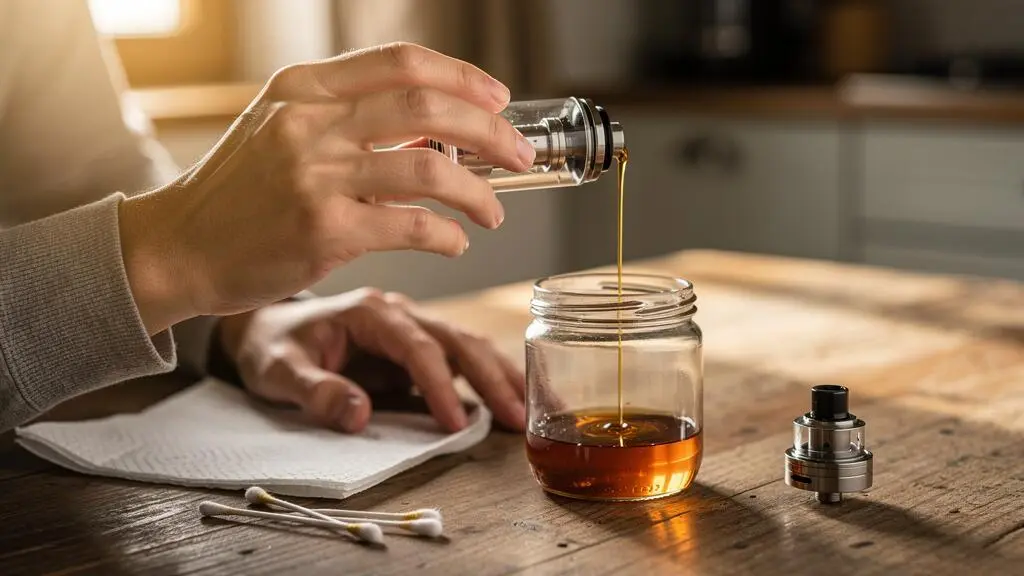
Residual e-liquid is the small amount of vape liquid left inside a tank or pod when you finish a session, change flavours or prepare to clean your device. It might look insignificant, but what you do with it affects the taste of your next refill, the condition of your coil and the likelihood of leaks.
You do not need to empty every tank before every refill. If the remaining liquid is in good condition and you are continuing with the same flavour, topping up is usually reasonable. Changing to a contrasting flavour, dealing with a burnt coil or putting equipment away for an extended period calls for a different approach.
The safest practical routine is to assess the liquid, switch off the device, drain it when necessary and clean only the components intended to be washed. Used liquid should not automatically be returned to a fresh bottle, particularly when it contains nicotine.
For adult UK vapers using refillable tanks and compatible pods, the following guidance separates routine maintenance from situations where a thorough clean or replacement coil makes more sense.
Leftover vape liquid: the essential decisions
- Top up when the remaining liquid appears normal, the coil is working properly and the new flavour is the same or compatible.
- Empty and clean before substantially different flavours, after contamination or ahead of extended storage.
- Replace the coil when burnt, degraded or persistent flavour contamination remains after the washable tank components have been cleaned.
- Why Does Residual E-Liquid Change the Taste of a Fresh Refill?
- How Do You Empty Residual E-Liquid From a Tank Without Making a Mess?
- Top Up or Empty First: Which Is Better Before Changing E-Liquid Flavour?
- When Should Leftover E-Liquid From a Tank Be Discarded Instead of Reused?
- When Should You Empty a Vape Tank Before Storing the Device?
- Quick Rinse or Deep Clean: Which Does Your Vape Tank Actually Need?
- How Do You Remove Flavor Ghosting Before Switching to a Very Different E-Liquid?
- When Should You Replace a Vape Coil Instead of Continuing to Use It?
Why Does Residual E-Liquid Change the Taste of a Fresh Refill?
Residual e-liquid changes the taste of a fresh refill because old liquid remains inside the coil’s absorbent wick, around the heating element and on internal tank surfaces. When new liquid enters, the flavours mix. Even a nearly empty tank can therefore produce a noticeable overlap, particularly when switching between strongly contrasting flavours.
The visible liquid at the bottom of the tank is only part of the problem. A cotton wick remains saturated after the reservoir has been drained, while small amounts of liquid may also collect around the chimney, airflow channels and other internal surfaces.
There are three different causes of unwanted flavour, and identifying the correct one prevents unnecessary cleaning.
- Liquid mixing: Two flavours blend in the remaining reservoir. Emptying the tank can significantly reduce this overlap.
- Wick saturation: The old liquid remains absorbed inside the coil. Emptying the reservoir alone does not remove it.
- Coil deposits: Residue accumulates around the heating element during use, especially with certain sweetened liquids. A deteriorating coil can introduce bitter, muted or burnt notes independently of the liquid in the reservoir.
Consider a hypothetical switch from strawberry to raspberry. A slight overlap may be acceptable, and the old flavour can become less noticeable as fresh liquid replaces it. Switching from a concentrated menthol flavour to vanilla custard creates a more obvious contrast because the previous flavour may remain perceptible in the wick.
A useful severity check is to distinguish ordinary blending from an abnormal taste. A mild flavour overlap that gradually fades is different from persistent bitterness, metallic notes or a distinctly burnt taste. The latter symptoms deserve a coil inspection rather than repeated topping up.
Innokin’s device maintenance FAQ recommends clearing the atomiser before changing flavours and identifies deteriorating flavour or a burnt taste as possible reasons to replace a coil. These are manufacturer maintenance recommendations, not experimental measurements of how many refills are needed to eliminate an old flavour.
The important distinction is between liquid that can be poured away and flavour contamination that remains trapped inside the coil. Once that distinction is clear, emptying the tank becomes a straightforward maintenance task rather than a guessing exercise.
How Do You Empty Residual E-Liquid From a Tank Without Making a Mess?
To empty residual e-liquid cleanly, switch off the device, detach the tank if the design allows, open it according to the manufacturer’s instructions and carefully drain the remaining liquid into a suitable container. Catch the final drops with absorbent material, wipe the threads and keep nicotine-containing liquid away from skin, children and pets.
Different tank designs require different handling. A conventional removable tank may allow access through its base, while a top-fill tank may be easier to drain through its filling opening after removing it from the device. An airflow opening should only be used as a drainage route if the specific design permits it and the liquid can be controlled without wetting electrical contacts.
Never force a sealed pod apart. If a pod is not designed to be emptied or disassembled, follow its manufacturer instructions rather than attempting to prise it open.
For refillable equipment with an accessible reservoir, use this sequence:
- Turn off or lock the device and remove the tank where possible.
- Place a protective paper towel on a stable work surface and prepare a suitable, clearly identified container that can be closed securely.
- Open the intended fill or disassembly point, keeping the device’s electrical connections away from the draining liquid.
- Tilt the tank slowly and direct the liquid into the container without shaking or squeezing the reservoir.
- Use a clean cotton bud or lint-free absorbent material to remove remaining droplets from accessible threads and edges.
- Inspect the tank exterior, seals and connector before proceeding with cleaning or refilling.
When only a few drops remain, pouring may no longer be practical. With the device switched off and the tank removed where possible, gently drawing through the mouthpiece without activating the coil can sometimes move small amounts of trapped liquid towards the airflow area. Use an absorbent tissue to catch accessible droplets, but stop if liquid reaches the mouthpiece or the design does not allow this safely. The purpose is to clear accessible liquid, not to inhale it or completely dry the wick.
Never fire the device to burn off the remaining liquid. Activating a nearly dry cotton-wicked coil can scorch the wick and create a persistent burnt taste that requires coil replacement. Dry-burning methods intended for certain rebuildable metal coils must not be confused with firing ordinary replaceable cotton-wicked heads.
Nicotine-containing liquid also requires careful handling. The National Capital Poison Center warns that accidental ingestion can cause poisoning, particularly in children. Its e-cigarette safety advice recommends retaining nicotine products in their original containers and securing them away from children and pets. Do not store recovered liquid in food or drink containers, or pour it into drains. Follow applicable local disposal guidance for nicotine-containing waste.
Five checks before refilling an emptied vape tank
- Power down: Confirm that the device is switched off or locked before opening the tank.
- Drain safely: Confirm that collected liquid is contained securely and cannot spill onto the work surface.
- Clear the edges: Check that accessible threads, filling openings and exterior surfaces have no visible droplets.
- Inspect the hardware: Confirm that seals are seated correctly and electrical contacts are clean and dry.
- Choose the next step: Identify whether the tank is ready for a compatible refill, needs cleaning or requires a replacement coil.
Once the remaining liquid has been contained and the tank exterior is dry, the next decision is whether a new flavour can be added directly or whether the equipment needs a more complete reset.
Top Up or Empty First: Which Is Better Before Changing E-Liquid Flavour?
Topping up is generally reasonable when only a little liquid remains, both flavours are similar and the existing coil is performing normally. Emptying first is preferable when a substantial quantity remains or when the new flavour contrasts strongly with the old one. Neither approach can fully remove flavour already absorbed into the wick.
Three variables determine how noticeable the transition is likely to be: the quantity of residual liquid, the similarity between the flavours and the strength of the flavour being replaced.
The following comparison is a practical decision aid rather than a scientifically tested compatibility scale.
| Situation | Recommended approach | Reason |
|---|---|---|
| Small remainder, same flavour | Top up | There is no intended change in flavour profile, provided the liquid and coil remain in good condition. |
| Small remainder, similar fruit flavours | Top up if a blended taste is acceptable | A temporary overlap may be less noticeable. |
| Large remainder, different flavour | Empty first | The old liquid would form a substantial part of the new mixture. |
| Strong menthol to dessert flavour | Empty and clean; consider a new coil | Strong flavour residue can remain in the wick and other components. |
| Any flavour change with burnt or degraded taste | Inspect and replace the coil if necessary | Fresh liquid cannot repair a damaged wick or remove established coil deposits. |
For example, imagine a tank containing a small remainder of peach liquid. Refilling it with another mild fruit flavour may produce an acceptable blend. The same remainder could be much more disruptive when switching to a tobacco-style or rich dessert flavour, depending on personal taste sensitivity.
The hidden cost of topping up across contrasting categories is that the transition may take longer than expected. As the new liquid reaches the coil, the wick can continue releasing the old flavour. Adding more liquid may reduce the relative contribution of the old reservoir contents without eliminating flavour retained inside the coil.
There is also a legitimate preference-based exception. Some adults may find that gradually introducing a related flavour over successive refills makes the change less abrupt. That is a sensory choice, not a cleaning technique or a guaranteed method for eliminating residue.
If an immediate, distinct flavour is the goal, draining the reservoir and addressing the used wick is more reliable than repeatedly diluting the previous liquid. Any drained e-liquid then needs to be assessed before reuse.
When Should Leftover E-Liquid From a Tank Be Discarded Instead of Reused?
Discard leftover e-liquid when it may be contaminated, has been exposed to a burnt or deteriorating coil, shows unexpected changes in appearance or smell, or has an uncertain age or origin. Liquid recovered from a used tank should not be treated as equivalent to fresh, sealed e-liquid, even when it looks normal.
Recovered liquid has already been inside an operating device. It may have experienced repeated heating, air exposure or contact with deposits from the coil. These conditions differ from storage in the original sealed bottle, and visual inspection cannot establish that the liquid’s composition is unchanged.
Discard rather than reuse in the following situations:
- The coil has produced a burnt taste or shows significant deposits.
- The liquid contains visible particles or material from damaged hardware.
- The colour has changed unexpectedly compared with the product’s usual appearance.
- The liquid has separated, developed an unusual smell or shows another unexplained change.
- The remaining liquid has been exposed to an unknown substance or cleaning product.
- The tank has been stored for an uncertain period, or the liquid is older than the manufacturer’s recommended usable period.
Discolouration alone does not identify a specific chemical problem, and the absence of visible changes does not prove that a liquid is suitable for reuse. These signs are practical reasons for caution rather than validated chemical safety tests.
A 2025 ACS Omega study on e-liquid flavouring stability investigated 20 flavouring chemicals and 14 commercial e-liquids over a storage observation period of up to 24 months. Some flavouring chemicals changed during storage, and tested reference formulations exposed to ambient temperatures and light showed lower flavour stability than those held in more protective conditions. The study did not investigate liquid drained from used vape tanks and does not establish a safe reuse period for it.
For expensive or high-nicotine liquid, the temptation to recover every drop is understandable. A sensible assessment begins with provenance: was the liquid recently added from a known bottle, was the tank clean and working correctly, and was there any reason to suspect contamination?
Even when those conditions are favourable, reuse remains a compromise. If someone chooses to reuse recently drained liquid, keeping it within the same compatible setup and avoiding transfer into a fresh supply bottle limits additional mixing and handling. It does not guarantee chemical quality or safety. Where there is uncertainty, disposal is the more cautious option.
Do not pour unwanted nicotine-containing e-liquid into a sink, toilet or outdoor drain. Keep it contained, protected from accidental contact and away from children and animals while following local waste-disposal instructions.
When the tank is not going to be used immediately, the question changes from whether the liquid can be reused to whether it should remain inside the equipment during storage.
When Should You Empty a Vape Tank Before Storing the Device?
Empty a vape tank before extended storage, particularly when the device will remain unused for weeks or months. For a short break of a few days, leaving a properly functioning tank filled may be acceptable if the manufacturer permits it. Store the device upright, away from heat and protected from accidental activation.
Vape tanks are designed to retain liquid during normal use, but they are not necessarily intended to function as long-term storage containers. Liquid remains in contact with the wick, seals and internal surfaces while the device sits unused.
Temperature changes, pressure differences, component wear and the design of the airflow system can contribute to leakage. Liquid that reaches an electrical contact or collects inside a storage case creates an additional maintenance problem.
Menthol and other strongly flavoured liquids may also leave persistent flavour traces in absorbent components. However, there is no universal evidence-based rule establishing that every menthol formulation leaks more readily than other liquids.
A practical storage decision depends on the anticipated break:
- A few days: A filled, leak-free tank may be left upright if this is compatible with the manufacturer’s instructions.
- Several weeks: Draining the tank and cleaning accessible components is a more cautious approach.
- Several months: Empty and clean the tank, remove the replaceable coil where appropriate, dry all washable parts and store the equipment according to its manual.
These intervals are maintenance examples, not experimentally established storage thresholds. Some devices and pod systems have different storage requirements.
For a longer break, start by switching off the device. Drain the reservoir using its intended opening, absorb remaining accessible droplets and remove the coil if the design allows. A small amount of liquid will normally remain in the wick; never activate the coil to force it dry.
Clean and fully air-dry the washable components. Keep the parts organised, protect the seals from damage and avoid overtightening threaded assemblies during storage. Any removable battery should be handled according to the manufacturer’s specific storage and safety guidance.
On returning to the device, inspect the seals, airflow passages, electrical contacts and coil. A coil left unused is not automatically ruined, but a deteriorated or contaminated wick should be replaced rather than put back into service.
Before reassembly, the remaining maintenance question is how thoroughly the tank needs to be cleaned. Not every flavour switch or period of inactivity requires the same level of washing.
Quick Rinse or Deep Clean: Which Does Your Vape Tank Actually Need?
A quick warm-water rinse is usually sufficient for accessible, washable tank components when changing between similar flavours and there is no significant residue. A more thorough clean is appropriate after strongly flavoured or sweetened liquids, visible buildup, leakage or extended storage. Remove the coil before washing unless its manufacturer explicitly provides another procedure.
The difference is not simply how long the tank spends under a tap. A quick rinse removes accessible surface liquid, while a deep clean exposes the removable parts that may trap residue around seals, airflow openings and threaded connections.
Choose a quick rinse when the tank is in good condition, the flavour change is minor and the washable components have no visible buildup. For this task, detach the tank, remove the replaceable coil where possible, rinse the manufacturer-approved parts with warm water and let them dry completely.
For deeper cleaning, carefully disassemble the tank into the parts the manufacturer identifies as removable. Wash compatible glass and metal components with warm water, using a gentle soak where appropriate. Inspect recesses, the drip tip and removable seals for remaining deposits. Avoid abrasive tools that could damage sealing surfaces.
A small amount of mild washing-up liquid may be suitable for some removable components, provided the manufacturer permits it and all residue is thoroughly rinsed away. Isopropyl alcohol and other solvents should not be treated as universal cleaning products: they may damage plastic, coatings, adhesives or seals. Avoid alcohol on polycarbonate tanks and do not use acidic or aggressive cleaners without explicit material-specific instructions.
Innokin’s published atomiser cleaning procedure supports removing the coil, rinsing the other atomiser components in water, air-drying them and priming a newly installed coil before use. It does not establish that detergent or solvent cleaning is appropriate for every device.
Do not rinse a conventional replaceable cotton-wicked coil in an attempt to restore a neutral flavour. Water trapped in its wick may interfere with subsequent use, and washing does not reliably remove heat-formed deposits. Rebuildable metal coil assemblies require separate, device-specific maintenance procedures.
The completion test is simple: no visible water should remain in washable components, threads or airflow channels before reassembly. Trapped moisture can dilute the next refill or contribute to gurgling, making a cleaning problem resemble a malfunctioning coil.
Coil replacement also offers a useful opportunity to clean the tank. With the old coil already removed, the glass, base and accessible seals can be inspected and washed without disturbing a serviceable wick.
If the cleaned tank still produces the previous flavour, the most likely remaining source is no longer the glass reservoir. Attention should turn to the wick and the smaller components that retain flavour.
How Do You Remove Flavor Ghosting Before Switching to a Very Different E-Liquid?
Remove flavour ghosting by draining the old liquid, washing compatible tank components and replacing the coil when persistent flavour remains in the wick. Strong flavours such as menthol or certain spice-style blends may also linger in the drip tip and seals. Cleaning the glass alone cannot remove liquid absorbed inside a used cotton wick.
Flavour ghosting describes the perception of a previous e-liquid after a new one has been added. It differs from ordinary reservoir mixing because the old taste may persist even after the tank has been emptied.
In conventional replaceable coils, the wick is the principal component to consider. It absorbs liquid by design, so residual flavour can remain until the old liquid has been displaced or the coil is replaced. Some removable polymer components may also retain odours or flavour traces.
The most useful approach is graduated:
- Remove the old reservoir liquid. Drain the tank without allowing liquid to enter the device’s contacts.
- Wash the compatible components. Rinse the tank and removable drip tip, and clean accessible seals as permitted by the manufacturer.
- Assess the existing coil. If the taste remains acceptable and the flavours are relatively similar, continued use may be reasonable.
- Replace the coil for a substantial flavour change. This is generally the most reliable way to avoid liquid retained in a previous cotton wick.
- Prime and assess the new setup. Follow the coil manufacturer’s priming instructions before use, then judge the flavour once the new liquid has reached the wick properly.
Do not dry-burn a conventional cotton-wicked coil to remove ghosting. Firing it without sufficient liquid can char the wick. Drawing through a switched-off device may shift some accessible liquid, but it cannot be relied upon to purge flavour trapped in the cotton.
The first refill after a flavour change should not automatically be discarded as a supposedly necessary sacrificial fill. If a serviceable old coil is being retained, its flavour may change gradually over subsequent use. If a clean, distinct flavour is essential, installing a fresh compatible coil is the more predictable choice.
Drip tips and O-rings deserve attention, particularly after strongly flavoured liquids. Wash components made from compatible materials and inspect seals for odour retention, swelling, cracking or loss of elasticity. Replace damaged seals with suitable manufacturer-compatible parts rather than attempting to restore them with aggressive cleaning agents.
For example, a hypothetical switch from strong peppermint to mild vanilla may leave an unwanted cooling impression even after the reservoir is washed. A replacement coil and clean drip tip remove two common sources of carryover without requiring repeated flushes of the entire tank.
When the same coil continues producing unwanted notes after the tank has been cleaned, keeping it may no longer be worthwhile. The final decision is whether the coil still performs well enough to justify further use.
Key takeaways before deciding on coil replacement
- A clean tank does not guarantee a clean flavour if the previous liquid remains absorbed in the wick.
- Persistent burnt or abnormal taste should prompt a coil inspection rather than another refill.
- A strong flavour change can justify replacing an otherwise functional coil, but minor flavour overlap does not automatically require it.
When Should You Replace a Vape Coil Instead of Continuing to Use It?
Replace a vape coil when it develops a persistent burnt taste, noticeably deteriorating flavour, visible damage or residue that cleaning the tank cannot resolve. Replacement may also be worthwhile when changing between strongly contrasting flavours because the old liquid remains in the wick. A fixed replacement schedule is less useful than assessing actual performance.
Coil life varies with the liquid formulation, device power, frequency of use and the coil’s design. Highly sweetened liquids and repeated operation with insufficient liquid can contribute to deposits or wick damage, but there is no single lifespan that applies to every setup.
The key is to separate a failing coil from a temporary liquid or airflow issue.
| Observed symptom | Possible explanation | Practical response |
|---|---|---|
| Persistent burnt or scorched taste | Damaged wick or established coil deposits | Replace the coil after checking for an unsuitable power setting or insufficient liquid. |
| Muted flavour | Coil wear, flavour adaptation or liquid-related changes | Check the liquid and device settings; replace the coil if deterioration persists. |
| Metallic or unusual taste | Possible hardware or coil problem | Stop using the device until the cause has been inspected and resolved. |
| Gurgling or leaking | Flooding, damaged seals, incorrect assembly or a coil problem | Inspect the tank and seals before assuming the coil must be replaced. |
| Persistent previous flavour | Old liquid retained in the wick | Consider a replacement coil when a clean flavour transition matters. |
| Dark, crusty coil deposits | Accumulated residue from use | Replace a conventional disposable coil head if performance has deteriorated. |
Gurgling alone does not establish that a coil has reached the end of its useful life. It may reflect flooding, excess condensation or an assembly issue. Similarly, a muted flavour may sometimes result from changes in perception rather than hardware deterioration.
By contrast, a persistently burnt cotton wick is unlikely to improve through topping up or washing the outer tank. Continuing to use it can make the next liquid taste unpleasant even when the reservoir is clean.
There is also an economic balance. Replacing a functioning coil after every minor flavour change creates unnecessary waste and expense. Continuing with a noticeably deteriorated coil can undermine the purpose of buying a different liquid or cleaning the tank.
When a new coil is required, confirm that its model and resistance are compatible with the device. Prime it according to the manufacturer, refill the tank and allow sufficient time for the wick to saturate before activation. Avoid exceeding the coil’s recommended operating range.
Replacing a coil does not resolve every problem. Damaged seals, contaminated connectors, unsuitable liquid or a malfunctioning device may require separate attention. Persistent abnormalities should be investigated before using the equipment again.
The practical next step is to inspect the liquid, reservoir and coil together: keep serviceable parts, clean the components designed for washing and replace anything showing persistent contamination or damage. That provides a more consistent result than emptying every tank automatically or continuing to refill a failing coil.
Can you leave a small amount of e-liquid in a tank overnight?
Usually, yes, if the tank is functioning correctly and its manufacturer permits storage while filled. Keep the device upright, switched off and away from heat, children and pets. Check for leaks or unusual liquid changes before using it again.
Can you pour leftover e-liquid back into its original bottle?
It is better not to. Liquid recovered from a used tank may contain residue or contaminants that could affect the fresh supply. Keeping unused e-liquid in its original container also preserves clearer information about the product and its handling history.
Can you use a vape tank immediately after washing it?
Only after the washable parts have dried completely and the tank has been reassembled correctly. If a new coil is installed, prime it and follow the manufacturer’s recommended saturation period before use. Do not activate a wet, improperly assembled or unprimed setup.
What should you do if e-liquid leaks into the device’s connector?
Stop using the device, switch it off and disconnect the tank if safe to do so. Carefully remove accessible external liquid with a dry absorbent material. Do not introduce water into the electrical connector or activate the device while contamination may remain. If liquid has entered the device internally or operation becomes abnormal, consult the manufacturer or a qualified service provider.
Does nicotine strength change how you should handle leftover e-liquid?
All nicotine-containing liquids require precautions against accidental ingestion, skin exposure and access by children or pets. Higher nicotine concentration increases the amount of nicotine present in a given volume, making careful containment particularly important. Do not assume that a small quantity is harmless, and seek appropriate medical or poison-information guidance after suspected exposure.