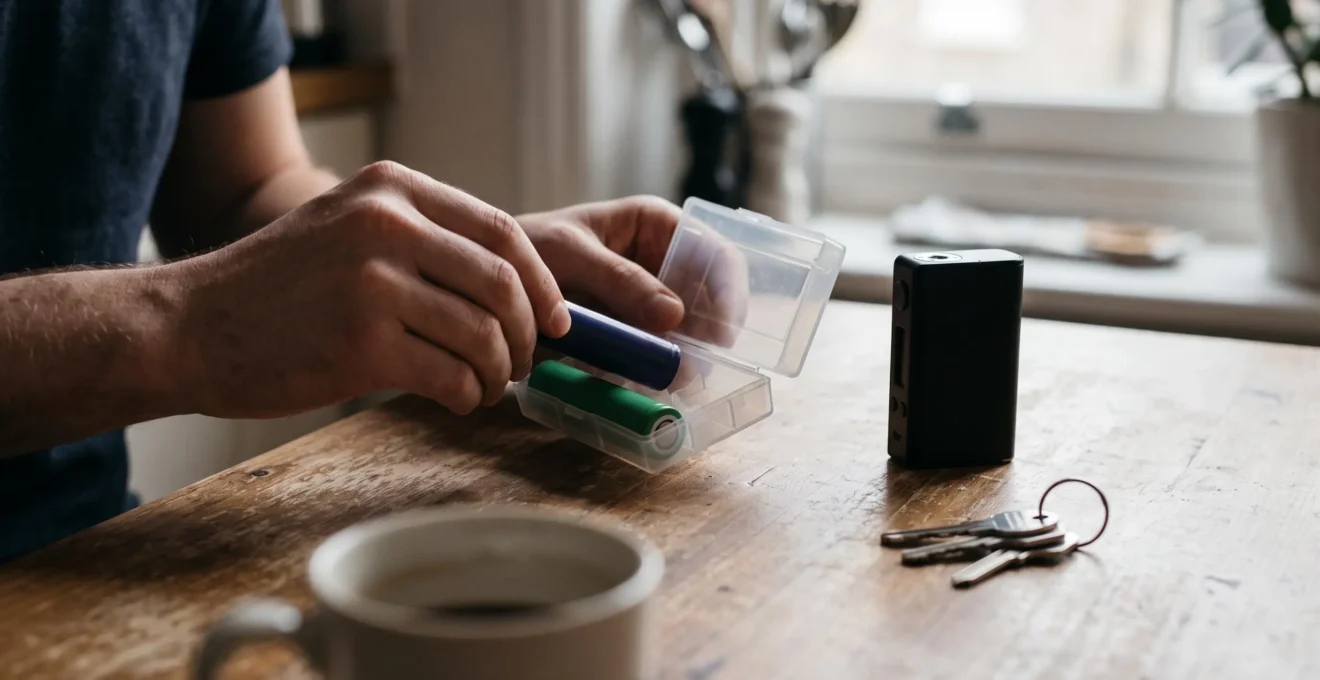
Spare vape batteries should always travel in a dedicated, non-metallic protective case that prevents their terminals from contacting keys, coins, other batteries or conductive surfaces. Whether carrying an additional 18650 or 21700 cell for a long day or keeping several batteries in rotation at home, protecting the terminals is the first safety requirement.
Removable lithium-ion cells are compact energy sources, but their exposed electrical contacts require more careful handling than an ordinary accessory. Damaged insulation, accidental short circuits, unsuitable charging conditions and excessive heat can create serious hazards. A battery can also deteriorate through repeated use without showing an obvious external failure.
For adults using removable-battery vaping devices, safe handling is mainly a matter of consistent routines: choose a suitable carrier, inspect cells regularly, charge them under supervision and store them in appropriate conditions. The aim is to prevent avoidable incidents while recognising the limits of what a visual inspection can establish.
Spare vape battery safety essentials
- Carry every loose cell in a properly fitting plastic battery case that prevents accidental electrical contact.
- Stop using batteries with damaged wraps, dents, swelling, abnormal heat or other signs of deterioration.
- Store spare cells somewhere cool and dry, monitor charging and avoid keeping unused batteries fully charged for months.
- Why Should Spare Vape Batteries Never Be Carried Loose in a Pocket?
- How Do You Carry Spare Vape Batteries Without Risking a Short Circuit?
- Spare Batteries or USB Charging: Which Is More Practical for Long Days Away?
- Which Battery Damage Means a Spare Vape Cell Should Not Be Used?
- When Should Spare Vape Batteries Be Inspected During Regular Use?
- Daily or Long-Term Storage: What Changes for Vape Battery Care?
- How Do You Check a Vape Battery for Physical and Performance Problems?
- Is an External Battery Charger Better for Removable Vape Batteries?
Why Should Spare Vape Batteries Never Be Carried Loose in a Pocket?
Spare vape batteries must never be carried loose in a pocket because contact with metallic objects can create an external short circuit. Keys, coins or other conductive items may connect parts of the battery that should remain electrically separated, allowing a dangerously high current to flow. The resulting heat can cause burns, venting or fire.
On a typical cylindrical lithium-ion cell, the positive terminal is located at one end, while the metal casing is electrically connected to the negative terminal. A thin insulating wrap covers most of the casing, and an insulating ring helps protect the positive terminal area.
If a metal object connects the positive terminal to the negative casing, it bypasses the electrical resistance normally provided by the device. Current can then flow through the unintended path. Depending on the cell and contact conditions, substantial heating may develop rapidly, without a useful warning period.
The consequences extend beyond a warm battery. Severe overheating can damage internal components, release hot gases through safety vents and, under sufficiently adverse conditions, initiate thermal runaway. A cell venting against clothing or skin presents a direct burn hazard.
The HSE research report on 18650 vape battery safety, commissioned by the UK’s Office for Product Safety and Standards, examined ten batches of 18650 cells. Some short-circuit experiments produced high surface temperatures and packaging damage, demonstrating that internal protective features do not eliminate every hazard.
There are two contact situations worth distinguishing:
- One battery and a metal object: a key or coin may bridge the positive terminal and negative casing directly, particularly where insulation is absent or damaged.
- Two loose batteries: their terminals and casings may come into conductive contact, potentially creating an unintended circuit. The actual current path depends on how the cells touch and whether other conductive objects are present.
Neither arrangement has a reliably predictable time to failure. It would be misleading to assume that one configuration always becomes dangerous faster than the other.
A history of carrying batteries loose without an incident proves little about the next journey. Contact pressure, insulation condition and the objects sharing a pocket can change from one day to another.
Once that risk is understood, the next decision is selecting a carrier that maintains the electrical separation reliably during ordinary movement.
How Do You Carry Spare Vape Batteries Without Risking a Short Circuit?
Carry spare vape batteries in a rigid, non-metallic case designed for their exact cell size, with each cell securely retained and its terminals protected. The case should prevent contact with loose metal objects and between cells, even when shaken or turned upside down. Inspect the case as well as the battery before travelling.
The UK’s Office for Product Safety and Standards specifically recommends plastic cases for removable batteries in its UK government guidance on e-cigarette battery safety. This is a practical minimum rather than an endorsement of a particular case design.
Different carrying options offer different levels of protection:
| Carrier | Practical advantage | Important limitation |
|---|---|---|
| Rigid plastic battery case | Protects cells from surrounding objects and can provide separate compartments. | Must fit the cell size correctly and close securely. |
| Individual silicone sleeve | Compact option that may protect a single cell during everyday carrying. | Only suitable if it fully isolates the terminals, fits securely and cannot slip off. |
| Metal storage tin | Provides a durable outer enclosure. | Not suitable for directly holding unprotected cells; conductive surfaces create an additional hazard. |
For multiple cells, use compartments that prevent movement and battery-to-battery contact. Do not assume that placing two cells in opposite directions makes an inadequately designed carrier safe. Terminal isolation matters more than orientation alone. Follow any positioning instructions supplied with the case manufacturer.
Always check that the battery’s wrap and positive insulating ring are intact. A split wrap can expose the negatively connected casing, making unintended contact easier. Do not use ordinary adhesive tape as a temporary substitute for proper insulation. Set the affected cell aside for appropriate assessment or professional rewrapping; retire it if its condition is uncertain.
Everyday placement also matters. A closed battery case can be carried in a bag or suitable pocket, but avoid keeping it where sitting pressure or heavy objects could crush it. Keep keys and coins outside the battery case, and inspect worn closures or retaining clips that no longer hold cells firmly.
After a drop onto a hard surface, inspect both the case and the battery. The absence of visible damage does not prove that no internal damage occurred. A significant impact or suspected cell deformation warrants taking the battery out of service.
A reliable carrying arrangement makes spare cells more practical, but it also raises a separate question: whether transporting additional batteries is preferable to charging the device during a long day.
Spare Batteries or USB Charging: Which Is More Practical for Long Days Away?
Spare batteries are often more convenient for adults using removable-cell vape devices over long periods away from home because a compatible charged cell can be swapped without waiting for charging. USB charging may be adequate for moderate use or devices with internal batteries. The better option depends on device compatibility, daily energy requirements and access to safe charging conditions.
For removable-battery devices, a properly protected spare provides an immediate replacement when the installed cell runs low. It also avoids the need to connect a charging cable while travelling. However, additional cells add weight, require protective cases and create more batteries to inspect and maintain.
USB charging reduces the number of loose batteries carried, but it introduces another dependency: access to an appropriate charger, suitable power source and safe place to monitor the process.
| Consideration | Protected spare cells | USB charging |
|---|---|---|
| Returning to use | Quick swap in a compatible removable-cell device. | Depends on available power and charging time. |
| Items carried | Additional cells and protective cases. | Charging cable and potentially a power bank. |
| Suitable devices | Devices specifically designed for removable cells. | Devices with manufacturer-supported USB charging. |
| Main safety consideration | Insulation, compatibility and safe transport of spare cells. | Compatible charging equipment, temperature and supervision. |
| Long-day convenience | Useful when safe charging facilities are unavailable. | Useful when charging facilities are available and charging can be monitored. |
Charging inside a hot parked car, or leaving equipment unattended while it charges, is inappropriate regardless of which option seems more convenient. Using a vape while connected to power should only be considered where the manufacturer explicitly supports that operating mode, and it does not remove the need to follow charging precautions.
There is no defensible universal number of spare batteries for a heavy user. Cell capacity, device power, battery condition and individual consumption all affect runtime. A practical method is to observe how long a known, compatible battery lasts during normal use, then carry only the additional protected cells reasonably needed for the planned period.
For multi-cell devices, follow manufacturer requirements for compatible, matched cells and their rotation. Avoid mixing cells with different histories, specifications or states of charge merely to extend runtime.
Keeping more fully charged spares than necessary can also leave batteries unused for extended periods. Long-term storage at full charge is undesirable for lithium-ion cell ageing, so unused stock should not be treated as maintenance-free.
Whichever arrangement is chosen, convenience must never justify continuing to use a cell showing signs of deterioration.
Which Battery Damage Means a Spare Vape Cell Should Not Be Used?
A spare vape battery should be taken out of use if it has a dent, swelling, a torn or missing protective wrap, a damaged insulating ring, leakage or signs of overheating. Abnormal performance can also justify retirement. A cell that still powers the device is not necessarily safe, particularly after physical damage.
Visible damage matters because the cylindrical casing, internal electrodes and insulation are parts of an interconnected system. A dent may deform internal components, while a torn wrap can expose the electrically conductive outer casing. Damage around the positive terminal may compromise the separation needed to prevent external short circuits.
Take particular care with the following warning signs:
- Dents or crushed sections: possible internal deformation that cannot be assessed reliably by appearance alone.
- Torn or missing wrap: exposed casing that increases the risk of accidental external contact.
- Swelling or distortion: evidence of an abnormal physical condition requiring immediate withdrawal from use.
- Damaged positive terminal or insulating ring: potentially compromised electrical separation or venting components.
- Leaks, unusual smells or evidence of venting: possible battery failure requiring careful isolation.
- Unusual heat or repeated device errors: operational warning signs requiring investigation rather than continued use.
General lithium-ion safety guidance from Health Canada identifies dents, swelling and torn wrappers as reasons not to use a battery. These warnings apply even where the cell appears to retain its normal electrical performance.
Performance problems deserve similar caution. A battery that repeatedly drains much faster than comparable cells, becomes unusually hot during normal operation or causes errors in an otherwise functioning device should be removed from rotation while the cause is assessed.
Do not attempt to demonstrate that a suspect battery is safe by repeatedly discharging it or testing it at a lower power setting. Such tests do not establish internal integrity. A physically damaged cell should not simply be assigned to a less demanding device.
With superficial wrap damage, trained replacement of the correct insulating sleeve and ring may be possible when the cell is otherwise demonstrably undamaged. For ordinary users unable to establish that condition confidently, retirement is the safer option. Mechanical damage, swelling, leakage or venting are not wrapping problems and should not be repaired for reuse.
Retired lithium-ion cells belong at a suitable battery recycling or disposal facility, not in household rubbish. Follow the facility’s instructions for protecting terminals and handling damaged cells. If a battery is actively overheating, hissing or smoking, do not handle or transport it; move away and contact emergency services when necessary.
Because damage is not always immediately obvious, establishing a repeatable inspection routine is the next important safeguard.
When Should Spare Vape Batteries Be Inspected During Regular Use?
Inspect a spare vape battery whenever it is removed from or returned to its protective case, and examine it more closely around each charging cycle. Check immediately after a drop, unusual heating, unexpected device behaviour or visible damage. This routine is practical preventative advice rather than a scientifically validated inspection interval.
Regular handling exposes cells to friction against their cases, repeated insertion into battery compartments and occasional impacts. These activities can gradually wear insulation or reveal previously unnoticed damage. A stored spare that is rarely handled has a different exposure pattern, although it still needs periodic examination.
A quick inspection need not involve specialised equipment. Rotate the cell under good light, check the entire wrapper and examine the positive terminal area. Look for dents, discolouration, deposits, distortion and anything that appears different from the previous inspection.
Temperature and performance deserve attention as well. A battery that is unexpectedly hot after ordinary use or repeatedly performs differently from comparable cells should be withdrawn for assessment. Do not rely on memory alone if several cells are rotated regularly; simple identification and usage records can make patterns easier to recognise.
Five-step inspection checklist before battery rotation
- Rotate the cell under good lighting and confirm that its entire protective wrap is intact, with no exposed casing.
- Examine the positive terminal and insulating ring, confirming that neither appears damaged, displaced or distorted.
- Check the cylindrical body for dents, swelling, leakage or other visible changes, and classify the cell as suitable for further checks or out of service.
- Review the previous charge and use cycle for abnormal heat, shortened runtime or device errors, recording any concern.
- Inspect the protective case for a secure closure and proper cell retention before returning an apparently serviceable battery to storage.
These five steps produce a practical outcome: the cell is either returned to its protected rotation or isolated because further use cannot be justified. They cannot certify its internal safety.
Any rattling suggestive of internal damage, crushed casing edge or unusual heat overrides the normal routine. Stop using the battery rather than waiting for the next charge cycle.
Inspection frequency also changes when batteries leave the daily rotation and remain stored for weeks or months.
Daily or Long-Term Storage: What Changes for Vape Battery Care?
Daily storage focuses on keeping spare vape batteries protected, dry and away from heat, metal objects and accidental handling. Long-term storage adds charge management and periodic condition checks. Lithium-ion cells should not be left fully charged or deeply discharged for extended periods, and their condition should be reassessed before returning them to service.
For everyday storage, a closed battery case in a suitable drawer or cupboard is generally preferable to a windowsill, bathroom shelf or vehicle compartment. Choose somewhere out of reach of children and pets, without exposure to direct sunlight, moisture or significant temperature fluctuations.
The protective case remains necessary indoors. A loose battery in a drawer can encounter metal stationery, keys or tools just as it can inside a bag.
For batteries that will remain unused for weeks or months, charge level becomes more important. Maintaining a cell at full charge over extended periods can accelerate ageing, while allowing it to become excessively discharged may make it unsuitable for further charging or use.
Health Canada’s lithium-ion battery safety guidance recommends storing cells at approximately 50% charge for long periods and checking them every 3 months, restoring the charge towards that level if necessary. This is general lithium-ion guidance rather than a precisely established optimum for every vape battery model.
About 50%
The approximate state of charge recommended by Health Canada for long-term lithium-ion battery storage, rather than a compulsory level for every short period between uses.
Health Canada, lithium-ion battery safety guidance.
Storage conditions may need adjustment with the season. A cupboard near a radiator can become unsuitable during winter, while a sunny room or parked vehicle may expose batteries to excessive heat in summer. Humid rooms also raise concerns about moisture around terminals.
Before returning a long-stored cell to regular use, inspect its wrap, insulation, terminals and casing. If a compatible charger can safely assess its charge condition, follow the manufacturer’s instructions. Do not attempt to revive a deeply discharged or otherwise suspect battery through improvised methods.
If it passes the preliminary checks, charge it under supervision and observe its subsequent performance. Any significant difference from known serviceable cells may warrant retirement, but normal behaviour is not proof of internal integrity.
A battery returning from storage should undergo the same physical and performance checks as an active cell, with particular attention to unexpected changes.
How Do You Check a Vape Battery for Physical and Performance Problems?
Checking a vape battery involves two separate assessments: visible physical condition and behaviour during normal use. Examine the wrap, insulating ring, terminals and casing, then consider whether runtime, temperature or device warnings have changed. These checks can identify reasons to reject a battery, but they cannot demonstrate that its internal components are undamaged.
Start with the physical inspection while the cell is outside the device and not connected to a charger. Use good lighting and examine the complete cylindrical surface, rather than just the side normally visible when the battery is fitted.
The protective wrap should be continuous, with no tears exposing the metal casing. The positive insulating ring should be present and correctly positioned. Look for deformation, dents, swelling, unusual deposits or signs of leakage. Do not press, puncture or manipulate a suspicious battery to determine whether a defect is serious.
Next, review performance under ordinary manufacturer-approved operating conditions. Useful indicators include:
- A noticeable reduction in usable runtime compared with the cell’s previous performance.
- Repeatedly earlier low-battery warnings than with otherwise comparable cells.
- Unusual warmth or overheating during normal operation.
- Device errors consistently associated with one particular battery.
- Unexpected charging behaviour that cannot be explained by the charger or its settings.
Comparison is most meaningful between cells of the same model, specification and similar age that have been used under comparable conditions. Different power settings, charging states and usage patterns can otherwise explain apparent differences.
A mod displaying individual battery information or a compatible external charger showing voltage can provide useful additional observations. However, a normal voltage reading does not establish battery safety, and a simple consumer inspection cannot reliably detect internal electrode damage.
Do not attempt to diagnose a questionable cell through deliberate high-current discharge, short-circuit testing or improvised electrical measurements. If the evidence is ambiguous but potentially serious, taking the cell out of service is preferable to attempting to prove that it still works.
Practical example: identifying an underperforming cell
Consider a hypothetical pair of otherwise identical cells used separately in the same compatible device. Both previously gave similar runtime, but one now repeatedly triggers the device’s low-battery warning noticeably earlier under comparable conditions.
The difference is a reason to remove the weaker cell from rotation and investigate. It is not sufficient to diagnose a particular internal fault, and a normal-looking wrap does not cancel the concern.
Physical damage alone can justify retirement without waiting for a performance symptom. Conversely, a battery may develop performance problems before any obvious change becomes visible.
Once a cell is considered suitable for continued use, attention shifts to how it is charged and whether separate charging equipment offers practical advantages.
Key takeaways before choosing a charging method
- A battery should pass basic condition checks before charging, regardless of the charger selected.
- Compatibility with the specific cell chemistry and device matters more than charging convenience.
- Supervision, a suitable charging surface and prompt disconnection remain essential precautions.
Is an External Battery Charger Better for Removable Vape Batteries?
A quality external battery charger can be more practical for users rotating multiple removable vape cells because it allows batteries to charge independently of the device and may provide individual charging information. However, it is not automatically safer than properly designed in-device charging. Compatibility, protective features, correct operation and active supervision determine whether either method is appropriate.
With USB charging inside a compatible vape mod, the device’s own charging circuitry manages the process. This can be convenient because it avoids carrying another accessory. However, users depend on the quality and correct operation of the device’s charging system and must follow its manufacturer’s instructions.
An external charger removes the cells from the mod during charging. A suitably designed model may offer separate monitoring for each charging bay, automatic charge termination and useful information about battery voltage or charging status.
Those features can make battery rotation easier, particularly when several cells need charging at different times. A charger with independent bays may also make certain differences in charging behaviour more apparent, although it does not provide a complete battery diagnostic test.
| Criterion | Compatible in-device charging | Quality external charger |
|---|---|---|
| Convenience | Requires no separate charger when the device supports USB charging. | Requires additional equipment and removal of the cells. |
| Multiple spare cells | Usually less convenient for charging cells outside the device. | Can charge separate cells in individual bays where supported. |
| Monitoring | Depends on information provided by the device. | May display per-cell status, depending on the charger. |
| Compatibility | Must follow device manufacturer instructions. | Must explicitly support the cell chemistry, size and charging requirements. |
| Safety | Requires suitable equipment, a safe location and supervision. | Requires the same precautions and correct cell placement. |
For removable-cell users, the main reason to choose an external charger is better control over routine charging and access to individual charging bays, not a guaranteed reduction in every failure risk. A poorly designed, incompatible or incorrectly used external charger can be hazardous.
Always verify that the charger supports the exact rechargeable lithium-ion cell type being used. Follow the manufacturer-specified charging settings, ensure correct battery orientation and keep the equipment away from flammable materials.
Charge on a clean, stable surface where the equipment remains visible. Avoid charging overnight while asleep, leaving batteries charging unattended or placing a charger on bedding, upholstery or other surfaces that retain heat. Stop charging if abnormal heat, odour, noise or other warning signs develop, and avoid handling a cell showing signs of active failure.
For an internal-battery device, a separate cylindrical-cell charger has no practical role unless the manufacturer provides a suitable removable battery system. For devices that do accept removable cells, the decision should reflect how many batteries are rotated and whether the original device provides an appropriate charging method.
Before the next battery change, check the cell and its carrier, charge only with compatible equipment under supervision, and remove any questionable battery from the rotation. These habits offer a more dependable safety foundation than relying on a charger label or accessory feature alone.
Can an 18650 or 21700 vape battery be carried in hand luggage when flying?
Spare lithium-ion cells are generally subject to aviation restrictions and normally must be carried in cabin baggage with their terminals protected, rather than placed loose in checked luggage. Airline and aviation-authority rules can impose additional conditions based on battery specifications and journey details. Check the applicable airline and airport requirements before departure.
Can two different brands of vape batteries be used together in one mod?
For devices using multiple removable cells together, follow the manufacturer’s requirements for matched batteries. Using cells with different capacities, specifications, ages or states of charge may create unbalanced operating conditions. A properly matched set is preferable to combining unrelated spare cells.
Is a battery safe to use immediately after it feels unusually hot?
No. Unusual heat is a warning sign that should prompt the user to stop operating the device and assess the situation safely. Do not immediately recharge or reuse the battery. If it is actively overheating, smoking, hissing or venting, keep away and seek emergency assistance where necessary.
How should an old vape battery be prepared for recycling?
Take unwanted lithium-ion cells to a collection facility that accepts rechargeable batteries, following its instructions for insulating terminals and transporting the cells. Do not put them in household rubbish. Batteries that are swollen, leaking, unusually hot or otherwise damaged may require specialist handling and should be reported to the collection operator in advance.
Can a fully charged spare vape battery remain in its case for several months?
Keeping a lithium-ion battery fully charged for months is not ideal for its long-term condition. For extended storage, a moderate charge level, a dry environment and periodic condition checks are preferable. Follow the cell manufacturer’s recommendations where available, and inspect the battery before returning it to service.