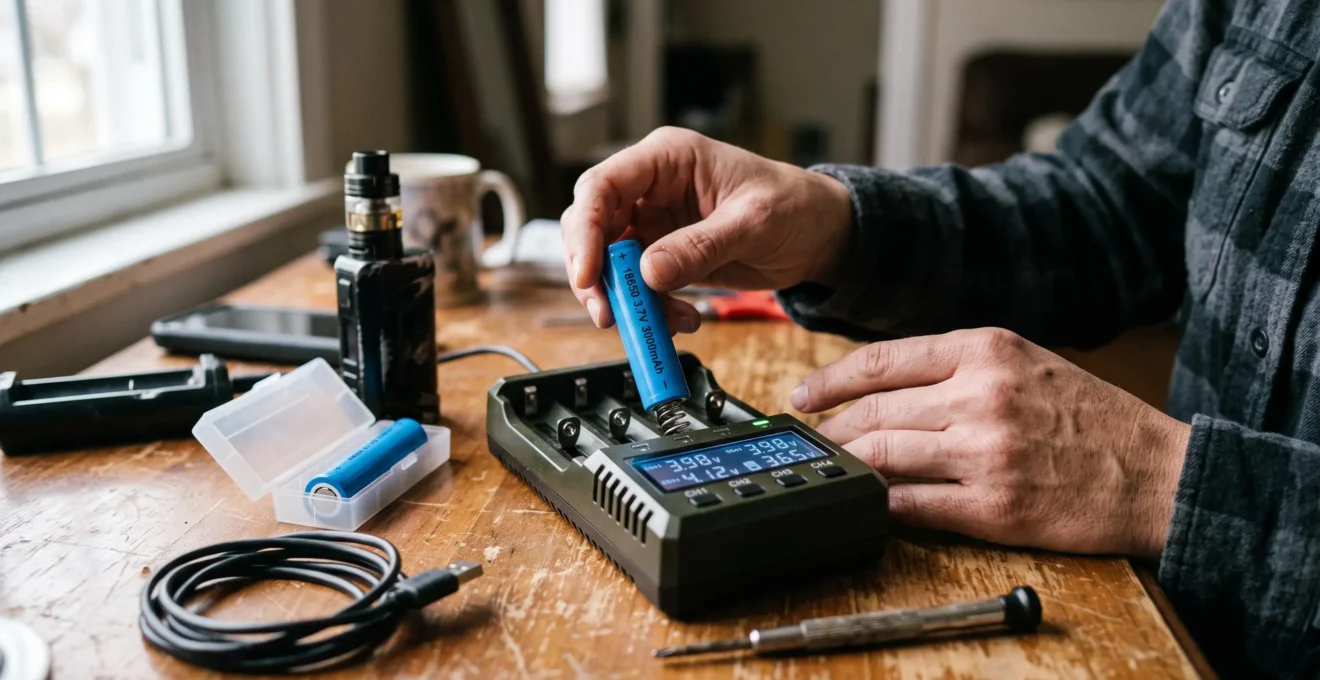
For a vape device powered by removable lithium-ion batteries, a dedicated external charger can offer more visibility and control over charging than the device’s built-in USB connection. Individually monitored slots, adjustable charging currents and clear completion indicators make battery management easier, particularly when several cells are used regularly.
However, an external charger is not automatically safer. Its advantages depend on compatible charging electronics, reliable protection features, correct settings and careful handling. A well-designed built-in charging circuit may be entirely suitable for a compatible single-cell device, while a poorly made external charger introduces hazards of its own.
The most useful comparison is therefore not simply external versus USB. It is whether the complete charging arrangement matches the battery chemistry, cell configuration and manufacturer’s instructions. Understanding the differences helps adult users make more informed decisions without assuming that a digital display or a particular charging method guarantees battery safety.
External vape battery charging: the essentials
- A compatible external charger with independently monitored slots offers useful control, especially for multi-cell devices.
- Neither external nor built-in charging is inherently safe without appropriate protection, battery inspection and supervision.
- Remove cells after charging, protect spare batteries during transport and retire damaged or unreliable cells.
- Why Do Many Removable-Battery Users Prefer Dedicated External Chargers?
- How Do You Use an External Vape Battery Charger Safely?
- External Charger or Built-In USB: Which Better Suits Removable Batteries?
- Which External Charger Warning Signs Mean You Should Stop Using It?
- When Should Vape Batteries Be Removed From an External Charger?
- Built-In USB or External Charger: Which Better Fits Your Battery Type?
- How Do You Carry Spare Vape Batteries Without Risking a Short Circuit?
- How Can You Check Vape Battery Health Before Problems Develop?
Why Do Many Removable-Battery Users Prefer Dedicated External Chargers?
Many removable-battery vape users prefer dedicated external chargers because compatible models can monitor individual cells, display charging information and provide configurable current or voltage settings. These functions can make battery management more transparent than charging through a vape device’s USB port. The benefit is greater control, not proof that every external charger performs better.
An external charger uses its own circuitry to manage the energy delivered to a battery. Depending on its design, it may measure cell voltage, regulate current, switch between charging stages and terminate charging automatically.
Built-in USB charging also relies on charging circuitry. The USB connection supplies power, while electronics inside the vape device control how that power reaches the battery. A properly designed internal circuit can regulate voltage and current accurately, even if it provides little information to the user.
The distinction is therefore primarily about available functions and visibility, rather than the presence or absence of charging regulation.
For example, the NITECORE UM2 technical specifications describe two independently controlled slots, real-time charging information, selectable charging parameters, automatic termination and reverse-polarity protection. These are documented characteristics of one particular charger, not universal features of external models.
Battery chemistry matters as much as the charger’s display. IMR, INR and ICR are commonly used labels for different lithium-ion cell formulations. They do not, by themselves, provide enough information to select a safe charging profile. The relevant cell manufacturer’s specifications determine the permissible charging voltage and current.
For conventional lithium-ion cells specified for a 4.2 V maximum charging voltage, a compatible charger typically uses a controlled charging profile that reduces current as the cell approaches its prescribed limit. Other cell types can require different voltage settings.
Correct charging conditions can help limit unnecessary battery stress. However, there is no basis for assuming that built-in USB charging routinely causes repeated micro-overcharging or that an external charger necessarily extends battery lifespan. Those outcomes depend on the actual circuitry and how accurately it operates.
External charging also introduces practical compromises: purchasing another device, finding a suitable charging location and removing batteries more frequently. Repeated handling can damage wrappers or contacts if performed carelessly.
This distinction becomes particularly important when selecting a charging routine, because even a sophisticated charger cannot compensate for damaged cells or unsuitable charging conditions.
How Do You Use an External Vape Battery Charger Safely?
To use an external vape battery charger safely, confirm that the charger supports the exact cell type, inspect the battery before insertion, check polarity and verify that charging begins normally. Charge on a suitable surface while awake and present, and disconnect the equipment when charging finishes. Never attempt to recover a visibly damaged battery.
Begin with the charger manufacturer’s compatibility information and the cell manufacturer’s specifications. A charger that accepts the physical dimensions of an 18650 or 21700 cell is not necessarily appropriate for every battery of that size.
Check the battery wrapper, positive-terminal insulating ring and metal casing before insertion. Tears, dents, corrosion or signs of leakage require attention before any charging attempt.
Insert the battery without forcing the spring contacts and follow the polarity markings. On chargers with multiple slots, check every slot separately rather than assuming that all positions are configured identically.
Modern independently regulated chargers may safely manage different supported cells in separate slots, but this capability must be explicitly documented. Never rely on a neighbouring slot to identify the correct settings for another battery.
Where the display provides a voltage reading, compare it with the expected range for that particular cell. An implausibly low reading may indicate an over-discharged cell, defective contact or measurement problem. Do not repeatedly attempt recovery or override protection features merely to make the charger start.
Charging location is another safety control. Use a stable, clean, non-combustible surface away from bedding, paper and other flammable materials. Leave the charger uncovered and allow ventilation according to its instructions.
The Buckinghamshire Fire & Rescue Service lithium-ion battery safety guidance advises against charging batteries unattended or while asleep and recommends disconnecting them once charging is complete.
A charger display can confirm electrical measurements, but it cannot establish the full internal condition of a lithium-ion cell. Internal damage or chemical degradation may be present without an immediately obvious voltage abnormality.
Five checks before starting an external charging cycle
- Confirm compatibility: identify the cell model and verify it against the charger’s supported battery specifications. Outcome: a confirmed cell-and-charger match.
- Inspect the battery: examine the complete wrapper, insulating ring, casing and contacts. Outcome: a cell with no visible damage or warning signs.
- Check insertion: align the terminals with the polarity markings and ensure the cell sits securely. Outcome: correctly positioned contacts without forced components.
- Verify charging information: review the displayed voltage, selected settings and fault indicators where available. Outcome: a normal initial charging indication consistent with the equipment instructions.
- Prepare the environment: clear combustible materials, position the charger on a suitable surface and remain available to supervise charging. Outcome: an unobstructed, supervised charging location.
Once a suitable routine is established, the next question is whether external charging offers meaningful advantages over the charging electronics already built into the vape device.
External Charger or Built-In USB: Which Better Suits Removable Batteries?
An external charger often suits people who regularly manage several removable cells or want individual charging information. Built-in USB may be more convenient for compatible single-cell devices with properly designed charging protection. Neither approach is automatically superior: safety, battery longevity, cost and convenience depend on the particular charger and vape device.
The technical difference lies in how charging functions are implemented and exposed. A dedicated charger is designed principally to charge supported cells, whereas a vape device combines its main operating electronics with any built-in charging system.
That shared design can impose space and thermal constraints, but it does not prove inferior voltage regulation or charge termination. Those characteristics must be evaluated from manufacturer documentation or reliable technical testing.
The practical differences are easier to examine through the following comparison.
| Criterion | Dedicated external charger | Built-in USB charging |
|---|---|---|
| Individual monitoring | Available on models with independently managed slots and displays | Depends on device design; often less visible to the user |
| Charging protection | Depends on charger quality, compatibility and protective functions | Depends on the device’s internal charging circuit |
| Battery longevity | May support suitable current selection; no automatic lifespan advantage | Can preserve battery health when correctly designed and used |
| Convenience | Requires removing and reinserting cells | Allows charging without cell removal |
| Initial cost | Separate charger purchase | No additional charger purchase if the function is supported |
| Multiple removable cells | Independent-slot charging may simplify cell management | Requires an appropriate internal arrangement for the specific battery configuration |
| Travel | Extra equipment to carry and protect | Fewer separate accessories |
Consider three hypothetical situations. A person using several interchangeable pairs of removable cells might appreciate an external charger with individually monitored slots. Someone using one manufacturer-approved cell in a device explicitly designed for USB charging may prioritise convenience without abandoning safe practice.
A traveller may prefer the simplest charging arrangement compatible with the device but should still consider battery transport protection and the equipment manufacturer’s instructions.
For multi-cell devices, a major issue is whether built-in charging provides appropriate management or balancing for the installed battery configuration. The presence of a USB port alone does not establish that the port is intended for charging removable cells; it may serve data or firmware functions instead.
An external charger can remain usable across different devices, provided future batteries are compatible. This may be economical over several equipment changes, although the charger’s own condition and service life still matter.
Whichever method is selected, users need to recognise when charging equipment itself may be malfunctioning, because protective features are only useful while they continue to operate correctly.
Which External Charger Warning Signs Mean You Should Stop Using It?
Stop using an external battery charger if it develops abnormal heat, damaged contacts, inconsistent readings, intermittent operation or failure to complete charging normally. Battery swelling, hissing, unusual odours or smoke are more urgent warning signs. Distinguishing a charger fault from a potentially failing cell helps determine whether the equipment should be isolated or immediate emergency precautions are required.
Charger problems can involve damaged springs, poor electrical contacts, defective sensors, worn connectors or faulty control electronics. Possible warning signs include:
- A display that repeatedly freezes or reports implausible values.
- Charging that does not terminate as specified by the manufacturer.
- Excessive heat, unusual noises or a burning smell from the charger.
- Visible scorching, damaged contacts or a deteriorating power connection.
- Intermittent charging despite correctly inserted compatible cells.
A reading that remains identical after different cells are inserted may justify suspicion, but identical readings alone do not prove a fault. Display resolution, similar cell voltages and measurement timing can explain some observations.
Contact resistance can create localised heating or unreliable measurements. An actual charging-control failure may also produce incorrect current or voltage regulation. These problems should not be diagnosed by repeatedly inserting questionable cells.
Battery-related warning signs require particular caution. A cell that becomes unusually hot, swells, leaks, hisses, emits smoke or produces an unfamiliar chemical smell may be entering a dangerous failure condition.
If a battery is smoking, venting or on fire, move away, keep other people clear and contact emergency services. In the UK, call 999 for an active fire or immediate danger. Do not handle a venting cell or attempt to remove it from the charger.
For a suspected charger malfunction without signs of battery failure, stop charging and disconnect power when it is safe to do so. Do not resume use until the equipment has been appropriately assessed or replaced.
A suitably competent person may assess a removed, cool and otherwise undamaged cell using appropriate test equipment. A multimeter can help establish terminal voltage but cannot certify internal battery safety. Opening a charger or experimenting with fault recovery is not an appropriate consumer diagnostic method.
Visible defects should override reassurance from an apparently normal display. A charger is one layer of protection, not an instrument capable of proving that every connected cell is safe.
Some charging problems also arise from an ordinary habit: leaving batteries connected long after the completion indicator appears, which makes understanding charge termination essential.
When Should Vape Batteries Be Removed From an External Charger?
Remove removable vape batteries from an external charger once charging has completed and it is safe to handle them. A quality charger should terminate charging according to the supported cell’s requirements, but automatic termination is not a reason to leave batteries connected indefinitely. Disconnect the charger from power when it is no longer needed.
In a properly regulated charging cycle, the charger limits current and voltage according to its intended charging profile. For many conventional lithium-ion cells, a constant-current phase is followed by a constant-voltage phase, after which charging terminates when the prescribed conditions are reached.
The precise termination conditions depend on the battery specification and charging electronics. A full-charge indicator is therefore useful, but its meaning should be understood through the manufacturer’s instructions rather than a general assumption about every charger.
Some products offer automatic termination, additional protection and individually controlled slots. Others may lack those capabilities or provide limited information about their operation.
Leaving batteries in a charger for extended periods creates unnecessary reliance on the equipment’s continued correct operation. In addition, keeping lithium-ion cells near their maximum state of charge for prolonged periods can contribute to calendar ageing, particularly at elevated temperatures.
That does not mean a battery immediately becomes unsafe when it reaches full charge. The practical goal is to avoid unnecessary prolonged charging, unattended operation and long-term storage at a high state of charge.
A cell discovered to be unusually deeply discharged should not simply be placed into an automatic recovery cycle. Some chargers offer activation or recovery functions, but their availability does not establish that recovery is appropriate for a particular battery.
If the cell’s condition or discharge history is uncertain, follow the battery manufacturer’s instructions and seek competent assessment rather than repeatedly trying to restore it.
For everyday use, adopt a behaviour-based routine:
- Begin charging only when it can be supervised.
- Do not start a charging cycle before sleeping or leaving home.
- Remove cells when the charger indicates completion.
- Disconnect the charger when charging is finished.
- Place removed cells in a suitable protective case if they are not immediately installed in a compatible device.
Cells being stored for an extended period should follow the manufacturer’s storage recommendations, which may specify a partial state of charge. A charger is not a substitute for a proper storage case.
These principles apply across removable lithium-ion cells, but the type and number of batteries inside a vape device can significantly change which charging method is most practical.
Built-In USB or External Charger: Which Better Fits Your Battery Type?
Battery chemistry, cell count and device design determine whether built-in USB or an external charger is more appropriate. A compatible single-cell device may charge safely through its approved USB system. Devices using several removable cells can benefit from independently controlled external charging, especially when the manufacturer’s instructions recommend it. Chemistry alone cannot establish which option is safer.
Removable vape batteries commonly use cylindrical lithium-ion cells marketed under designations such as IMR, INR and ICR. These names refer broadly to electrode chemistry families, although commercial naming conventions are not always sufficiently precise to determine operating limits.
High-drain cells used in demanding applications must be selected according to the device manufacturer’s requirements. Charging compatibility is a separate question from discharge capability: a battery’s suitability for delivering high current does not establish its preferred charging current or voltage.
Protected cells may incorporate additional protective electronics, whereas many high-drain cylindrical cells are unprotected. Neither classification eliminates the need for the correct charger or a compatible device.
Some battery chemistries require different charging limits. Consequently, a charger’s automatic recognition should never be treated as universally reliable for every supported physical cell size. Use the actual model documentation and check any required manual setting.
The number of cells also matters. A single-cell device avoids the additional challenge of managing several cells within one battery arrangement. A multi-cell device needs charging electronics suitable for its configuration, including any required balancing or individual-cell management.
External chargers with independently regulated slots allow each supported cell to be monitored and charged separately. However, charging cells individually does not correct poor pairing practices or make an incompatible multi-cell arrangement safe.
The FDA guidance on preventing vape battery fires and explosions recommends using batteries specified for the device and avoiding combinations of different brands, ages or charge levels.
For devices requiring matched removable cells, follow the manufacturer’s recommendations for keeping appropriate cells together and replacing them as a set when necessary.
Before choosing a charging method, consider four questions: how many cells does the device use, is USB charging explicitly supported, can the charger individually manage the cells, and is the intended charging speed compatible with the battery specifications?
Charging speed should never be prioritised over safe current selection. A high charging-current rating on the charger indicates a capability, not a suitable setting for every installed cell.
Alternating between built-in USB and external charging does not inherently damage cells merely because the charging profiles differ. What matters is that both systems respect the battery’s specified limits. However, inconsistent management can make it harder to compare charging behaviour or identify an emerging problem.
Once the appropriate charger is identified, protection must continue beyond the charging location, especially when spare cells are carried between home, work and travel.
How Do You Carry Spare Vape Batteries Without Risking a Short Circuit?
Carry spare removable vape batteries in individual protective cases or suitable original packaging that prevents their terminals from contacting conductive objects. Never carry loose cells with keys, coins or other batteries in a pocket or bag. Effective protection must prevent both accidental short circuits and mechanical damage during transport.
A typical cylindrical lithium-ion cell has a positive contact at one end and a metal casing that forms part of its negative electrical connection. If a conductive object bridges the positive terminal and an exposed negative surface, a short circuit can allow a very large current to flow.
That current can generate rapid heating and potentially trigger battery failure. The risk is especially relevant when a wrapper is torn or the insulating ring near the positive terminal is damaged.
Protective cases reduce the opportunity for conductive objects to bridge exposed surfaces. A rigid plastic case designed for the cell size can keep batteries separated from metal objects and from one another.
Silicone sleeves may provide protection when properly designed to cover the relevant conductive surfaces, but not every sleeve encloses the entire cell or prevents contact at both ends. A sleeve that leaves critical areas exposed should not be assumed equivalent to a fully protective case.
Tape over exposed terminals may provide temporary protection when applied appropriately, but it does not provide the same mechanical protection as a properly fitting case. Adhesive covering is not a substitute for repairing damage to a battery wrapper or insulating ring.
For air travel, the IATA guidance on travelling with lithium batteries explains the importance of protecting spare battery terminals against short circuits and carrying spare lithium batteries in hand baggage rather than checked baggage, subject to applicable restrictions.
Always check current airline and destination-specific requirements before travelling. Rules governing vaping devices, batteries and their use or charging during flights may differ from general lithium-battery allowances.
A protective case also needs inspection. Cracked hinges, missing dividers or loose closures can undermine its ability to keep cells isolated. Two batteries inside one damaged compartment may still make unintended contact.
During routine handling, move a cell directly between the device, charger and suitable case. Avoid leaving loose batteries temporarily on metal worktops or among tools while preparing a charging cycle.
Transport and charging safety are closely connected. A cell that is physically damaged in a bag can present a hazard when it is later inserted into otherwise reliable charging equipment.
Before a transported cell returns to service, a brief condition check can reveal damage and electrical changes that would otherwise remain unnoticed.
Key takeaways before checking battery health
- Charging equipment cannot compensate for a damaged wrapper, deformed casing or defective insulating ring.
- Changes in how comparable cells behave can provide useful warnings, but require interpretation rather than guesswork.
- A battery that presents credible safety concerns should be taken out of service and assessed for safe disposal, not reserved for less demanding use.
How Can You Check Vape Battery Health Before Problems Develop?
Check removable vape battery health through regular visual inspection, attention to abnormal heating and observation of charging behaviour over time. Look for torn wrappers, damaged insulating rings, dents, corrosion and unexplained differences between comparable cells. Voltage readings can provide useful clues, but cannot independently confirm battery health or rule out internal damage.
Begin with the exterior. The plastic wrapper on a cylindrical lithium-ion battery helps insulate its metal casing from surrounding conductive surfaces. A tear exposing the casing can create a short-circuit risk in the device, charger or carrying case.
Examine the positive-terminal insulating ring as well as the wrapper’s main surface. A missing or displaced ring can increase the risk of contact between the positive terminal and nearby negative metal surfaces.
Then inspect the casing for deformation, dents, punctures, unusual residue, corrosion or discolouration. Visible damage should not be dismissed because a battery still powers the device.
A damaged wrapper or insulating ring means the cell must not be used until it has been appropriately assessed and, where suitable, correctly rewrapped or reinsulated by a competent person. Cells with damaged metal casings, leakage, overheating, swelling or other suspected internal faults should be permanently removed from service.
Electrical behaviour provides another source of information. A compatible charger’s display or an appropriately used multimeter can show terminal voltage, but a single reading is insufficient to establish remaining capacity, internal resistance or overall condition.
Voltage also depends on recent charging, discharge activity, resting time and the characteristics of the particular cell. A low reading does not automatically identify a defective battery, just as a normal reading does not exclude internal damage.
Changes over time can be more informative than isolated measurements. For example, a cell that consistently loses charge unusually quickly while stored under comparable conditions may warrant further investigation.
Likewise, batteries purchased together and used in similar circumstances may gradually develop different characteristics. A significant, repeatable divergence can justify checking their condition, although differences may also arise from unequal use, temperature or measurement conditions.
Voltage sag under load is another relevant behaviour, but interpreting it requires knowledge of current, temperature and measurement method. A charger’s resting-voltage display cannot directly establish loaded voltage sag or diagnose its underlying cause.
For users without suitable testing equipment or expertise, the safest approach is not to improvise high-current testing. Instead, observe charging behaviour, look for visible defects and obtain competent advice when a cell becomes unreliable.
The decision to retire a battery should be conservative when credible safety concerns appear. Do not continue using a damaged or suspect cell simply because it still holds some charge.
In the UK, unwanted lithium-ion batteries should go through an appropriate battery collection or recycling service rather than household rubbish. Damaged, leaking or potentially unstable cells may require special arrangements; contact the collection operator or local council for instructions before transport.
Before the next charging session, inspect every removable cell, confirm that the charger supports its exact specification and remove questionable batteries from use. This simple routine is a practical way to reduce avoidable risks without assuming that any charging method can make damaged lithium-ion cells safe.
Can an external charger charge two different battery sizes at the same time?
Some multi-slot chargers support simultaneous charging of different compatible cell sizes and chemistries through independently managed slots. Check the exact charger’s specifications and settings before using this function. Physical fit does not establish electrical compatibility.
Does a USB-C connection mean a vape device charges its batteries safely?
No. USB-C describes the connector rather than the quality or suitability of the charging electronics. Safe charging depends on the device’s battery management design, supported battery configuration, power supply compatibility and manufacturer instructions.
Should removable lithium-ion batteries be fully discharged before recharging?
No. Lithium-ion cells do not require routine full discharge before charging. Deliberately running a cell down to an abnormally low voltage can create unnecessary stress and may trigger protective circuitry. Follow the battery manufacturer’s recommended operating limits.
Can a charger detect whether a lithium-ion battery is damaged internally?
Not reliably through voltage monitoring alone. Some chargers provide additional measurements and error detection, but a normal charging indication cannot rule out internal chemical degradation, mechanical damage or every possible failure condition. Visual inspection and careful assessment remain necessary.
Is it safe to leave removable vape batteries in an unplugged charger for storage?
A charger is not the preferred long-term storage solution. Remove the cells and use a protective case that prevents terminal contact and physical damage. Follow the cell manufacturer’s guidance on storage charge level, temperature and inspection intervals.