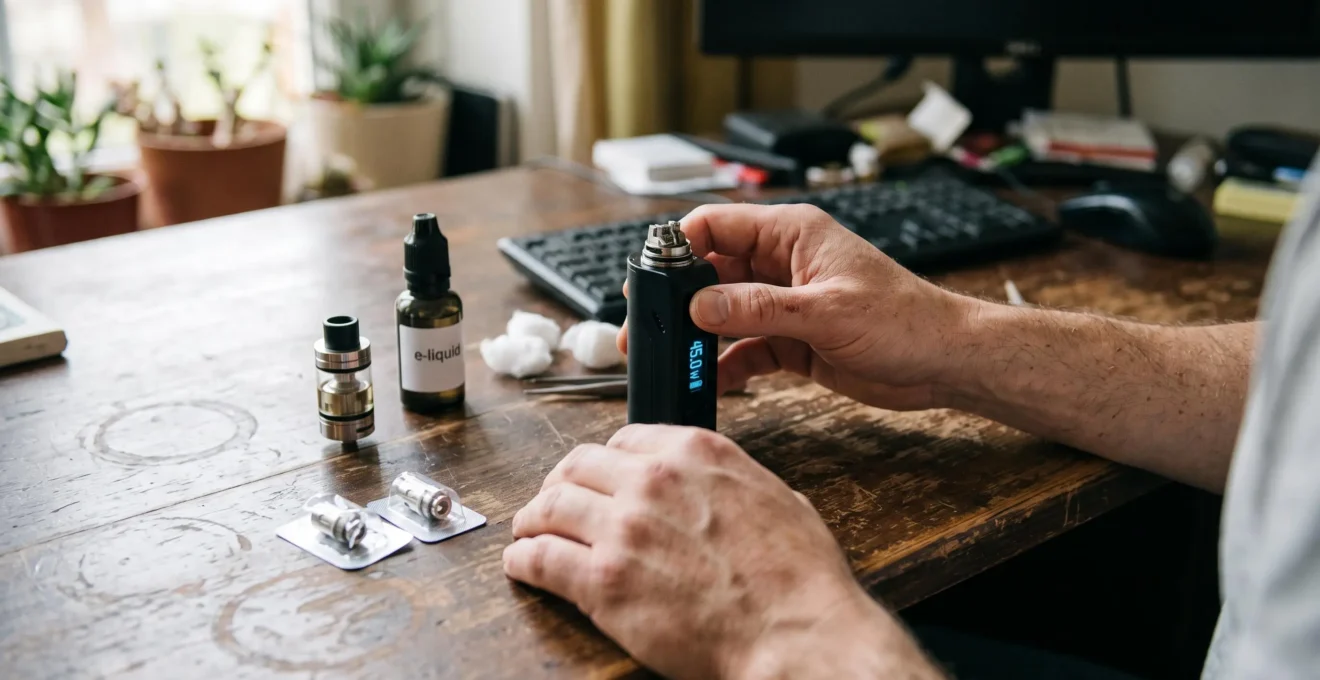
Adjustable wattage determines how much electrical power a regulated vape device delivers to its heating coil. For consistent performance, the starting point should be the coil manufacturer’s recommended wattage range, not the device’s maximum output. Beginning near the lower end, then making small adjustments while monitoring vapour, flavour and heat, helps identify a comfortable operating setting.
Higher power does not automatically mean better performance. The heating element, cotton wick, e-liquid composition and airflow must work together. If liquid cannot replenish the wick quickly enough, increasing wattage can produce an unpleasant dry hit and eventually damage the coil.
The most reliable approach is therefore to treat wattage as a setting that belongs to a particular coil and setup. Changing the coil, liquid or airflow may change the appropriate power level, even when the mod itself stays the same.
This guide focuses on adult users of regulated devices. Wattage control can improve operating consistency, but it does not make vaping risk-free or guarantee protection against overheating-related emissions.
Adjustable wattage: the essential settings
- Start at the lower end of the replacement coil’s stated wattage range and increase power gradually only when necessary.
- Match wattage to coil design, airflow, e-liquid composition and inhale style rather than resistance alone.
- Reduce power and investigate immediately if vapour becomes excessively hot, harsh or persistently burnt.
- Why Does Changing Wattage Affect Flavour, Heat and E-Liquid Use?
- How Do You Increase Vape Wattage Without Burning a New Coil?
- Low or High Wattage: Which Range Better Suits Your Coil and Inhale Style?
- Which Wattage Errors Most Often Lead to Burnt Coils or Rapid E-Liquid Use?
- When Should You Recheck Wattage After Changing Your Vape Setup?
- Box Mod or Pod Mod: Which Better Suits Adjustable Power Without Excess Bulk?
- How Do You Tune Airflow and Wattage for More Consistent Vapour Density?
- Is Temperature Control Worth Using on a Compatible Vape Mod?
Why Does Changing Wattage Affect Flavour, Heat and E-Liquid Use?
Changing wattage alters the rate at which electrical energy reaches the coil, affecting its heating behaviour and the amount of e-liquid vaporised. Increasing power generally produces more aerosol, changes perceived warmth and can intensify flavour or throat sensation. However, these effects depend on the coil, wick, airflow and liquid, and higher settings can eventually reduce performance rather than improve it.
A coil converts electrical energy into heat. During a puff, that heat transfers to e-liquid supplied by the wick, producing an inhalable aerosol. More power can increase the rate of vaporisation, but actual coil temperature also depends on heat loss, liquid availability and puff duration.
The three noticeable outcomes are connected:
- Flavour: changing the amount and temperature of aerosol can change how strongly flavour compounds are perceived. Excessive heating may instead produce unpleasant notes.
- Warmth and throat sensation: increasing power may produce warmer, denser aerosol, although airflow and liquid formulation also influence the sensation.
- E-liquid consumption: more energetic vaporisation generally uses liquid faster when the coil is operating effectively.
An experimental study on coil power ranges and e-liquid consumption examined 13 commercial atomizers and distinguished under-heating, optimal vaporisation and over-heating regimes. Within the optimal regime, liquid consumption increased approximately linearly with supplied power, although the relevant ranges varied between devices.
13 atomizers
The number of commercial atomizers examined in the 2018 experimental study. The results demonstrate device-specific operating behaviour, not a universal recommended wattage.
Research published in the International Journal of Environmental Research and Public Health.
The manufacturer’s printed wattage interval should be treated as a compatibility and operating guide, not proof that every setting within it delivers equally good flavour or avoids dry hits. The preferred setting, often called the sweet spot, may occupy only part of that interval.
E-liquid formulation further complicates the relationship. Vegetable glycerine (VG), propylene glycol (PG), flavourings and sweeteners can affect liquid transport, residue formation and aerosol production. Research on aerosol chemistry has found that coil temperature, PG/VG composition and puff duration influence the resulting aerosol.
If the wick cannot replace vaporised liquid quickly enough, its wetting level falls. An unpleasant dry sensation can warn of insufficient liquid supply before persistent damage develops.
The useful wattage setting is therefore a balance between heat delivery and liquid replenishment, rather than simply the highest number a coil can tolerate.
How Do You Increase Vape Wattage Without Burning a New Coil?
To increase wattage on a new coil, first saturate its wick according to the manufacturer’s instructions and allow sufficient time for absorption. Begin at the lower end of its recommended power range, then increase gradually while checking flavour, heat and vapour production. Stop if the coil produces persistent dryness, harshness or burnt flavour.
A new coil can contain absorbent cotton that has not yet become evenly saturated with e-liquid. Firing it before sufficient liquid reaches the heated area increases the risk of overheating the wick.
The appropriate preparation depends on whether the coil has accessible cotton ports, uses a replaceable head or belongs to a sealed pod. Do not dismantle a sealed coil or pod to apply liquid.
For compatible replaceable coils, follow this sequence:
- Confirm that the coil is compatible with the device and read its marked wattage range.
- Where the manufacturer instructs it, apply a small amount of the intended e-liquid to accessible cotton wicking without flooding the coil.
- Install the coil, fill the tank correctly and allow the specified saturation period.
- If permitted by the device instructions, take a few gentle draws without pressing the fire button to help establish liquid flow.
- Start near the bottom of the recommended wattage range, take a short test puff and increase power gradually only if the coil remains adequately saturated.
Innokin’s official coil troubleshooting and wattage recommendations advise allowing at least 15 minutes after priming and filling, then beginning at the low end of the recommended wattage range. Its guidance also recommends a gradual increase during the first day. These instructions apply to the manufacturer’s equipment and should not override another coil’s directions.
The purpose of gradual adjustment is to observe the coil’s response before imposing additional heat. A modest increase should be assessed with normal pauses between puffs, rather than rapid repeated firing.
Warning signs include muted or distorted flavour, a dry aftertaste, unexpected throat harshness and vapour that feels excessively hot. A peppery sensation may also reflect nicotine concentration or liquid composition, so it should not be used as the sole indicator of wattage suitability.
Jumping immediately to the top of the stated range can be problematic if the wick is incompletely saturated. Nevertheless, no universal number of tank fills is established as necessary before a coil can operate at its full rated output. Manufacturer instructions and observable performance remain the appropriate guides.
Five checks before settling on a new coil’s wattage
- Read the coil’s resistance and wattage marking; record both in a short setup note.
- Complete the manufacturer’s priming and soaking instructions; mark the preparation as finished.
- Set the device near the lower rated wattage boundary; record the initial setting.
- Make a small adjustment only after checking several normally spaced puffs; record the resulting flavour and warmth.
- Keep the lowest setting that provides satisfactory operation without warning signs; save it as the starting reference for that particular coil.
If a properly primed coil already tastes burnt at its lowest recommended setting, stop using it and check compatibility, liquid supply and installation rather than continuing to raise the wattage.
Low or High Wattage: Which Range Better Suits Your Coil and Inhale Style?
Lower or higher wattage should be selected according to the coil’s specified operating range and the intended inhale style. Mouth-to-lung setups commonly use coils designed for relatively modest power and restricted airflow, while direct-to-lung systems often use coils designed for greater output and more open airflow. Resistance alone cannot determine the correct setting.
Coil resistance, expressed in ohms (Ω), describes an electrical property of the heating element. It does not fully describe its surface area, mass, wick structure or intended airflow. Consequently, two coils with similar resistance can require substantially different power settings.
The following decision grid describes general equipment categories rather than universal wattage thresholds.
| Setup characteristic | Lower part of rated range | Upper part of rated range |
|---|---|---|
| Mouth-to-lung (MTL) | Often a sensible starting point for compatible MTL coils and restricted airflow. | Consider only when permitted by the coil specification and supported by sufficient liquid supply. |
| Direct-to-lung (DTL) | Useful for initial testing, although some high-output coils may produce weak aerosol. | May suit coils designed for open airflow and higher vaporisation rates. |
| Higher-resistance coil | Commonly paired with lower-power designs, subject to the actual rating. | Not appropriate unless explicitly supported by the coil specification. |
| Very low-resistance sub-ohm coil | May underperform if power falls below its specified operating range. | May be appropriate for high-output designs, with adequate airflow and wicking. |
| Restricted airflow | Often supports a cooler, less intense operating preference. | Excessive heat or harshness may become more noticeable. |
| Open airflow | May feel comparatively cool or produce less concentrated aerosol. | Can support greater output when the coil and liquid supply are compatible. |
Lower wattage is not automatically better if it falls below the coil’s intended range. Insufficient vaporisation can contribute to pooled liquid, gurgling or spitting in some atomizer designs. Leaks may also result from poor seals, overfilling or incompatible liquid viscosity.
Similarly, higher power can produce denser aerosol while increasing e-liquid consumption and thermal stress. It may shorten coil service life under demanding conditions, but the exact relationship depends on many variables and cannot be reduced to a universal lifespan prediction.
Users seeking a cooler, more restricted draw should generally select equipment designed for that purpose, rather than forcing a high-power sub-ohm coil to operate far below its intended range.
Choose the coil architecture for the desired draw first, then fine-tune power within its stated range; this is more predictable than trying to make one coil behave like every other design.
Which Wattage Errors Most Often Lead to Burnt Coils or Rapid E-Liquid Use?
The most common wattage-related problems involve operating above the coil’s rated range, increasing power before a new wick is saturated, taking repeated high-power puffs without adequate recovery time, and ignoring persistent dry or burnt sensations. Excessive power may also accelerate e-liquid consumption, although usage patterns and liquid formulation must be considered before attributing the change to wattage alone.
Burnt flavour is a symptom, not a complete diagnosis. Problems involving tank assembly, low liquid levels, blocked wicking channels or unsuitable e-liquid may produce similar sensations.
Four recurring errors deserve particular attention:
- Exceeding the rated range: more heat is delivered than the coil was intended to handle during normal operation, increasing the likelihood of unpleasant overheating.
- Using excessive power on an unprepared coil: the heated area may become too hot before its cotton receives enough liquid.
- Chain-vaping: repeated firing can consume liquid faster than the wick replenishes it, especially at higher power.
- Ignoring repeated dry hits: continued overheating may permanently degrade cotton or leave deposits that alter subsequent flavour.
Wick damage can accumulate. One brief dry sensation does not establish that a coil has been irreversibly damaged, but repeated severe overheating may char or degrade the wick. Once permanent damage occurs, lowering wattage cannot restore the original material.
A persistently burnt coil should generally be replaced after confirming that the liquid supply and power settings are correct. Continuing to use it at lower power is not a reliable repair method.
Unexpected liquid consumption should be investigated systematically. Compare the current power setting, approximate number and duration of puffs, liquid formulation and tank condition with the previous setup. A faster decline in the liquid level could indicate greater vaporisation, but leaking or changed usage may also explain it.
In addition, the PubMed record of the study on e-liquid composition and aerosol chemistry describes experimental findings showing that higher coil temperature and longer puff duration increased aerosol mass and carbonyl degradation products under the tested conditions. These findings reinforce why excessive heating should not be dismissed as merely a flavour problem.
If an unexplained burnt sensation persists, stop using the affected coil and investigate the device before another attempt. Reducing power is a precaution, not a guarantee that undesirable emissions or component damage have been eliminated.
When Should You Recheck Wattage After Changing Your Vape Setup?
Wattage should be rechecked whenever a coil, pod, tank or e-liquid formulation changes, and after substantial airflow adjustments. Even a replacement coil with identical resistance may have different heating and wicking characteristics. The most reliable reset is to consult the new coil’s stated operating range, begin near its lower boundary and reassess performance gradually.
Regulated mods may remember the last power setting. That convenience becomes a potential problem when the stored setting belongs to a different coil or tank.
Revisit the power setting after these changes:
- Installing a replacement coil, including one with the same nominal resistance.
- Switching to a different resistance, coil construction or manufacturer.
- Changing e-liquid composition, particularly VG/PG proportions or a formulation that behaves differently during use.
- Opening or restricting airflow substantially.
- Moving to a different tank, replaceable pod or atomizer on the same regulated mod.
A coil’s nominal resistance cannot reliably substitute for its operating instructions. Heating characteristics also depend on the element’s construction, geometry, material and surrounding wick.
For example, consider a hypothetical regulated mod previously used with one compatible coil. Replacing the tank with a model that specifies a different wattage range should trigger a new adjustment process, even if both coils display the same resistance. The original power setting is no longer a sufficient reference.
After making a change, confirm component compatibility, read the marked range, ensure sufficient liquid saturation and begin at the lower recommended power. Observe a few normally spaced test puffs before making any further adjustment.
Changes in flavour or vapour over a coil’s lifetime should also prompt inspection. Residue accumulation, wick wear and liquid supply problems may alter performance. Increasing wattage to overcome ageing is not necessarily appropriate and can aggravate overheating.
Keeping a brief record of the coil model, liquid type and preferred operating setting can make future replacements easier, provided every new component is checked against its own instructions.
Box Mod or Pod Mod: Which Better Suits Adjustable Power Without Excess Bulk?
A regulated box mod generally offers broader wattage adjustment and more configuration options, while an adjustable pod mod prioritises portability and simpler operation. Neither format inherently delivers better coil consistency. The practical choice depends on how much control the user needs, how compatible coils are managed and whether compact dimensions matter more than extensive adjustment features.
Traditional box mods often provide visible power controls, replaceable tank connections and wider compatibility with atomizers. Some use removable batteries, although many have integrated batteries; external batteries are not a defining requirement of adjustable wattage.
Pod mods typically combine a compact battery unit with a dedicated cartridge or coil system. Some allow manual wattage adjustment, while others automatically set or restrict power according to the installed pod.
| Consideration | Regulated box mod | Adjustable pod mod |
|---|---|---|
| Power control | Often offers a wide adjustment range and fine increments. | Usually provides a more restricted range or simplified controls. |
| Portability | Can be bulkier, particularly with larger tanks. | Usually easier to carry in a pocket. |
| Coil compatibility | Can support multiple compatible atomizers, depending on device specifications. | Generally limited to a particular pod or coil family. |
| Setup effort | May require more manual checking and adjustment. | Can reduce the number of user-adjustable settings. |
| Consistency considerations | Offers control but requires attention to individual coil requirements. | May simplify power management within a defined system. |
For someone who frequently changes compatible tanks and prefers detailed control, a regulated box mod can be practical. However, additional flexibility creates additional opportunities to select unsuitable settings.
A pod mod with restricted power controls may reduce certain adjustment errors, but automatic power selection does not eliminate problems caused by poor wick saturation, unsuitable liquid or a worn coil.
There is also a middle category: compact regulated mods and pod-mod hybrids. These can provide adjustable output without requiring the size associated with larger box-mod configurations.
For equipment with removable batteries, use only manufacturer-compatible cells and observe the device’s battery-handling instructions. Never use damaged battery wraps or bypass a regulated device’s protections.
A compact device with clear coil compatibility information and accessible controls may offer sufficient adjustment for consistent everyday operation without unnecessary complexity.
How Do You Tune Airflow and Wattage for More Consistent Vapour Density?
Airflow and wattage should be adjusted together because air movement influences coil cooling, vapour dilution and the sensation of heat. First select an airflow setting appropriate for the intended inhale style, then adjust power within the coil’s recommended range. Stable vapour density comes from balancing heating with liquid supply and airflow, not simply maximising one setting.
Opening the airflow generally allows more air to pass through the atomizer during a draw. Depending on coil construction and draw behaviour, this can increase cooling and reduce perceived vapour concentration. Restricting airflow can change the opposite characteristics, but the result is not identical across all devices.
Because airflow changes heat transfer and the amount of air mixed with aerosol, the same wattage may feel noticeably different after an airflow adjustment.
For predictable results, use this order:
- Check that the coil and liquid are compatible and that the wick is adequately saturated.
- Choose an airflow opening suited to the desired MTL or DTL draw.
- Begin near the lower end of the coil’s recommended wattage range.
- Assess vapour density, heat and flavour through normally spaced test puffs.
- Make small adjustments without exceeding the coil’s operating limits.
Two opposite symptoms can help identify an imbalance. Gurgling, spitting or pooled liquid may occur when vaporisation is insufficient for the liquid reaching the coil, although flooding can also originate from damaged seals or overfilling. Harsh, excessively hot vapour may indicate insufficient cooling, inadequate liquid supply or unsuitable power.
Neither symptom should trigger an automatic wattage increase. Check the actual cause before changing settings, particularly when a coil already operates within its specified range.
Consistency over an extended session also depends on puff frequency and sufficient time for the wick to recover. As a coil ages, deposits and wear may affect how it performs at its original setting.
Minor adjustments can sometimes accommodate ordinary variation, but power increases should not be used to disguise persistent burnt taste or deteriorating liquid absorption. A worn coil may need replacement rather than more heat.
Once a comfortable balance is found, leaving both controls stable is usually more informative than frequently changing them; any later deterioration can then be investigated against a known baseline.
Key takeaways before considering temperature control
- A stable coil setup depends on compatible equipment, sufficient liquid supply and appropriate airflow, not wattage alone.
- Temperature-control mode requires specific coil materials and correct device configuration; ordinary wattage-compatible coils are not necessarily suitable.
- Electronic temperature regulation may reduce certain overheating problems, but it should never be treated as a guarantee that dry hits or harmful emissions are prevented.
Is Temperature Control Worth Using on a Compatible Vape Mod?
Temperature control can be worth considering when a regulated mod supports it and the installed coil uses an appropriate temperature-sensitive wire. The device estimates changes in coil temperature through resistance measurements and adjusts power accordingly. This can help limit overheating, but accuracy varies, setup matters and temperature control does not guarantee protection against dry hits or harmful emissions.
In ordinary wattage mode, the user chooses a power level. The actual coil temperature then changes with liquid availability, airflow, puff duration and other operating conditions.
Temperature-control (TC) mode instead attempts to regulate heating against a selected temperature limit. Compatible coil materials change electrical resistance with temperature in ways the device can estimate.
Common TC-compatible materials include stainless steel, nickel and titanium when specifically supported by the mod and coil design. Standard Kanthal wire is generally unsuitable for conventional resistance-based temperature control because its resistance changes too little with temperature for the intended method.
Successful operation requires the correct material profile, a stable electrical connection and any resistance-locking or calibration procedure specified by the manufacturer. Nickel and titanium coils should only be operated in modes explicitly approved for their material.
Temperature control’s limitations are significant. A peer-reviewed PLOS ONE investigation published in 2018 measured the performance of three fourth-generation electronic nicotine delivery systems and found substantial differences between displayed set points and measured coil temperatures.
Experimental evidence: temperature settings versus measured temperatures
Researchers investigating three commercial temperature-control systems compared their displayed settings with independent thermocouple measurements.
At a 300°C set point, one tested device sample measured 40°C below the selected temperature, while another sample of the same brand exceeded that setting by more than 100°C. Certain tested coils also exhibited temperature differences of approximately 100°C along their length. These results apply to the tested devices and do not establish how every modern chipset performs.
Temperature regulation therefore cannot be assumed to hold every part of a coil at precisely the displayed temperature. Material selection errors and poor electrical connections can further undermine the intended behaviour.
A setting that is too restrictive may produce weak aerosol. Conversely, a high temperature limit does not ensure that liquid supply remains adequate or that overheating-related chemical products are avoided.
For adults prioritising straightforward operation, wattage mode remains the simpler choice when used with compatible coils and manufacturer-recommended settings. Temperature control may appeal to those prepared to verify coil material, follow calibration instructions and monitor actual performance.
The practical next step is to check the mod’s manual and the coil’s exact material specification. Use temperature control only when both explicitly support it; otherwise retain a conservative wattage setting within the recommended range and investigate any signs of overheating.
Can the same wattage be used for every coil with the same resistance?
No. Two coils with identical nominal resistance may differ in heating-element construction, wicking and airflow requirements. Always use the replacement coil’s stated wattage range rather than copying a setting solely because its ohm rating matches the previous coil.
Does reducing wattage repair a coil that already tastes burnt?
Reducing wattage may stop further excessive heating, but it cannot reverse permanently damaged cotton or remove established burnt deposits. Check liquid supply and installation, and replace the coil if the burnt flavour persists. Do not continue using a coil that shows signs of serious overheating.
Should wattage be increased when vapour production becomes weak?
Not automatically. First check the liquid level, coil condition, airflow, battery charge and any device error indicators. A power increase may be appropriate only when the coil is functioning correctly and the adjustment remains within its recommended operating range.
Can thicker e-liquid require a different wattage setting?
Changing the VG/PG ratio can alter how e-liquid reaches the wick and how aerosol forms. However, increasing wattage is not a universal solution for thick liquids. Check the coil manufacturer’s liquid compatibility advice and verify adequate saturation before adjusting power.
Does a regulated vape mod automatically prevent dry hits?
No. Regulation can provide power limits and other electrical protections, but it does not guarantee that the wick contains enough liquid. Even temperature-control systems have measurable limitations. Correct priming, compatible settings and attention to abnormal flavour or heat remain important.