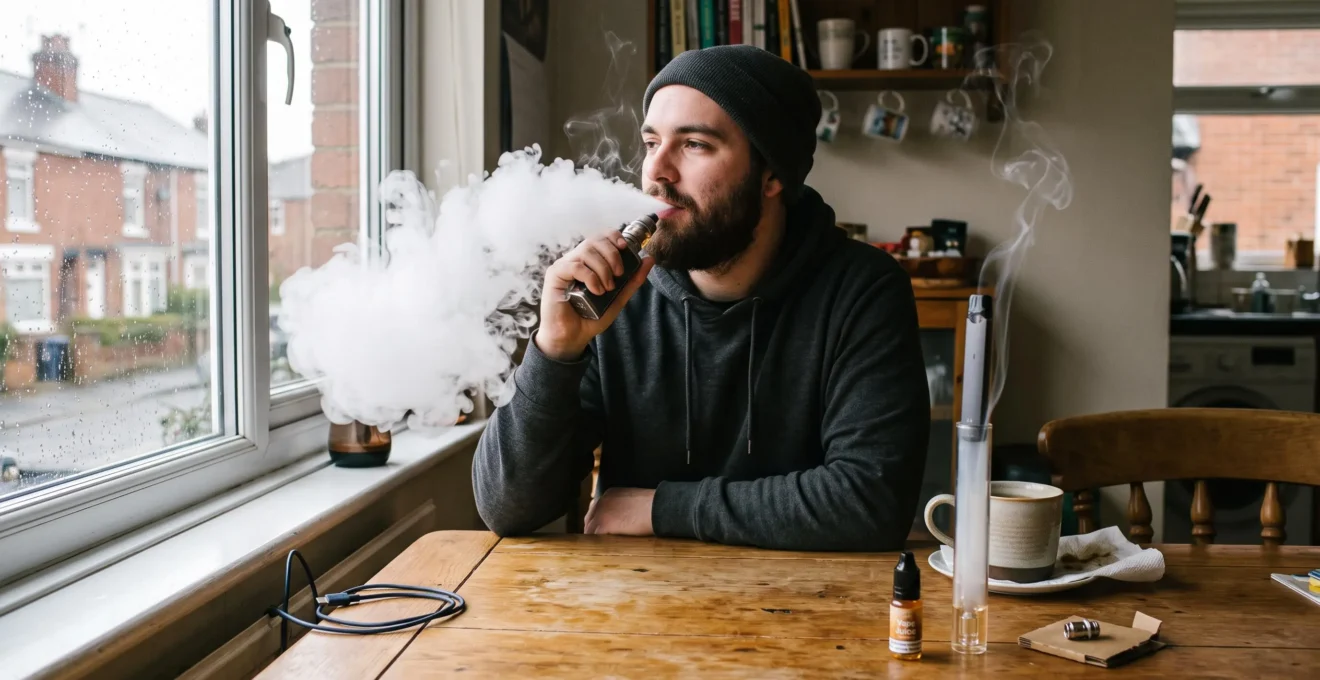
Two vape devices can use similar e-liquid yet produce noticeably different clouds. One delivers a compact, warm draw that feels concentrated, while another releases a larger, more diffuse plume. Neither observation alone tells you how much aerosol the device generates or whether the coil is operating properly.
Vapour density depends on airflow, operating power, coil construction, e-liquid composition and the way a puff is taken. These factors influence aerosol generation, dilution, droplet characteristics and visible appearance. Ambient temperature, humidity and lighting can also change how a cloud looks after exhalation.
For adult UK vapers comparing existing devices, the useful distinction is between consistent performance and maximum cloud size. A setup that produces more visible aerosol is not necessarily more efficient, more satisfying or safer. Understanding the interaction between the settings makes it easier to identify genuine faults without unnecessarily increasing power or replacing working components.
Vapour density at a glance
- Airflow changes concentration: a restricted draw can feel more concentrated even when a device produces less aerosol overall.
- Power and liquid must suit the coil: increasing wattage or using thicker e-liquid cannot compensate for inadequate wicking.
- Consistency matters more than cloud size: output that fades, tastes burnt or becomes irregular calls for troubleshooting rather than automatic power increases.
- Why Can a Restricted Draw Feel Denser Even When Total Vapour Output Is Lower?
- How Do You Tune Airflow and Wattage for More Consistent Vapour Density?
- High-VG or 50/50 Liquid: Which Creates Denser Vapour in a Compatible Device?
- Which Faults Can Make Vapour Output Suddenly Become Thin or Inconsistent?
- When Should Lower Vapour Density Trigger a Coil Check Instead of More Wattage?
- MTL or DTL: Which Produces More Vapour and Uses More E-Liquid?
- How Do You Use High-VG E-Liquid Without Starving the Coil?
- How Should Adjustable Wattage Be Set for Consistent Coil Performance?
Why Can a Restricted Draw Feel Denser Even When Total Vapour Output Is Lower?
A restricted draw can feel denser because a relatively small volume of incoming air carries the aerosol towards the mouth. The resulting sensation may be warmer and more concentrated, even if the device generates less aerosol overall than an open-airflow setup. Perceived thickness and total vapour production are different measurements, so neither can reliably be inferred from the other.
Consider two separate characteristics. Aerosol production concerns how much material the heated coil turns into suspended droplets during a puff. Perceived density concerns the concentration, temperature and sensory characteristics of the aerosol reaching the user.
The airflow-to-chamber relationship offers a useful mental model. A narrow airflow opening introduces less diluting air than a wider opening under otherwise comparable conditions. However, changing airflow can also alter cooling, draw resistance and aerosol generation. A smaller opening therefore does not guarantee a higher measured aerosol concentration.
This distinction is supported by experimental research on airflow and e-cigarette aerosol emissions. The investigators examined five device designs and found that particulate mass concentration depended on airflow conditions, puff duration, power and product construction. The findings do not establish that restricted airflow always creates denser visible clouds.
For a practical comparison, an adult already using a compatible adjustable device can observe two manufacturer-supported airflow settings at the same approved wattage and approximately the same puff duration. Compare draw resistance, warmth and consistency without deliberately taking repeated or unusually long puffs. This is a subjective demonstration, not a laboratory measurement.
Warm aerosol may also feel fuller in the mouth and throat than cooler aerosol. Sensory warmth can change an impression of density without proving that more liquid has been aerosolised. Flavour perception and perceived nicotine impact are similarly influenced by more than cloud appearance.
For users who value discretion or a compact draw, a restricted mouth-to-lung configuration may be preferable to a large cloud. That preference does not establish more effective nicotine delivery or reduced exposure.
Once the intended draw style is clear, airflow and power can be assessed together rather than treating either setting as an independent route to thicker vapour.
How Do You Tune Airflow and Wattage for More Consistent Vapour Density?
Consistent vapour density comes from matching airflow and wattage to the coil’s approved operating range and the liquid’s wicking behaviour. Start conservatively, change one setting at a time, and observe whether output remains stable during ordinary use. If the aerosol becomes excessively hot, harsh or burnt-tasting, stop rather than compensating with more power.
Wattage determines the electrical power supplied to the heating element. Airflow affects cooling, draw resistance and how aerosol mixes with incoming air. Increasing power can generate more aerosol under suitable conditions, but it also increases the rate at which the wick must supply liquid.
There is no universal combination that produces the same density across different tanks and coils. A restricted MTL coil, a larger mesh coil and a rebuildable atomiser have different thermal and liquid-supply characteristics.
For a regulated device with adjustable airflow and wattage, the following conservative approach helps establish a repeatable baseline:
- Confirm that the coil, liquid and device are compatible, and check the manufacturer’s wattage range.
- Begin near the lower end of that range with the airflow set to a supported, relatively open position.
- Allow the coil to reach its normal operating condition, following the manufacturer’s priming instructions if newly installed.
- Make one small airflow adjustment within the supported settings while keeping wattage unchanged.
- Assess ordinary-use consistency before considering any small power adjustment within the permitted range.
Wide airflow is not automatically optimal for every MTL coil. Some designs are engineered around restricted cooling and may perform poorly with airflow arrangements outside their intended specification.
Power and airflow should be considered together. Raising wattage without adequate cooling or liquid supply can produce hotter aerosol and an unpleasant burnt taste rather than reliably improving density. Experimental dry-puff research confirms that the onset of burnt flavour varies between coils and liquids.
Also observe what happens during normal consecutive puffs. If the first is satisfactory but subsequent ones become progressively thinner, insufficient wick recovery is one possibility. If output remains poor from the first puff, the cause may instead involve power delivery, coil condition or device operation.
Gurgling suggests possible excess liquid near the heating element, while dry or burnt flavour points towards a different problem. Neither symptom can be diagnosed from cloud appearance alone.
Before adjusting further, check whether the chosen e-liquid can replenish the wick at the rate required by that coil. Liquid formulation may impose a more important limit than either adjustable setting.
High-VG or 50/50 Liquid: Which Creates Denser Vapour in a Compatible Device?
High-VG e-liquid often produces substantial visible aerosol in devices designed to handle its higher viscosity, while 50/50 PG/VG liquid commonly suits smaller, lower-power coils. However, high-VG is not universally denser in practice. If a thick liquid cannot reach the heating element quickly enough, output may decline despite its potential for visible cloud production.
Vegetable glycerin (VG) and propylene glycol (PG) are principal carrier ingredients in many e-liquids. VG is more viscous and contributes to aerosol formation, while PG also contributes to flavour transport and the sensory character of the draw.
The critical compatibility question is whether the coil’s wick openings, heating requirements and operating conditions suit the liquid.
For example, a narrow-wicking MTL coil may struggle to replenish very thick liquid during repeated use. Conversely, a low-viscosity 50/50 formulation in a tank intended for thicker blends can behave differently during liquid feeding and may increase the likelihood of leakage or flooding in some designs.
These are device-dependent tendencies rather than universal rules.
The following comparison describes typical compatibility patterns, not guaranteed performance. Manufacturer guidance takes precedence over these general categories.
| Device configuration | Commonly suitable formulation | Main consideration |
|---|---|---|
| Compact MTL pod with narrow wick openings | 50/50 or another manufacturer-approved balanced blend | Reliable liquid movement at relatively low power |
| Intermediate or restricted-DTL device | Balanced or moderately VG-rich liquid, when supported | Matching viscosity to wick opening size |
| High-power sub-ohm DTL tank | High-VG where explicitly supported | Maintaining liquid supply during higher consumption |
| Rebuildable atomiser | Depends on build and manufacturer guidance | Wick geometry, coil characteristics and power compatibility |
Liquid composition also affects nicotine emissions. A 2018 study on PG/VG ratios and nicotine emissions compared three solvent compositions at 4.3, 6.7 and 9.6 watts. At the lowest tested power, nicotine yield increased with PG proportion; at the highest, differences between formulations were not statistically significant.
That study measured nicotine emissions, not the visible opacity of clouds. It should not be used as proof that one VG ratio always produces denser vapour.
Nicotine salts introduce another compatibility consideration. They are available in formulations designed for particular device types, often including lower-power pods, but nicotine-salt chemistry alone does not establish a required PG/VG ratio. Concentration and manufacturer instructions matter; using a high-strength nicotine liquid in an unsuitable high-output device can result in excessive nicotine exposure.
If a previously reliable combination suddenly becomes inconsistent, it is worth checking for faults before changing liquid formulation or operating settings.
Which Faults Can Make Vapour Output Suddenly Become Thin or Inconsistent?
Suddenly thin or irregular vapour can result from an ageing or flooded coil, inadequate power delivery, restricted airflow, insufficient wicking or deteriorated liquid. The most useful clue is when the change occurs: immediately, after consecutive puffs or gradually over several days. The symptom narrows the possibilities but rarely identifies one cause with certainty.
Begin with observable changes rather than assuming that the device needs more wattage. A regulated mod may show a battery warning, resistance error or unexpected power limitation. A pod may have poor electrical contact or liquid collected around its connectors.
These conditions require different corrective actions from a coil that has reached the end of its useful service life.
The following diagnostic table provides possible explanations and safe initial checks. It is not a definitive fault-identification system.
| Observed symptom | Possible explanation | Initial check |
|---|---|---|
| Low output from the first puff | Low battery, poor contact or power-delivery fault | Check charge status, warnings and accessible contacts |
| Output fades during ordinary consecutive puffs | Wick replenishment cannot keep up | Pause use and check liquid compatibility and level |
| Gurgling, spitting or excessive moisture | Flooding or condensation | Follow the manufacturer’s cleaning procedure |
| Gradual decline over several days | Coil ageing or residue accumulation | Inspect the replaceable coil and compare with its usual performance |
| Unusually tight draw | Partially obstructed airflow | Inspect accessible air inlets for residue or debris |
| Changed taste after poor storage | Possible liquid degradation or contamination | Inspect storage history and condition; discard suspect liquid |
Storage matters because light, heat and time can affect e-liquid quality. Darkening does not by itself prove a liquid is unsafe or unusable, and an apparently unchanged colour does not prove it remains suitable. Unusual odour, contamination or unexpected changes warrant caution rather than experimentation.
Battery problems also need careful treatment. Use the approved charging method, and never continue using a device with a damaged, overheating or swollen battery. Removable cells should only be handled and replaced according to the device and cell manufacturer’s requirements.
Five checks to document inconsistent vapour output
- Record the symptom: note whether output is weak immediately, fades during use or has declined over several days. Deliverable: one written symptom description.
- Check power status: read the battery indicator and any device warnings without bypassing protections. Deliverable: recorded charge status or error message.
- Inspect accessible airflow: look for condensation or obstruction and clean only as instructed. Deliverable: confirmation that accessible air openings are clear.
- Review liquid condition: check the tank level, formulation compatibility and storage history. Deliverable: a note of the liquid used and any visible concerns.
- Assess the coil: inspect for damage, residue or abnormal taste and compare against the usual setting. Deliverable: a documented decision to retain, replace or seek support for the coil.
A device that continues behaving abnormally after routine checks may require manufacturer support. Do not dismantle sealed electrical components, defeat protections or attempt to compensate for a persistent fault with more power.
When routine checks identify no obvious liquid or power problem, the next decision is whether the coil itself can still operate reliably.
When Should Lower Vapour Density Trigger a Coil Check Instead of More Wattage?
Check the coil before increasing wattage when vapour remains thin despite adequate liquid, normal power delivery and unchanged settings, especially if flavour has deteriorated or the wick appears damaged. More power will not repair degraded cotton, remove persistent deposits or restore a failing heating element. A burnt taste is a reason to stop using the affected coil.
Coils gradually accumulate deposits from e-liquid constituents during use. Depending on construction and formulation, residue can affect heating behaviour, while the wick may lose its ability to supply liquid consistently.
Signs worth investigating include:
- Persistent muted or unpleasant flavour compared with previous use.
- Darkened or visibly damaged cotton, particularly when accompanied by performance changes.
- Changed popping, crackling or gurgling behaviour.
- Lower output after normal charging and refilling.
- Repeated burnt or dry sensations at previously suitable settings.
None of these indicators individually proves that the coil has failed. Some darkening is normal, while gurgling may indicate flooding rather than wick deterioration.
Research on overheating offers a more specific caution. A laboratory study on detecting dry-puff conditions compared coil and liquid combinations across power settings. Thirteen experienced users participated in sensory assessments, and the onset of burnt flavour varied between the tested configurations.
The study demonstrates why raising wattage cannot be treated as a universally safe solution to reduced aerosol production.
For a straightforward verification, compare performance at the previously satisfactory wattage after checking the device’s charge status and refilling with a known compatible liquid. If the coil has become dry, stop and allow the wick to replenish according to the manufacturer’s instructions rather than repeatedly firing it.
If abnormal output or taste persists, replacing the manufacturer-approved coil is more appropriate than increasing power. Where a device uses an integrated, non-replaceable coil, the relevant pod or assembly may need replacement.
Persistent burnt flavour should never be treated as a normal break-in stage. A damaged wick does not become reliable simply because additional liquid is supplied.
Beyond individual coil health, device architecture also determines how much liquid is consumed and how the aerosol is experienced during normal use.
MTL or DTL: Which Produces More Vapour and Uses More E-Liquid?
Direct-to-lung (DTL) setups typically generate larger visible clouds and use more e-liquid per puff than lower-power mouth-to-lung (MTL) devices. DTL hardware commonly combines higher operating power with more open airflow and larger wicking systems. MTL devices usually deliver smaller aerosol volumes through a more restricted draw, which can nevertheless feel concentrated.
MTL describes drawing aerosol into the mouth before inhalation, whereas DTL describes drawing it more directly towards the lungs. Restricted direct-to-lung (RDL) systems sit between these categories, combining moderate airflow with a more constrained direct draw.
The terminology describes use patterns and device design, not fixed standards for wattage or aerosol emissions.
The relationship between higher-power configurations and liquid consumption is illustrated in a Scientific Reports study on aerosol particle size and e-liquid consumption.
8.3 mg vs 22.5 mg per puff
Measured e-liquid consumption at 15 W and 50 W respectively in specified laboratory configurations. Atomiser technology also differed, so these figures cannot establish a universal consumption ratio caused by wattage alone.
Scientific Reports, 2020; device-specific laboratory measurements.
For an everyday comparison, the following trade-offs are more useful than simply ranking devices by cloud size.
| Characteristic | MTL | RDL | DTL |
|---|---|---|---|
| Typical airflow | Restricted | Moderately restricted | Relatively open |
| Typical visible output | Smaller clouds | Intermediate | Larger clouds |
| Typical liquid consumption | Lower | Intermediate | Higher |
| Common power demand | Relatively low | Moderate | Often higher |
| Draw sensation | Concentrated and restricted | Balanced airflow | Airier, potentially cooler at suitable airflow |
These are broad patterns, not guaranteed outcomes for every product. Puff duration, liquid composition, coil design and individual use can change the comparison substantially.
Higher liquid consumption can increase running costs because more frequent refilling may be necessary. Coil replacement costs also depend on the product, liquid and use conditions; DTL coils cannot universally be assumed to have shorter lifespans.
Nicotine concentration deserves separate consideration. High-output systems can aerosolise more liquid during a puff, so concentration and exposure cannot be compared meaningfully without accounting for actual device behaviour. Larger clouds do not demonstrate better nicotine satisfaction or lower risk.
For a device intended to use thicker liquid, the next limiting factor is whether the wick can replenish it consistently without developing dry spots.
How Do You Use High-VG E-Liquid Without Starving the Coil?
High-VG liquid requires a coil and wicking system capable of supplying its relatively viscous formulation at the selected power. Preventing wick starvation begins with confirming manufacturer compatibility, properly preparing a new coil and allowing adequate replenishment during normal use. If output fades or a dry taste develops, stop and investigate rather than increasing wattage.
Wicking is the movement of liquid from the reservoir into the absorbent material surrounding or contacting the heating element. When the coil consumes liquid faster than it can be replaced, sections of the wick may become insufficiently saturated.
Thicker liquid moves differently through narrow wick channels. This is why high-VG formulations may be poorly suited to some compact pods even when the same formulation works reliably in a larger atomiser.
Large wick openings, appropriate coil construction and suitable power limits can help a device accommodate thicker liquids. However, an unusually large opening does not independently guarantee compatibility: the complete atomiser design matters.
When preparing a new compatible replaceable coil, follow its specific instructions. Where the manufacturer recommends priming, this may involve moistening exposed cotton with the intended liquid before installation, filling the tank and allowing time for saturation.
Some manufacturers also permit gentle, non-powered draws to help prepare the wick. This technique is not appropriate for every design, and excessive suction can cause flooding. It should only be used where specifically supported.
After a refill or installation, avoid assuming that the wick is ready simply because the reservoir appears full. Liquid still needs to reach the absorbent material.
Possible signs of inadequate replenishment include progressively weaker vapour, reduced normal crackling and the development of dry or burnt flavour. These are suggestive rather than conclusive because electrical faults and coil ageing can produce overlapping symptoms.
If wick starvation is suspected:
- Stop firing the device and allow it to cool.
- Check that adequate compatible liquid remains in the reservoir.
- Allow time for the wick to replenish naturally, following manufacturer guidance.
- Where supported, inspect tank orientation and liquid access without opening or tilting a leaking device unsafely.
- If the device permits adjustable power, verify that it remains within the coil’s recommended range; do not continue using a coil that tastes burnt.
Lowering the wattage within the permitted range may reduce liquid demand in an otherwise healthy coil. It cannot reverse damage to burnt cotton.
For long-term consistency, selecting a coil explicitly approved for the intended VG ratio is more dependable than trying to compensate for a mismatch through repeated setting changes.
The same supply-and-demand principle explains why the highest available wattage is rarely the most useful default operating point.
Key takeaways before setting wattage
- The coil’s printed power range defines operating boundaries, not a recommendation to use the highest value.
- Reliable aerosol output requires adequate liquid replenishment and suitable airflow alongside electrical power.
- A repeatable setting with normal flavour and stable output is more useful than an occasional larger cloud followed by inconsistent performance.
How Should Adjustable Wattage Be Set for Consistent Coil Performance?
Adjustable wattage should be set within the coil manufacturer’s specified operating range, beginning conservatively and selecting a setting that delivers stable performance without overheating or liquid starvation. The upper limit is not a target. Once a reliable combination of coil, liquid and airflow has been established, keeping the setting consistent makes changes in performance easier to identify.
Many replaceable coils have a printed wattage range, although some devices instead rely on automatic power regulation or manufacturer-defined modes. The appropriate setting depends on the actual coil installed, not simply the maximum capability advertised for the device.
For instance, a coil approved for a particular range should not be operated beyond that range merely because the mod can provide more power. Its resistance, wick geometry, surface area and intended airflow determine the applicable limitations.
Starting near the lower part of an approved range provides a conservative basis for assessing flavour and consistency. It is not a guarantee of longer coil life, nor is it proof that the lowest setting always performs best.
Higher wattage supplies more energy to the heating element, potentially increasing aerosol generation if liquid supply and cooling are adequate. At the same time, it increases demands on the wick and can contribute to overheating when those conditions are not met.
The useful operating point is a stable, supported setting, not necessarily the maximum available output.
Once a suitable setting has been established, record the coil model, liquid formulation, airflow position and wattage. This simple reference makes it easier to recognise a genuine change when replacing a coil or refilling the tank.
Where supported, locking the wattage controls can prevent accidental adjustment. After installing a replacement coil, check its specific power recommendation rather than assuming that the previous coil’s setting remains appropriate. Any manufacturer-recommended initial conditioning procedure should be followed.
Fixed-output pods operate differently. Their users may have no direct wattage control, and the device may adjust delivered power automatically. For these systems, performance consistency depends primarily on using compatible pods, suitable liquid and normal maintenance rather than searching for settings that do not exist.
Finally, neither a stable cloud nor a preferred wattage proves that the aerosol is harmless. E-cigarette aerosol is not simply water vapour, and visible density is not a reliable measure of toxicant exposure. For adults in the UK who smoke, complete switching from cigarettes to vaping is generally regarded as less harmful than continuing to smoke, but vaping is not risk-free. Non-smokers should not start vaping.
A practical next step is to document the device’s existing, manufacturer-supported settings and check whether ordinary output remains consistent. If performance is abnormal, resolve the underlying fault rather than pursuing a larger cloud as the objective.
Does thicker visible vapour contain more nicotine?
Not necessarily. Visible thickness does not directly measure nicotine mass. Nicotine emission depends on liquid concentration and formulation, power, coil design, puffing conditions and other factors. A larger or more opaque cloud cannot establish how much nicotine was delivered or absorbed.
Why does the same vape cloud look different indoors and outdoors?
Visible aerosol appearance changes with lighting, air movement, humidity and temperature. Outdoors, wind can dilute a plume quickly; indoors, still air may make it easier to see. Differences in appearance do not necessarily mean the heating coil generated different quantities of aerosol.
Can a new coil produce different vapour density at the same wattage?
Yes. A replacement coil may differ in construction, resistance, wick condition or initial saturation. Even a new coil of the same model can behave differently during initial use. Verify its specification and preparation instructions before attributing changes to the wattage setting.
Does more visible vapour mean a vape is working more efficiently?
No. Visible output does not establish electrical efficiency, liquid-use efficiency or health risk. A device may consume substantially more liquid to produce larger clouds without delivering a corresponding benefit in consistency or user preference. Efficiency must be defined and measured separately.
Should a vape be used if the vapour becomes unusually hot or tastes burnt?
No. Stop using the device and investigate the coil, liquid level, power setting and any relevant manufacturer warnings. Persistent burnt flavour can indicate overheating or an inadequately saturated wick. Do not attempt to overcome the problem with higher wattage, repeated firing or bypassing device protections.