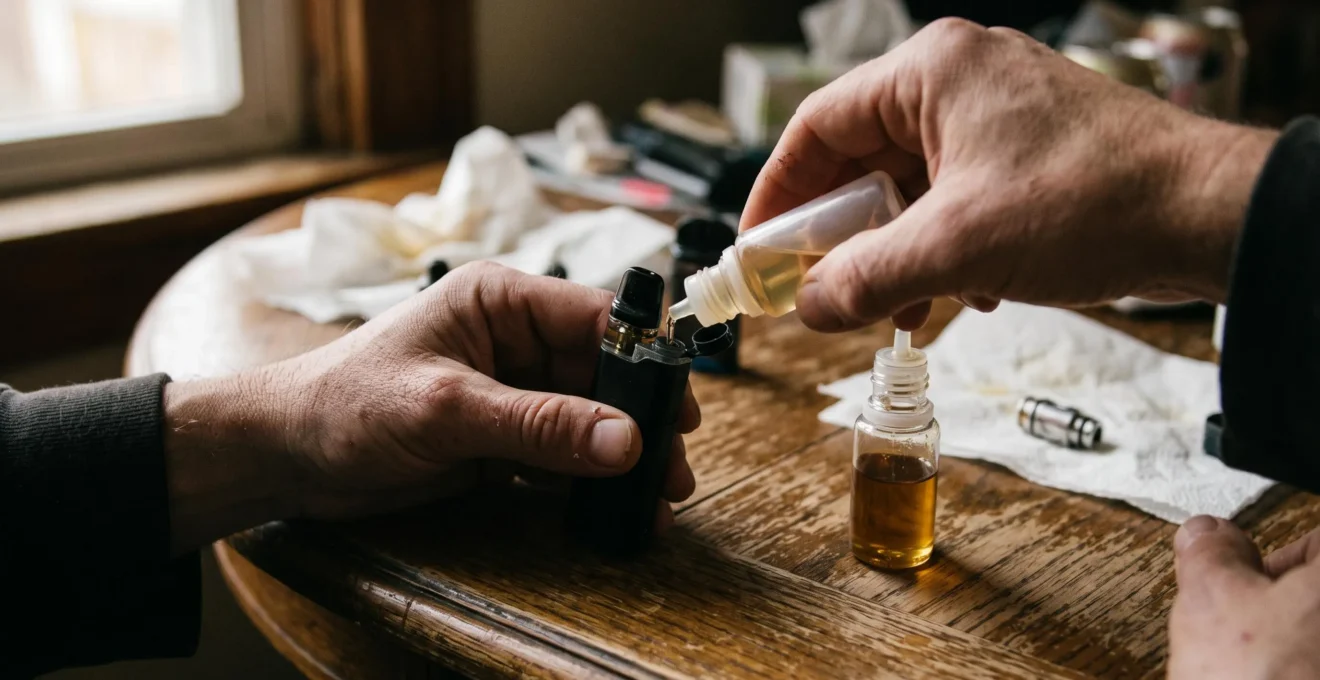
Propylene glycol (PG) affects how an e-liquid feels in the throat, how clearly its flavour comes through and how readily it moves through a vape coil. Compared with vegetable glycerine (VG), PG is thinner and generally produces less visible aerosol. A higher proportion of PG may also make inhalation feel more pronounced, although nicotine, device power and airflow all influence the sensation.
These differences matter when comparing e-liquid bases for refillable pods, mouth-to-lung (MTL) devices and direct-to-lung (DTL) kits. The same liquid can perform well in one device but cause gurgling, leakage or dry hits in another because their coils absorb and vaporise liquid at different rates.
Understanding the PG/VG balance is therefore more useful than assuming a particular ratio is universally better. For adult UK vapers, the practical question is whether the liquid’s viscosity, nicotine formulation and sensory characteristics suit the hardware being used. Neither a smoother sensation nor a larger visible cloud establishes that an aerosol is safer to inhale.
Propylene glycol in e-liquid: the essentials
- PG influences throat sensation and nicotine aerosol delivery, but nicotine form, concentration and operating conditions also determine perceived intensity.
- Higher-PG liquids are thinner and generally suit smaller, lower-power devices better than coils designed for thick, VG-rich liquids.
- VG contributes to denser visible aerosol, while the balance between PG and VG affects flavour perception, wicking and device compatibility.
- Why Can Higher-PG E-Liquid Produce a More Noticeable Throat Sensation?
- How Do You Use Higher-PG Liquid Without Creating Flooding in an Unsuitable Coil?
- PG or VG: Which Matters More for Flavour Clarity Versus Vapour Volume?
- Which Reactions Can Mean a High-PG E-Liquid Does Not Suit You?
- When Should You Choose a Different PG Level After Changing Vape Hardware?
- High-VG or 50/50 E-Liquid: Which Better Matches Your Device and Inhale Style?
- How Do You Match a PG/VG Ratio to Your Coil and Device Type?
- What Factors Make a Vape Feel Stronger in the Throat?
Why Can Higher-PG E-Liquid Produce a More Noticeable Throat Sensation?
Higher-PG e-liquid can produce a more noticeable throat sensation because the liquid’s composition affects aerosol formation, nicotine emissions and inhalation characteristics. However, PG does not independently determine throat hit. Nicotine concentration, nicotine chemistry, coil temperature and inhalation behaviour can substantially change how strong the same formulation feels.
PG has a lower viscosity than VG, making it easier for the liquid to move through suitable wicking materials. The two ingredients also influence the physical properties of the aerosol generated by a heated coil.
A scientific study on PG/VG composition and aerosol characteristics measured particle count median diameters ranging from 44 to 97 nm across experimental formulations. The PG-rich liquids produced smaller measured particle diameters and greater nicotine emissions under the tested conditions.
Those observations do not establish that smaller particles travel more directly to the throat or necessarily cause a stronger sensation. Aerosol behaviour depends on measurement methods, the device and the conditions of inhalation.
Nicotine provides another important explanation. In the experimental device, liquid composition affected nicotine emissions despite a fixed nicotine concentration. Consequently, a difference attributed to PG may partly reflect a change in nicotine delivery rather than a direct sensory effect of the carrier alone.
Power settings further complicate the comparison. Increasing power within a device’s operating range changes aerosol temperature and production. Depending on the formulation and inhalation pattern, the resulting sensation may become more intense or unpleasant. Excessive power can also cause poor wicking and overheating.
44–97 nm
Range of particle count median diameters measured across three experimental PG/VG formulations in a laboratory study. These values are not universal particle-size specifications for commercial e-liquids or vape devices.
Aerosol Science and Technology, 2017; controlled measurements using a second-generation electronic cigarette.
A defined throat sensation and irritation should not be treated as interchangeable. Some adults seek a noticeable sensation during inhalation, but persistent burning, stinging or coughing indicates that the experience should not simply be intensified further.
Throat sensation is therefore an outcome of the complete liquid-and-device combination. A sharper inhale does not, by itself, identify which ingredient or operating condition is responsible.
How Do You Use Higher-PG Liquid Without Creating Flooding in an Unsuitable Coil?
To reduce flooding with higher-PG e-liquid, first confirm that the coil is designed for relatively thin liquid. PG-rich formulations can enter large wicking openings faster than the coil vaporises them, particularly in some sub-ohm tanks. Gentle initial use and clearing excess liquid may help temporarily, but persistent flooding usually requires a better-matched liquid or coil.
Flooding occurs when more liquid reaches the coil chamber than can be vaporised during normal operation. Because PG-rich e-liquids are less viscous, they can move readily through large wicking ports designed to supply thicker liquid at higher power.
The result may be a bubbling or gurgling sound, droplets reaching the mouthpiece, inconsistent aerosol production or liquid escaping through the airflow openings. However, similar symptoms can also result from damaged seals, condensation, incorrect assembly or an unsuitable operating setting.
If a refillable tank starts gurgling after switching to a thinner liquid, inspect it before changing several settings at once.
- Check that the coil is correctly installed, the seals are intact and the tank is assembled according to its instructions.
- When preparing a new coil, follow the manufacturer’s priming guidance. Avoid leaving excess unabsorbed liquid in the coil chamber.
- Begin with gentle, relatively short draws at a recommended power setting, allowing normal wicking between puffs.
- If the device allows airflow adjustment, a modest reduction may be tested while remaining within its intended operating conditions.
- If liquid has accumulated in the central chimney, remove or isolate the tank as appropriate and carefully flick it downward over a tissue, following the device’s handling instructions.
Clearing the chimney addresses accumulated liquid, not the underlying cause of repeated over-wicking.
Large sub-ohm mesh coils and high-power DTL tanks often have generous liquid-feed openings because they are intended to support substantial liquid consumption. Their compatibility with thinner formulations varies by design, so resistance alone does not determine whether flooding will occur.
If gurgling and spit-back repeatedly return within a few puffs after the tank has been checked and cleared, a viscosity mismatch becomes a plausible explanation. A manufacturer-approved 50/50 or more VG-rich formulation may be preferable, depending on the coil’s requirements.
Persistent flooding is not necessarily a defective coil. Once assembly faults have been excluded, changing to a compatible liquid is generally more useful than repeatedly modifying the priming routine.
PG or VG: Which Matters More for Flavour Clarity Versus Vapour Volume?
PG is generally associated with clearer flavour delivery, while VG contributes more to dense, visible aerosol. PG works as a solvent for many flavour ingredients, whereas VG has a slightly sweet character and increases liquid viscosity. Neither ingredient guarantees better flavour or more satisfying inhalation: the final result also depends on the formulation, coil and device settings.
In e-liquids, PG helps dissolve and distribute many aromatic compounds. Its comparatively neutral taste can allow particular flavour notes to remain more distinct. VG adds viscosity and a mild sweetness that may change how those notes are perceived.
This creates a practical trade-off. Increasing the VG proportion can make the exhaled aerosol more visible, while a PG-rich formulation may produce a lighter-looking aerosol and a more defined sensory impression.
The evidence for visible aerosol is stronger than a universal claim about flavour superiority. In the 2017 laboratory study described earlier, VG-containing aerosols scattered approximately ten times as much light as the PG-rich aerosols under the tested conditions. Light scattering is not equivalent to the total amount of aerosol inhaled.
Flavour category adds another variable. Rich dessert and cream profiles may work well with VG’s sweet, fuller character, while fruit and menthol formulations are often designed to preserve crisp or distinct notes. These are formulation tendencies, not rules established for every flavour concentrate or user.
The experimental study on PG and VG sensory effects compared five PG/VG compositions with 16 e-cigarette users. It found stronger reported inhalation sensations for mixtures than for formulations containing only one carrier. Greater VG content was also associated with more visible exhaled aerosol.
Importantly, this small study used unflavoured formulations. Its findings cannot demonstrate that fruit flavours require PG or that dessert flavours are objectively better with VG.
| Characteristic | Higher PG proportion | Higher VG proportion |
|---|---|---|
| Liquid consistency | Thinner, generally faster-flowing | Thicker, generally slower-flowing |
| Flavour perception | Can emphasise distinct flavour notes | May add sweetness and alter perceived definition |
| Visible aerosol | Generally less dense-looking | Generally denser and more visible |
| Wicking behaviour | Better suited to some narrow liquid-feed systems | Better suited to some large-port, high-output coils |
| Throat sensation | May feel more defined in certain formulations | Often perceived as softer, but not universally |
Before attributing disappointing flavour to the PG/VG ratio, check whether the coil is worn, the power setting is appropriate and the liquid has been stored and used as intended. The formulation’s flavour ingredients and maturation characteristics can also affect the result.
The best ratio is not necessarily the one that maximises one characteristic. It is the ratio that produces acceptable flavour and consistent wicking in the intended hardware.
Which Reactions Can Mean a High-PG E-Liquid Does Not Suit You?
Persistent throat dryness, coughing, mouth irritation or discomfort after switching to a higher-PG e-liquid may indicate that the formulation does not suit you. These symptoms are not specific to PG, however. Nicotine strength, flavour ingredients, coil condition and device power can produce similar complaints, so a reaction should not automatically be labelled a PG allergy.
PG is hygroscopic, meaning it attracts and retains water. Dry mouth or throat discomfort may therefore be noticed during use, although the presence of these symptoms does not establish PG as their cause.
Other reactions worth monitoring include:
- Persistent dryness or irritation in the mouth or throat.
- Coughing that begins or becomes more frequent after a formulation change.
- Stinging or irritation affecting the lips or oral tissues.
- Chest tightness or breathing discomfort associated with use.
Some unfamiliar inhalation sensations may diminish after a change in formulation or usage pattern. Nevertheless, there is no medically established adjustment period that makes persistent irritation safe to ignore. Continuing exposure simply to see whether symptoms disappear is not a reliable approach.
True allergic contact reactions to PG are recognised but uncommon. A reported reaction during vaping does not establish allergy, and the studies in the supplied evidence concern aerosol characteristics and inhalation sensations rather than the diagnosis or frequency of PG allergy.
For mild, non-urgent symptoms, a controlled comparison can help identify a possible trigger. Stop using the suspected product while symptoms are present. Once symptoms have resolved, any decision to compare formulations should take account of medical advice where appropriate.
If comparing liquids, keep the device, nicotine concentration and operating conditions as consistent as possible and change only the PG/VG balance. Record the formulation used, timing and symptoms over several days rather than relying on memory.
Even if symptoms improve with a different liquid, that observation suggests a possible association rather than proving PG sensitivity. Flavouring composition and other formulation differences may remain uncontrolled.
Breathing difficulty, wheezing, swelling or significant chest tightness warrant stopping vaping and seeking prompt medical assessment. Severe breathing difficulty or swelling affecting the mouth or throat requires emergency assistance. These symptoms should never be treated as an ordinary adjustment to a new PG ratio.
A formulation that repeatedly causes discomfort is not made suitable simply by changing the airflow or persisting with it. When symptoms are significant or recurrent, medical assessment takes precedence over further experimentation.
When Should You Choose a Different PG Level After Changing Vape Hardware?
Reconsider the PG/VG ratio whenever a hardware change substantially alters coil resistance, power, wicking design or inhalation style. Moving from a low-power pod to a sub-ohm tank often favours a more VG-rich liquid, while switching to a small MTL device may require a thinner formulation. The manufacturer’s coil guidance should determine the final choice.
A refillable pod and a high-output DTL tank do not necessarily use liquid at the same rate. Their coils may differ in heating surface, operating temperature and the size of the openings supplying the wick.
That difference explains why continuing with the same e-liquid after changing devices can create problems even when the liquid previously performed well.
There are two common mismatch patterns:
- Thin liquid in a large-port coil: liquid may enter the chamber more quickly than it is vaporised, increasing the possibility of gurgling, spit-back or leakage.
- Thick liquid in a narrow-port coil: the wick may struggle to replenish liquid between draws, increasing the possibility of dry hits, poor flavour or overheated wicking material.
These are possible mechanisms rather than definitive diagnoses. Defective components, coil wear and operating settings can produce similar symptoms.
When moving between MTL and DTL hardware, reconsider nicotine concentration and formulation as well. Devices that generate more aerosol per puff may deliver nicotine differently from low-output systems. The same labelled concentration does not imply the same nicotine exposure across devices.
The distinction between refillable and pre-filled cartridges also matters. A pre-filled cartridge is ordinarily designed around its supplied formulation and is not necessarily intended to be opened or refilled. Compatibility guidance is therefore particularly important before changing hardware types.
During the first tankful in a new compatible device, observe three signals: dry or burnt-tasting puffs, recurring gurgling or leakage, and a noticeable loss of flavour quality. Each may indicate a mismatch, but none identifies the PG/VG ratio as the only possible cause.
If symptoms persist after confirming assembly, coil condition and recommended settings, review the liquid specification rather than repeatedly raising power or changing inhalation technique.
The objective is predictable liquid delivery rather than compensating for an unsuitable coil. Hardware compatibility also provides the starting point for choosing between standard 50/50 and VG-rich formulations.
High-VG or 50/50 E-Liquid: Which Better Matches Your Device and Inhale Style?
50/50 e-liquid generally matches many low-power MTL pods and vape pens, while high-VG formulations more commonly suit sub-ohm tanks designed for DTL inhalation. The deciding factor is the coil’s liquid-feed design rather than cloud preference alone. Some devices support intermediate ratios, but manufacturer guidance remains more reliable than a general rule.
A 50/50 e-liquid contains equal proportions of PG and VG in the stated base ratio. Its moderate viscosity can support the relatively small liquid-feed openings found in many lower-output devices.
High-VG describes formulations with a larger VG proportion, commonly around 70% or more. However, labels such as “high VG” and “max VG” do not identify a single universal composition. Check the declared percentages rather than assuming two products will flow identically.
Inhale style provides useful context. MTL devices are generally designed for drawing aerosol into the mouth before inhalation, often with relatively restricted airflow. DTL devices commonly support a more open draw and greater aerosol production.
The relationship is practical, not absolute. Certain modern pod systems support different coils and ratios, so the device category alone cannot establish compatibility.
| Decision factor | 50/50 e-liquid | High-VG e-liquid |
|---|---|---|
| Typical hardware | Compatible lower-power pods and MTL pens | Compatible sub-ohm tanks and high-output kits |
| Common inhale style | Mouth-to-lung | Direct-to-lung |
| Liquid viscosity | Moderate | Higher |
| Visible aerosol | Generally less dense-looking | Generally denser-looking |
| Main mismatch risk | Over-wicking in some large-port systems | Slow wicking in some narrow-port systems |
| Compatibility priority | Coil manufacturer’s supported ratios | Coil manufacturer’s supported ratios |
Intermediate formulations can provide another option. For instance, a liquid labelled 60VG/40PG is generally thinner than one labelled 70VG/30PG, all else being equal. These ratios are written here with VG first; product labels should always be checked for their stated order.
An intermediate ratio may be useful when a compatible device supports several formulations, but it should not be assumed to work across both a small pod and a high-powered tank.
Coil longevity introduces another consideration. Using liquid that is too viscous for a narrow-port coil may contribute to insufficient saturation, overheating and premature coil replacement. The financial cost of unsuitable liquid can therefore extend beyond the price of the bottle.
If a device supports both formulations, a small-scale comparison can clarify personal preferences. If it specifies a particular ratio range, that requirement should take priority over flavour or cloud expectations.
How Do You Match a PG/VG Ratio to Your Coil and Device Type?
Match a PG/VG ratio to your coil by checking the device manufacturer’s liquid recommendations, the coil’s resistance and operating power, and the size of its wicking openings. Higher-resistance, lower-power systems often favour thinner liquids, while lower-resistance, higher-output coils frequently accommodate more VG. The match should then be checked through normal device performance.
Coil resistance is usually expressed in ohms (Ω). It provides useful information about the type of hardware but does not independently determine which liquid ratio will work.
The underlying requirement is sufficient wicking: liquid must replenish the material around the heating element at a rate compatible with vaporisation. Too little supply can cause dry hits, while excessive supply or inadequate vaporisation can contribute to flooding.
This is why two devices can behave differently with the same 50/50 liquid. Their wicking ports, heating elements, power characteristics and airflow systems may not be comparable.
Published research also illustrates why liquid composition should not be reduced to a single physical measurement. A NIOSH-affiliated study on e-liquid aerosol particle size found that PG/VG composition influenced measured aerosol particle distributions. However, these differences did not produce substantial differences in modelled respiratory deposition.
That research concerns aerosol properties, not coil compatibility. Practical ratio selection still requires information about the particular device.
For a borderline match, allowing more time between draws may help a slightly viscous liquid replenish the wick. This is not a substitute for following the manufacturer’s specifications, and repeated dry hits should prompt the user to stop rather than continue testing a potentially unsuitable configuration.
Five checks before committing to a PG/VG ratio
- Identify the coil. Record its model, resistance in ohms and compatible device in a short reference note.
- Check official guidance. Find the manufacturer’s supported liquid types and operating range; record the recommendation or note when it is unavailable.
- Read the bottle specification. Write down the PG/VG percentages, their stated order and the nicotine concentration.
- Test a small quantity. Use one compatible sample under normal recommended conditions and keep a brief record of dry hits, gurgling, leakage and flavour quality over several days.
- Record the outcome. Mark the combination as suitable, uncertain or unsuitable, then identify the next change needed without altering several variables simultaneously.
Testing a small bottle before purchasing larger quantities limits waste and helps distinguish an occasional abnormal puff from a repeated compatibility issue. It does not guarantee long-term coil performance or establish the health effects of the liquid.
Once a liquid is compatible with the hardware, throat sensation becomes the next consideration. Even an appropriately wicked coil can produce an inhale that feels stronger than expected.
Key takeaways before adjusting throat sensation
- A compatible PG/VG ratio addresses liquid delivery, but it does not independently determine inhalation intensity.
- Nicotine chemistry, power and airflow can alter throat sensation without changing the PG/VG ratio.
- Identify whether the problem is unwanted harshness, poor wicking or an unsuitable nicotine formulation before making adjustments.
What Factors Make a Vape Feel Stronger in the Throat?
A vape can feel stronger in the throat because of nicotine concentration, nicotine form, PG/VG composition, operating power, airflow, coil condition and flavour ingredients. These variables interact rather than acting independently. Freebase nicotine often produces a sharper sensation than nicotine salts at comparable concentrations, while excessive heat or inadequate wicking can introduce unwanted harshness.
Nicotine is particularly important. Freebase and protonated nicotine differ in their chemical behaviour, including how they partition between the aerosol and gas phase. This can influence nicotine absorption and perceived throat sensation.
A 2026 study published in Tobacco Control combined physical modelling with human measurements of throat hit in DTL vaping. Its modelled nicotine absorption in the throat was associated with participants’ subjective throat-hit scores, with a reported correlation of r = 0.62 and p < 0.00001.
In the studied conditions, freebase nicotine produced calculated throat absorption values five to ten times those associated with protonated nicotine. These are model-based comparisons under particular experimental conditions, not universal ratios between commercial nicotine products.
The researchers also identified nicotine concentration, aerosol temperature and inhalation rate as influential factors. The findings reinforce why PG concentration alone cannot explain every difference in perceived intensity.
Airflow and power contribute to the complete experience. A more restricted MTL draw changes the inhalation pattern compared with an open DTL draw. Coil output and temperature also affect aerosol production, while a worn or inadequately saturated coil can create an unpleasant burnt sensation unrelated to a desirable throat hit.
Flavour ingredients add another layer. Menthol and other sensory-active flavourings may alter how inhalation feels, although their effects depend on the formulation and user. A stronger cooling sensation should not be confused with a higher nicotine dose.
For someone experiencing an overly intense inhale, the appropriate response depends on the suspected cause:
- If the sensation appears nicotine-related, review nicotine concentration and formulation rather than assuming PG is responsible.
- If the coil tastes burnt or produces dry hits, stop using that configuration and check the coil, liquid compatibility and recommended settings.
- If the intensity changed after a power adjustment, return to a manufacturer-supported operating setting.
- If coughing, irritation or chest discomfort persists, discontinue the suspected product and seek medical advice when appropriate.
Lowering nicotine concentration may reduce nicotine-related throat hit. Switching from freebase to a nicotine-salt formulation may also change perceived harshness, but neither adjustment guarantees comfort or makes vaping harmless. Nicotine exposure can vary substantially between devices and usage patterns.
For a practical next step, record the current liquid’s PG/VG ratio, nicotine type and concentration alongside the coil model and recommended settings. Review one relevant factor at a time, prioritise device compatibility and stop using any formulation that repeatedly causes discomfort.
Does a higher PG percentage always produce a stronger throat hit?
No. PG/VG composition affects aerosol properties and can influence inhalation sensation, but the relationship is not necessarily linear. Nicotine concentration, nicotine form, aerosol temperature and inhalation behaviour also matter. Experimental research has found that mixed PG/VG formulations can produce stronger reported sensations than either ingredient used alone.
Can two e-liquids with the same PG/VG ratio have different viscosities?
Yes. The stated PG/VG ratio describes the relative proportions of the main base ingredients, but other formulation components and temperature can influence how the finished liquid flows. Consequently, matching ratios do not guarantee identical wicking behaviour in every device.
Does a larger vapour cloud mean more nicotine is being inhaled?
Not necessarily. VG-rich aerosols can appear substantially more visible because of differences in light scattering. Cloud appearance does not directly measure nicotine intake. Nicotine delivery also depends on the liquid concentration, device characteristics and inhalation pattern.
Can you mix 50/50 and high-VG e-liquids to obtain an intermediate ratio?
Mixing formulations can change their overall PG/VG balance, but the resulting ratio depends on the volumes and compositions used. Nicotine concentration, flavour strength and other ingredients can also change. The resulting mixture should not be assumed to suit a particular coil without checking its requirements, and pre-filled cartridges should not be modified contrary to their instructions.
Is vegetable glycerine safer to inhale than propylene glycol?
The evidence discussed here does not establish that either ingredient is safer to inhale. The cited studies examine physical aerosol characteristics, nicotine emissions and sensory effects rather than providing a comprehensive comparison of long-term health risks. A smoother throat sensation or denser cloud is not evidence of lower respiratory harm.