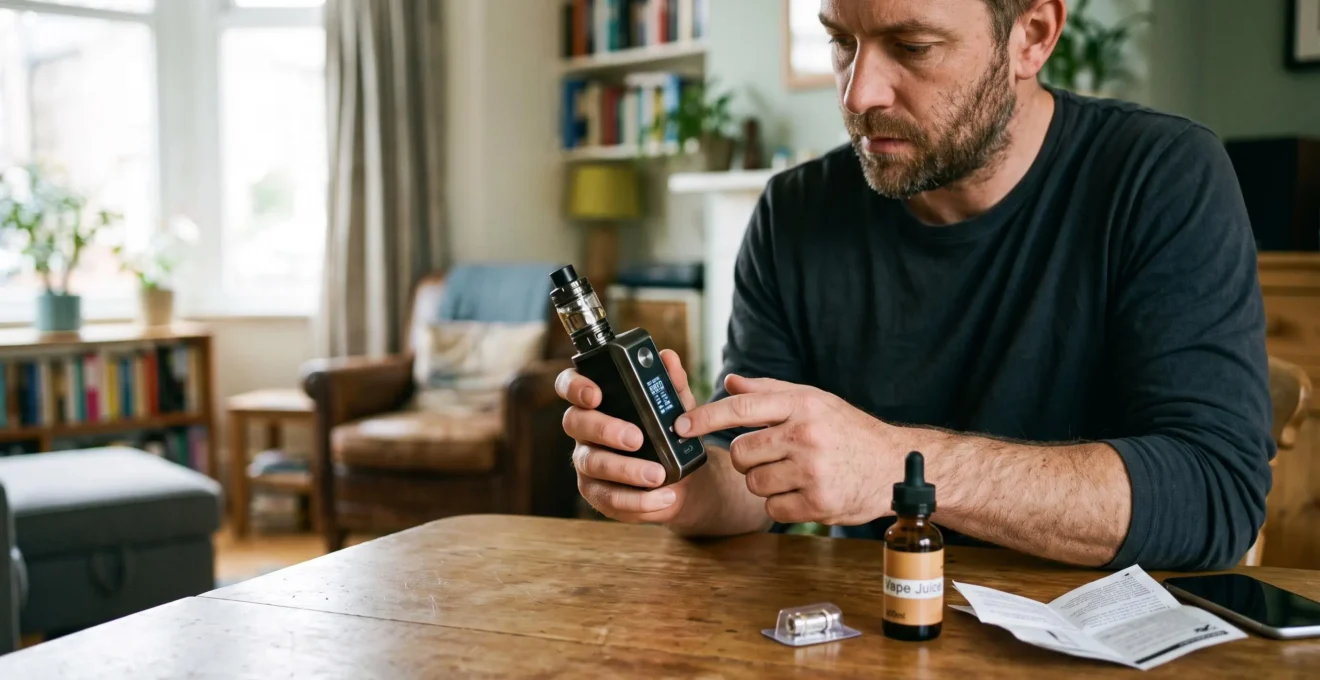
A box mod makes sense when an experienced adult vaper has a specific technical requirement that a smaller device cannot meet. Adjustable output, compatibility with different atomisers, replaceable batteries and specialist coil settings can justify the additional size. However, a box mod is not automatically better simply because it offers more power or a larger display.
The distinction is between having adjustable settings and knowing why they need adjusting. A suitable coil, appropriate power range, reliable battery arrangement and correctly configured operating mode matter more than the maximum wattage advertised by a device. Greater flexibility also introduces more opportunities for configuration errors.
For experienced UK vapers weighing a box mod against a pod mod or basic regulated device, the useful question is whether existing hardware imposes a genuine limitation. Understanding that limitation before upgrading helps avoid unnecessary purchases, incompatible components and potentially unsafe operating conditions.
Vaping is not risk-free, and technical adjustments cannot establish that aerosol exposure is safe. The following guidance concerns equipment compatibility, operation and risk reduction for adults already using vaping products, rather than encouraging non-users to start.
Box mods: the essential decisions
- Choose a box mod when precise output control, specific atomiser compatibility or replaceable batteries solve a practical limitation.
- Match power and temperature-control settings to the installed coil, not the device’s maximum capability.
- Consider battery condition, additional maintenance and overall equipment compatibility before upgrading.
- Why Do Box Mods Give Users More Control Over Vapour and Coil Performance?
- How Do You Set Up a Box Mod Without Exceeding the Coil’s Recommended Power Range?
- Box Mod or Pod Mod: Which Better Suits Adjustable Power Without Excess Bulk?
- Which Box Mod Mistakes Can Create Battery or Coil Safety Problems?
- When Is It Worth Upgrading From a Basic Mod to a More Advanced Box Mod?
- Low or High Wattage: Which Range Better Suits Your Coil and Inhale Style?
- How Do You Set Up Temperature Control Without Using an Incompatible Coil?
- Are RTAs Practical for Experienced Vapers Who Want Fewer Refills?
Why Do Box Mods Give Users More Control Over Vapour and Coil Performance?
Box mods offer greater control because their electronic circuitry can regulate power delivery and, on compatible models, estimate coil temperature from changes in resistance. Larger interfaces may also display electrical readings and additional operating modes. These features allow experienced users to manage specific coil behaviour, provided they understand the limitations of the atomiser and device.
Variable wattage is the most familiar control. Increasing electrical power generally increases the energy delivered to the heating coil over a given period. How that energy translates into coil temperature, vapour production and liquid consumption depends on coil construction, airflow and how effectively the wick supplies e-liquid.
The relationship is not simply a matter of choosing a higher number. A coil operating with insufficient liquid supply can overheat, while one receiving too little power may produce inadequate vaporisation or allow excess liquid to accumulate. The appropriate operating point is therefore specific to the atomiser.
Box mods can provide three distinct layers of adjustment:
- Power delivery: variable wattage, and sometimes programmable power curves, allow adjustment of the energy supplied during activation. Power curves are not available on every regulated device.
- Temperature control: compatible devices estimate coil temperature from resistance changes in suitable wire materials, subject to chipset accuracy and correct setup.
- Electrical feedback: resistance, voltage, battery indicators and, on some devices, current information can help identify changes or configuration problems.
Temperature control deserves particular caution. A 2018 experimental investigation published in PLOS ONE found substantial differences between measured coil temperatures and device settings in the systems examined. The researchers used direct temperature measurements rather than relying solely on the displayed values. The PLOS ONE research on temperature-control accuracy in e-cigarettes demonstrates why an on-screen temperature should not be treated as a guaranteed physical measurement.
This makes technical understanding more valuable than an extensive menu. Someone who regularly changes atomisers or works with different coil materials may benefit from additional controls. Someone who uses one compatible replaceable coil at a consistent setting may gain little from them.
Control is therefore a reason to choose a box mod only when it serves a clear purpose. The next consideration is whether the selected coil can operate correctly at the power being supplied.
How Do You Set Up a Box Mod Without Exceeding the Coil’s Recommended Power Range?
Start with the coil manufacturer’s recommended wattage range, not the box mod’s maximum output. Confirm that the fitted coil and atomiser are compatible, begin at the lower end of the stated range and increase power cautiously only if necessary. Stop if flavour deteriorates, the draw becomes unusually harsh or the device reports an electrical problem.
A box mod rated for a high maximum output does not make every attached coil capable of tolerating that power. The coil’s construction, resistance, wicking material and liquid supply determine its practical operating conditions. The manufacturer’s rating provides the relevant starting reference, although it is not a guarantee of safe aerosol composition.
Before operating a regulated box mod, follow the equipment’s specific installation instructions:
- Check the atomiser and coil documentation for compatibility, recommended power and any installation requirements.
- Inspect the device and battery arrangement. Install only the battery type and orientation specified by the manufacturer.
- Fit the coil correctly, check that seals and contacts are in suitable condition, and prepare the wick as directed by the coil manufacturer.
- Confirm that the device recognises the atomiser and that its displayed resistance is reasonably consistent with the coil specification. Stop and investigate unexpected or unstable readings.
- Select the correct operating mode and begin at the lower end of the coil’s recommended wattage range. Adjust gradually within that range only when the coil is properly saturated and operating normally.
Resistance locking is not a universal step for wattage-mode setup. It is primarily relevant to temperature-control systems that require a reliable cold-resistance reference. Follow the manufacturer’s instructions rather than locking an arbitrary reading.
There is a measurable reason to respect those limits. A 2020 experimental study examined power settings and carbonyl emissions using two electronic cigarettes and four atomiser configurations. Under some tested conditions, exceeding the manufacturer’s recommended upper power level by just 5 watts produced substantially higher carbonyl emissions.
Up to 20 times
The increase in carbonyl emissions measured in some experimental configurations when power exceeded the recommended maximum by 5 W. This was the maximum reported result under the study conditions, not a universal prediction for every coil.
Tobacco Induced Diseases study on power settings and carbonyl emissions, 2020.
A burnt or dry-tasting draw can indicate insufficient wicking or excessive heating. Continued use should stop while the cause is checked. Once cotton has been scorched, lowering the wattage may not restore the coil’s condition, and replacement may be necessary.
The correct settings depend on the installed hardware. Once those requirements are understood, the next question is whether a box mod is needed at all or whether a smaller device already provides sufficient adjustment.
Box Mod or Pod Mod: Which Better Suits Adjustable Power Without Excess Bulk?
A pod mod is generally sufficient when an adult user wants modest wattage adjustment, simple coil replacement and compact everyday hardware. A box mod becomes more relevant when interchangeable atomisers, replaceable batteries, specialist operating modes or greater configuration flexibility are essential. The choice depends on which features are actually needed, not which device category appears more advanced.
Modern pod mods are not necessarily fixed-output devices. Some provide adjustable power, informative displays and replaceable coil systems. Their main limitation is often the degree of compatibility with other atomisers or battery configurations rather than the complete absence of control.
Box mods can accommodate a wider range of suitable tanks through compatible connectors, although connector compatibility alone does not guarantee correct electrical or mechanical operation.
The following comparison highlights practical differences rather than treating either category as universally superior.
| Criterion | Pod mod | Box mod |
|---|---|---|
| Wattage adjustment | Available on some models, often within a more limited range | Usually adjustable, with the range determined by the model |
| Battery arrangement | Often an integrated rechargeable battery | May use integrated or replaceable batteries |
| Coil and tank options | Usually tied to a compatible pod or cartridge system | Potentially supports multiple compatible atomisers |
| Advanced operating modes | Typically fewer options | May include temperature control or configurable power delivery |
| Portability | Generally compact | Varies considerably; dual-battery devices are typically larger |
| Maintenance | Usually simpler cartridge or coil replacement | Can involve separate tank maintenance and battery management |
| Best fit | Users prioritising compactness and straightforward adjustments | Users with specific compatibility or configuration needs |
Size deserves a more nuanced assessment than the assumption that every box mod is bulky. A compact single-battery design may occupy only somewhat more space than a larger pod system, depending on the tank fitted. A dual-battery configuration creates a more noticeable increase in weight and volume.
However, replaceable batteries do not automatically provide longer operating time. Runtime depends on cell capacity, power demand, device efficiency and the condition of the batteries. A larger device may also be less convenient to transport and maintain.
Consider two hypothetical users. The first replaces a proprietary coil periodically, uses a single power setting and carries the device throughout the day. An adjustable pod mod may already meet those requirements.
The second uses several compatible tanks, requires a particular operating mode and regularly monitors coil resistance. A regulated box mod may provide features that a proprietary pod system cannot.
If a smaller device performs the required functions reliably, moving to a box mod adds complexity without necessarily improving the experience. When a larger device is justified, battery handling becomes a particularly important responsibility.
Which Box Mod Mistakes Can Create Battery or Coil Safety Problems?
The most consequential box mod mistakes include using damaged removable batteries, carrying exposed cells near metal objects, charging improperly and fitting incompatible atomiser components. Incorrect coil settings can also cause overheating or poor operation. Regulated devices provide electronic protections, but those safeguards cannot eliminate risks from battery damage, misuse or component failure.
Removable lithium-ion batteries require particular care because accidental contact between conductive objects and exposed terminals can create a short circuit. Damaged insulation, unsuitable chargers and incompatible cells can also contribute to dangerous conditions.
In multi-battery devices, differences between cells can complicate battery management. Where the manufacturer specifies paired cells, they should be identical in the required specifications, acquired together, used together and maintained in comparable condition. Never combine batteries simply because they physically fit.
Regulated and unregulated devices should not be treated as equivalent. Regulated box mods commonly incorporate some combination of short-circuit detection, current limits, temperature monitoring and low-voltage protection, but the exact safeguards vary by model. An unregulated device may lack these electronic controls and requires separate technical understanding of the electrical circuit and battery limits.
A protected electronic circuit cannot repair a torn battery wrap or prevent every external short circuit. Battery condition therefore remains an independent safety requirement.
The UK’s Office for Product Safety and Standards has issued consumer guidance recommending genuine, suitable batteries, protective cases for spare cells, regular inspection and immediate replacement of damaged batteries. The UK government guidance on e-cigarette battery safety also advises against overnight charging and recommends keeping charging equipment away from combustible materials.
Coil-related mistakes require a separate check. Excessive power can overheat the heating assembly, while incorrect temperature-control configuration can lead to unreliable regulation. A resistance reading that changes unexpectedly may indicate a connection, installation or component problem rather than a setting that simply needs adjusting.
Five checks before using a removable-battery box mod
- Inspect each battery: confirm that its wrap, insulating ring and casing show no visible damage; set aside any questionable cell for appropriate assessment or replacement.
- Verify battery compatibility: compare the cell identification and specifications with the device manufacturer’s requirements; retain the relevant specification information.
- Check multi-cell arrangements: confirm that required battery pairs have matching specifications and comparable condition; identify the cells that belong together.
- Check charging conditions: confirm charger compatibility and prepare a clean, suitable surface away from combustible materials; do not leave charging unattended or overnight.
- Inspect the atomiser connection: verify correct installation and a stable resistance reading; stop using the equipment if an unexpected warning or abnormal condition appears.
Loose batteries should never be carried with keys, coins or other metal objects. Use purpose-made protective cases, and keep damaged cells out of service. If a battery becomes unusually hot, swells, leaks or otherwise behaves abnormally, discontinue use and follow appropriate battery-safety guidance.
These precautions reduce foreseeable handling risks but cannot guarantee incident-free operation. Battery management and equipment maintenance should therefore be considered part of the cost of moving to more sophisticated hardware.
When Is It Worth Upgrading From a Basic Mod to a More Advanced Box Mod?
Upgrading is worthwhile when a basic mod prevents an experienced adult user from meeting a specific technical requirement. Examples include needing a supported temperature-control mode, compatibility with another atomiser or a suitable replaceable-battery arrangement. A higher maximum wattage, more elaborate screen or newer product alone does not establish a meaningful reason to change devices.
The term « advanced » describes capabilities, not price. A costly device may offer functions that remain unused, while a simpler regulated box mod may already provide the control required for a particular tank.
Different upgrades solve different problems:
- Temperature-control support: relevant when the user has an appropriate coil material and understands the configuration requirements.
- Power compatibility: relevant when a desired atomiser’s recommended operating range is not supported by the existing device.
- Battery configuration: relevant when replaceable cells or a different manufacturer-supported arrangement address practical maintenance needs.
- Improved information display: potentially useful when resistance readings, warnings or battery status are difficult to interpret on the existing unit.
- Firmware support: useful only when the manufacturer provides reliable, applicable updates addressing a genuine compatibility or operational need.
A useful upgrade decision begins with the precise function that is missing. If the current device already operates the chosen coil within its manufacturer’s specifications and provides the necessary safeguards, changing the mod may offer limited practical improvement.
Costs also extend beyond the device itself. A replacement mod may use a different battery format, require a compatible charger or reveal limitations with an existing tank. Changing the atomiser can introduce another coil family and a new maintenance routine.
Hypothetical upgrade assessment
An adult user owns a regulated mod that operates their usual replaceable-coil tank correctly. They are considering a more expensive box mod simply because it offers a substantially higher maximum output.
If the existing coil cannot operate at that additional power, the new output ceiling offers no practical benefit for the current setup. An upgrade would become more relevant only if a specific compatible atomiser or operating feature required capabilities the existing device lacks.
Before replacing anything, establish the complete equipment requirements and compare them against the current manufacturer’s specifications. This may reveal that a compatible component or better maintenance is sufficient without changing the entire device.
Advanced hardware is most useful after the user has mastered the basic relationship between coil compatibility, power settings and battery handling. That relationship becomes particularly important when choosing between lower- and higher-power atomisers.
Low or High Wattage: Which Range Better Suits Your Coil and Inhale Style?
Lower-wattage configurations are often associated with more restricted airflow, relatively higher-resistance coils and slower mouth-to-lung inhalation. Higher-wattage configurations commonly accompany lower-resistance coils and more open, direct-to-lung airflow. However, the appropriate setting is determined by the actual coil specification and liquid supply, not inhalation style or resistance alone.
Wattage determines the rate at which the device supplies electrical energy to the heating assembly. Coil surface area, construction, airflow and wicking determine how that energy is distributed and how effectively liquid is vaporised.
Consequently, two coils with the same resistance may have different operating requirements. Resistance alone does not indicate the correct power level, especially when comparing different materials or coil geometries.
Higher power can increase vapour production and liquid consumption within a coil’s intended operating conditions. It can also place greater demands on wicking and battery energy. A lower setting may consume less liquid, but operating too far below the intended range can produce weak vaporisation or contribute to flooding in some systems.
An experimental study of 13 commercial atomisers identified three broad operating regimes: under-heating, an optimal vaporisation region and overheating associated with dry-burn. The experimental study of coil power ranges and e-liquid consumption found that the appropriate power conditions varied across the atomisers tested.
That finding is more useful than a universal wattage recommendation. Even where manufacturers specify a range, the system’s actual behaviour depends on coil design and operating conditions.
| Characteristic | Lower-power configuration | Higher-power configuration |
|---|---|---|
| Typical airflow | More restricted | More open |
| Common inhalation association | Mouth-to-lung or restricted inhalation | Direct-to-lung inhalation |
| Liquid consumption | Often lower under comparable usage conditions | Often higher under comparable usage conditions |
| Battery demand | Lower instantaneous power demand | Higher instantaneous power demand |
| Primary constraint | Adequate vaporisation within the specified coil range | Adequate liquid supply and operation within the specified coil range |
For a compatible regulated device, start with the manufacturer’s lower recommended power setting and evaluate operation gradually within the specified range. Any adjustment should stop if the draw becomes harsh, flavour deteriorates or abnormal heating occurs.
There is no universal « flavour peak » that can be calculated from resistance alone. E-liquid composition, airflow, wick saturation and coil age all affect the result. A pleasant flavour is also not proof that emissions are harmless.
Users who need a different type of regulation may consider temperature control instead of wattage-only operation, but that requires specific coil materials and introduces a separate set of compatibility checks.
How Do You Set Up Temperature Control Without Using an Incompatible Coil?
Temperature control requires both a compatible regulated device and a heating coil made from a supported material. Nickel, titanium and suitable stainless-steel coils can support resistance-based temperature estimation when the device is configured appropriately. Standard Kanthal coils generally cannot provide the resistance changes required for conventional temperature control and should not be used in an incompatible TC mode.
Temperature-control electronics estimate changes in coil temperature by monitoring electrical resistance. This technique relies on the known relationship between a particular heating material’s resistance and temperature.
The accuracy of that estimate depends on the device, wire properties, electrical contacts and the initial resistance reference. Temperature control is therefore a regulation method rather than a guarantee that the displayed temperature matches every part of the coil.
Material compatibility is the first requirement:
- Nickel (Ni200): can be used with specifically supported nickel temperature-control settings; it requires compatible equipment and appropriate handling.
- Titanium: requires a suitable titanium temperature-control mode and should not be operated in an unsupported configuration.
- Stainless steel: suitable grades may support both wattage operation and compatible temperature-control modes, but the precise grade and device profile matter.
- Kanthal: generally intended for wattage-based operation rather than conventional resistance-based temperature control.
Coil composition should be verified from the coil packaging, atomiser documentation or manufacturer’s specification. Appearance alone is not a reliable way to identify heating-wire material.
For a compatible regulated device, the general configuration sequence is as follows:
- Verify the exact coil material and confirm that the device supports the corresponding temperature-control profile.
- Install the atomiser according to its documentation and ensure the electrical connections are clean and secure.
- Allow the coil and device to return to the reference temperature required by the manufacturer before establishing a baseline resistance.
- Use the device’s specified resistance-confirmation or locking function, where provided. Do not force an incorrect resistance value.
- Configure temperature and any associated power limit conservatively within the manufacturer’s supported operating instructions, then monitor for unexpected behaviour.
A cold-resistance reference matters because an inaccurate initial measurement can distort the device’s temperature estimate. If the connection is unstable or the coil is still hot when its baseline is established, temperature regulation may behave unpredictably.
Unexpectedly weak output or abrupt power reduction may indicate an unsuitable setting, inconsistent liquid supply, an unstable connection or incorrect material selection. Conversely, sustained abnormal heating may indicate that temperature regulation is not functioning as intended.
Neither symptom proves a single cause. Stop using the device and verify compatibility and configuration rather than repeatedly increasing settings in an attempt to override the problem.
The experimental findings discussed earlier also underline that temperature estimation varies between actual devices. Correct configuration improves the likelihood of appropriate operation but does not guarantee precise temperature control or eliminate harmful emissions.
For users who do not need a supported temperature-control function, wattage mode with a suitable manufactured coil may remain the simpler option. Greater atomiser control is possible with rebuildable tanks, although these introduce more substantial maintenance and safety obligations.
Key takeaways before considering a rebuildable tank
- A box mod’s additional controls are useful only when the selected atomiser actually requires them.
- Replaceable-battery arrangements and specialised coils increase the importance of compatibility checks and routine maintenance.
- Fewer refills depend on usable liquid capacity and consumption, not simply on whether an atomiser is rebuildable.
Are RTAs Practical for Experienced Vapers Who Want Fewer Refills?
Rebuildable tank atomisers (RTAs) can be practical for experienced adult users who want to customise coil construction and wicking, but they are not necessarily the simplest way to reduce refilling frequency. Refill intervals depend on tank capacity and liquid consumption. A larger compatible replaceable-coil tank may provide similar convenience without requiring the user to build and maintain coils.
An RTA combines a refillable reservoir with a rebuildable heating assembly. Unlike a tank that uses manufactured replacement coil heads, it typically requires the user to install a suitable coil and prepare the wicking material.
That arrangement offers control over construction and liquid delivery, but it introduces additional variables that can affect operation. Poor wicking may cause leaks, flooding or inadequate liquid supply. Incorrect coil installation can produce unstable electrical resistance, shorts or excessive heating.
Refilling frequency is primarily a matter of usable reservoir capacity and consumption rate. A high-power coil may consume liquid more quickly than a lower-power arrangement, potentially offsetting the benefit of a larger tank.
Some RTAs also have less usable capacity than particular replaceable-coil tanks. The term « rebuildable » describes the heating assembly, not a guaranteed increase in reservoir volume.
Before considering an RTA, an experienced user should compare the following:
- Actual tank capacity: check the manufacturer-specified usable volume and any capacity restrictions applicable to the intended UK product.
- Maintenance requirements: account for wick replacement, coil inspection, cleaning and potential troubleshooting.
- Device compatibility: verify that the mod supports the intended atomiser and its electrical characteristics.
- Expected operating conditions: consider airflow, liquid consumption and the atomiser’s documented requirements rather than assuming a larger reservoir guarantees fewer refills.
- Technical competence: assess whether the user can reliably identify unsuitable coil installations, unstable readings and wicking problems.
For someone already competent with rebuildable atomisers, a comparatively simple single-coil design may involve fewer construction variables than a complex multi-coil arrangement. Top-airflow designs may reduce the consequences of certain leakage paths, but airflow position does not guarantee leak-free operation.
Pre-made wire coils intended for rebuildable atomisers can reduce the need to fabricate heating elements from wire, yet they still require correct installation, resistance verification and wicking. They should not be confused with self-contained manufactured coil heads.
For a user whose main objective is fewer refills, an RTA may be unnecessary. Comparing compatible tank capacities and existing liquid consumption is a more direct starting point. A rebuildable system becomes relevant primarily when control over coil and wick construction is itself a desired capability.
Before buying another tank or mod, document the limitations of the existing setup, check manufacturer specifications and determine whether a compatible, simpler option would address them. If current equipment already meets the required operating and maintenance needs, there may be no technical reason to upgrade.
Does a box mod need two batteries to be considered advanced?
No. Advanced capability is defined by the device’s supported operating functions, compatibility and regulation, not its battery count. A single-battery regulated box mod may offer adjustable wattage, compatible temperature-control modes and useful monitoring features. Dual-battery arrangements add specific power-management and handling considerations but are not inherently more sophisticated or appropriate.
Can a box mod be used with an existing tank?
Potentially, provided the connection, atomiser dimensions, resistance, power requirements and operating mode are compatible with the device. A matching connector is not sufficient on its own. Consult both manufacturers’ specifications, and do not use a tank if the device displays unstable resistance or compatibility warnings.
Does using a lower wattage automatically make vaping safer?
No. Operating within a manufacturer’s coil range can help avoid inappropriate overheating, but there is no universal wattage that makes vaping safe. Emissions also depend on coil design, liquid composition, airflow, wicking and operating conditions. Lowering power below the intended range is not necessarily an effective or suitable solution.
Should removable vape batteries be replaced when they still hold a charge?
Yes, if they show damage, leakage, abnormal heating or other signs that make continued use unsuitable. The ability to retain charge does not establish that a lithium-ion cell is in safe condition. Follow the battery manufacturer’s instructions and applicable disposal guidance, and never continue using a visibly damaged cell simply because the device still operates.
Is a more expensive box mod likely to improve flavour?
Not necessarily. Flavour perception depends on the atomiser, coil condition, liquid, airflow, wicking and appropriate power delivery. A different mod may improve configuration options or regulation, but its price alone does not establish better flavour. The most useful comparison is whether it corrects a specific limitation in the existing equipment.