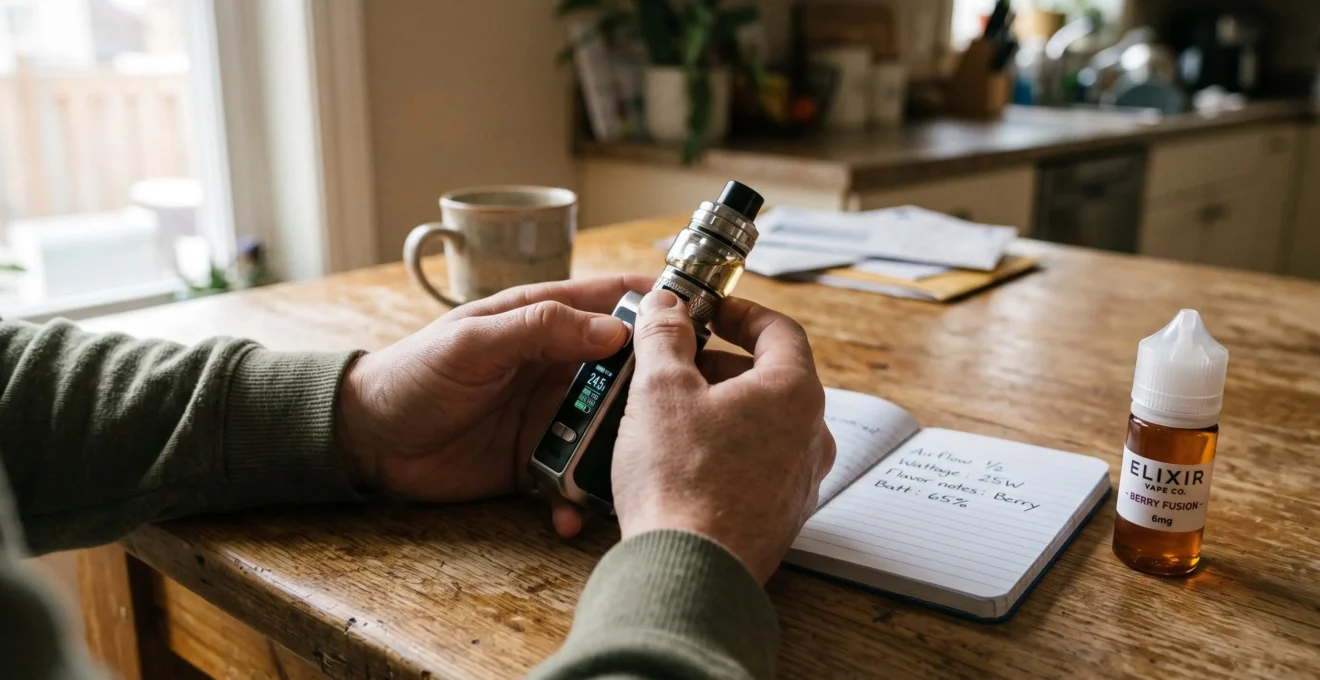
The most important vape device functions are power regulation, airflow control and activation. Together, they determine how the heating element operates, how air moves through the device and how aerosol production begins. Coil compatibility, battery protection and straightforward maintenance also matter more in everyday use than decorative finishes or extensive menus.
These functions are interconnected. Changing wattage affects the energy delivered to the coil, while adjusting airflow changes the draw and cooling conditions. The activation mechanism determines how the device responds when used. A setting that works with one coil or liquid may behave differently after a component change.
For adult UK users, understanding these interactions makes it easier to interpret manufacturers’ specifications, recognise unsuitable configurations and identify potential safety problems. The aim is not to maximise aerosol production, which can increase exposure to harmful substances, but to understand how a device operates within its intended limits.
Essential vape functions at a glance
- Prioritise coil compatibility, regulated power and airflow over appearance or unnecessary modes.
- Check the manufacturer’s operating range before changing wattage, and review settings after replacing hardware.
- Stop using a device with abnormal battery heat, swelling, hissing or visible damage, rather than attempting to correct it through settings.
- Why Do Basic Vape Functions Affect Performance More Than Cosmetic Features?
- How Do You Learn a New Vape Device Without Accidentally Changing Critical Settings?
- Draw-Activated or Button-Activated Vape: Which Is Easier for Daily Use?
- Which Device Function Problems Mean You Should Stop Using the Vape?
- When Should You Recheck Vape Settings After a Hardware Change?
- Low or High Wattage: Which Range Better Suits Your Coil and Inhale Style?
- How Do You Set Up a High-Airflow Vape Without Overpowering the Coil?
- What Does a Basic Vaping Setup Need for Straightforward Daily Use?
Why Do Basic Vape Functions Affect Performance More Than Cosmetic Features?
Basic vape functions affect performance because they control the physical conditions under which aerosol is generated. Power influences heating, airflow affects draw resistance and cooling, and activation determines when the heating cycle begins. Cosmetic features may improve handling or appearance, but they do not independently determine these operating conditions.
A vape device contains an electrical power source, a heating element and a mechanism for bringing liquid into contact with that element. When activated, the coil converts electrical energy into heat. Air movement and liquid supply then influence the resulting aerosol.
Scientific evidence confirms that hardware characteristics can make measurable differences. A scientific study on coil resistance and aerosol generation examined third- and fourth-generation electronic cigarettes, finding relationships between coil characteristics, temperature, aerosol mass and chemical emissions under specific experimental conditions.
The results do not establish a universally ideal resistance or wattage. They do, however, demonstrate why functional hardware choices deserve closer attention than external styling.
A useful distinction is whether a feature changes device operation or primarily changes convenience.
| Feature | Primary role | What to evaluate |
|---|---|---|
| Power adjustment | Controls electrical output | Compatibility with the installed coil |
| Adjustable airflow | Changes draw resistance and cooling | Available adjustment range |
| Activation system | Starts and stops heating | Reliability and accidental-activation protection |
| Battery capacity | Influences operating duration | Capacity, charging protection and condition |
| Decorative finish | Changes appearance | Handling, durability and personal preference |
| Display design | Communicates device information | Clarity of essential settings and warnings |
Not every convenience feature is expendable. A readable battery indicator, clear fault messages or an accessible locking function can make a device easier to operate correctly. Ergonomics and build quality also influence practical usability.
Before comparing appearance or additional modes, check three essentials: coil compatibility, power regulation and airflow design. Battery capacity and safety protections should then be evaluated in relation to the device’s intended use.
Once those core functions are identified, the next challenge is learning how to operate them without accidentally disturbing an otherwise suitable configuration.
How Do You Learn a New Vape Device Without Accidentally Changing Critical Settings?
Learn a new vape device by identifying its controls, checking the manufacturer’s instructions and recording the initial settings before making changes. Confirm which actions activate heating, adjust power or lock the interface. Change only one permitted setting at a time, so any difference in operation can be understood and reversed.
Modern devices vary considerably in interface design. Some use separate adjustment buttons, while others assign several functions to repeated presses of a single control. A sequence intended to switch off a device might select a mode on another model.
Start by identifying the actual settings rather than assuming familiar button sequences apply. Useful information includes the displayed wattage, resistance reading, activation mode, airflow position and battery status.
A factory configuration is not necessarily suitable for every installed coil. Before operating a new device, check that its components are correctly installed, the coil is properly prepared and the configured output falls within the manufacturer’s specified limits.
Once these conditions are satisfied, the following sequence helps preserve a known reference configuration:
- Inspect: Read the instruction manual, identify the controls and locate any warning indicators.
- Record: Note the initial power setting, detected coil resistance, airflow position and activation mode.
- Verify: Confirm that the displayed values are compatible with the installed hardware before use.
- Adjust: If adjustment is necessary, change one parameter within the manufacturer’s permitted range.
- Compare: Check whether the intended change occurred and restore the recorded configuration if its effect is unclear.
Accidental adjustments often happen when buttons are pressed during handling, transport or cleaning. Use the interface lock when available, and follow the manufacturer’s shutdown instructions before carrying or storing the device.
Where a device offers both locking and complete power-off functions, understand the difference. A display lock may prevent setting changes without necessarily disabling the heating control.
A simple written record is particularly useful for devices with multiple operating modes. It also makes unfamiliar screen indications easier to interpret without experimenting with combinations of buttons.
With the interface understood, activation becomes the next practical decision: should the device respond automatically to inhalation or require an intentional button press?
Draw-Activated or Button-Activated Vape: Which Is Easier for Daily Use?
Draw-activated devices minimise manual interaction because inhalation triggers the heating system. Button-activated devices require an intentional press, offering a more explicit activation control. Neither design is universally easier or more reliable. The practical difference depends on sensor behaviour, ergonomics, device maintenance and protection against unintended operation.
Draw activation generally relies on an airflow or pressure sensor to detect inhalation. Button activation uses an electrical switch to initiate heating. Some devices combine both systems, allowing the user to select or alternate between them.
These differences affect ordinary handling, but the presence of a button does not necessarily mean the device supports variable power, preheating or additional modes. Such capabilities must be verified separately.
| Criterion | Draw-activated | Button-activated |
|---|---|---|
| Starting activation | Inhalation operates the sensor | Intentional button press |
| Manual interaction | Usually minimal | Requires a deliberate action |
| Possible malfunction | Sensor may fail to detect a draw or respond incorrectly | Button may stick, fail or be pressed unintentionally |
| Control options | Depends on model | Depends on model and interface |
| Transport precautions | Follow shutdown and storage instructions | Use appropriate button locking or shutdown |
Research has identified measurable differences between activation mechanisms. A scientific study comparing button-activated and airflow-activated e-cigarettes examined nine disposable products and found differences in the airflow and pressure drop needed to produce aerosol.
The older disposable devices in that study cannot represent every modern refillable pod or regulated device. The results establish that activation design can influence operating characteristics, not that one system provides universally better performance.
For a device with dual-mode activation, confirm whether the two methods operate independently and how each can be disabled. An interface lock should not be assumed to disable draw activation unless the instructions explicitly confirm it.
Unexpected activation, whether caused by a sensor problem or a mechanical button fault, warrants stopping use until the cause is identified. Avoid carrying a malfunctioning device in a pocket or bag.
Ease of use therefore involves more than the number of actions required. The ability to recognise when the device is active, disable it reliably and interpret its behaviour is equally important.
Whatever activation system is selected, the device must remain capable of stopping safely. Knowing which symptoms indicate an actual hazard is more important than fine-tuning its response.
Which Device Function Problems Mean You Should Stop Using the Vape?
Stop using a vape immediately if the battery becomes unusually hot, swells, hisses or shows signs of serious damage. Smoke, sparking or unexpected heating are also warning signs. Ordinary performance changes may require maintenance, but symptoms suggesting battery failure or uncontrolled activation should never be treated as routine setting problems.
A weak flavour, reduced operating time or unusually restricted draw may indicate coil deterioration, liquid-supply problems or another maintenance issue. These symptoms alone do not establish that the battery is dangerous.
By contrast, battery swelling is a physical warning sign. Lithium-ion cells can generate gases through unwanted internal chemical reactions. A visibly deformed cell or housing should not be treated as a cosmetic defect or corrected by changing device settings.
The London Fire Brigade‘s vaping and e-cigarette safety guidance specifically identifies unusual battery heating, bulging and hissing as reasons to stop using a device immediately.
3 battery warning signs
Unusual heat, bulging and hissing are explicitly identified in London Fire Brigade guidance as reasons to stop using an e-cigarette immediately. This is not an exhaustive list of hazardous symptoms.
London Fire Brigade, official vaping and e-cigarette fire-safety guidance.
Use the distinction between maintenance problems and safety warnings to determine the appropriate response.
| Observed symptom | Possible significance | Appropriate response |
|---|---|---|
| Gradually reduced flavour | Possible coil or liquid-supply deterioration | Stop operation and inspect according to manufacturer guidance |
| Persistent burnt taste | Possible overheating or insufficient liquid at the wick | Stop activation and investigate before further use |
| Shorter battery runtime | Possible capacity loss or charging problem | Check charging conditions and device instructions |
| Unexpected activation | Possible sensor, button or electronic fault | Stop using the device until resolved |
| Unusual heat, swelling or hissing | Potential battery failure | Stop using and charging immediately |
| Smoke, fire or sparks | Immediate fire or electrical hazard | Move away, evacuate and contact emergency services |
If a device develops a suspected battery fault, stop using it and disconnect charging only if doing so is safe. Do not dismantle, puncture, compress or attempt to recharge a damaged battery.
If the device is stable and can be left safely without handling, keep people and combustible materials away. Do not attempt to move a smoking, burning or dangerously hot battery. In the UK, call 999 in a fire emergency.
Vaping devices and batteries must not be placed in ordinary household rubbish. Use appropriate electrical waste or battery collection services and inform the facility if the battery is damaged, since special handling may be required.
For a device without safety warnings, hardware changes still require attention because a new component can alter how the existing settings behave.
When Should You Recheck Vape Settings After a Hardware Change?
Recheck vape settings whenever a coil, pod or other relevant hardware component changes, and whenever the device detects a different resistance. Changes in e-liquid composition can also affect wicking behaviour. The essential checks are component compatibility, the displayed resistance and the manufacturer’s operating limits before the device is activated again.
Coils are not interchangeable merely because they fit a similar-looking device. Their resistance, heating structure and recommended power range can differ, even within the same product family.
A replacement coil may therefore require a different setting from the component previously installed. An old wattage value should not automatically be retained simply because the device remembers it.
Check the following triggers:
- Coil replacement: Confirm its exact model, resistance and specified operating range.
- Pod or tank replacement: Verify electrical and mechanical compatibility with the device.
- Battery replacement: For devices designed to accept replaceable cells, verify the required battery specifications and condition.
- Liquid change: Consider whether a different formulation affects the coil manufacturer’s stated compatibility requirements.
- Unexpected resistance reading: Stop and investigate an unexplained change rather than overriding safety warnings.
The first verification stage is electrical and mechanical. Ensure the replacement component is correctly fitted and check that the device displays the expected resistance. A discrepancy may indicate an incorrect part, poor contact or a fault requiring attention.
The second stage concerns operating power. Where the device allows manual adjustment, follow the coil manufacturer’s recommended range and begin at its lower end rather than immediately restoring a previous setting.
For a new liquid-fed coil, also follow the specified filling and priming instructions. Its wicking material must be adequately saturated before heating. Otherwise, insufficient liquid can expose the wick to excessive temperature and produce an unpleasant burnt taste.
Battery replacement deserves separate treatment. Cell compatibility is a safety requirement, not an adjustment preference. Never substitute an arbitrary cell or attempt to replace an internal sealed battery unless the manufacturer explicitly supports that procedure.
Keeping a simple record of the installed coil model and recommended range is more useful than memorising one preferred wattage for every configuration.
Once compatibility has been established, resistance and the specified wattage range provide the starting point for understanding how different power levels relate to inhalation styles.
Low or High Wattage: Which Range Better Suits Your Coil and Inhale Style?
Lower wattage generally suits coils designed for restricted airflow and lower-power operation, while higher wattage is commonly associated with lower-resistance coils intended for more open airflow. The appropriate range is determined by the specific coil and device, however, not by inhalation style alone or an assumption that more power improves performance.
Wattage represents the rate of electrical energy delivery. Increasing it can change how quickly and intensely the heating element transfers energy to the liquid, subject to the device’s regulation and operating conditions.
Resistance is relevant but does not determine wattage requirements in isolation. Coil geometry, heating surface, materials, wicking capacity and liquid properties also affect how a particular assembly behaves.
Manufacturer specifications provide the most useful starting point. Innokin‘s technical explanation of vape coils describes coil resistance, wattage ranges and airflow characteristics, recommending that users begin at the lower end of the specified power range and increase gradually according to the particular coil’s instructions.
Such manufacturer guidance is relevant to its own products and does not establish a universal power setting for every device.
| Characteristic | Lower-power configurations | Higher-power configurations |
|---|---|---|
| Typical coil design | Often higher resistance | Often lower resistance |
| Airflow design | Often more restricted | Often more open |
| Inhalation style | Commonly associated with mouth-to-lung | Commonly associated with direct-to-lung |
| Key limitation | Insufficient heating may affect aerosol production | Excessive heating may damage the wick and alter emissions |
| Setting priority | Specified coil operating range | Specified coil operating range |
These categories overlap. A restricted-draw device does not automatically require a particular resistance, and two coils with the same nominal resistance may have different recommended wattage ranges.
Research on aerosol generation illustrates this complexity. In one experimental comparison involving specific nicotine-salt pod configurations, the tested 0.6-ohm, 0.8-ohm and 1.2-ohm coils operated at different powers and produced different measured temperatures and aerosol masses.
Those measurements cannot be transferred directly into consumer settings. The study also examined carbonyl formation, showing that aerosol chemistry depends on more than a simple low-versus-high-power distinction.
A persistent burnt taste may indicate a wicking or heating problem, while a weak output may reflect unsuitable settings or a separate component issue. Neither symptom should be used to justify exceeding manufacturer limits.
Higher wattage is not inherently safer or better. Greater aerosol production may also change exposure to nicotine and other substances.
Power should therefore be considered alongside the amount of air moving through the device, especially where airflow is adjustable over a wide range.
How Do You Set Up a High-Airflow Vape Without Overpowering the Coil?
A high-airflow vape should operate within the coil’s specified power range, with airflow adjusted only as the device design permits. Opening the airflow can change cooling and draw resistance, but it does not increase the coil’s safe operating power. Never compensate for an airy draw by exceeding the manufacturer’s wattage limits.
Airflow and power affect different parts of the same process. Electrical output supplies energy to the heating element, while moving air influences heat transfer and carries the aerosol away from the coil.
With more airflow, the perceived temperature and concentration of the resulting aerosol may change. This can make an otherwise unchanged configuration feel different, even though its displayed wattage remains constant.
The critical distinction is that airflow adjustment does not redefine coil limits. A coil designed for a restricted operating range cannot safely be treated as a higher-power component simply because the air inlet is fully open.
A useful conceptual approach is to establish component compatibility first, confirm the permitted power range and then consider airflow independently. If the device offers an adjustable ring, its available positions should be interpreted according to its manual rather than a universal half-open setting.
E-liquid composition adds another consideration. Propylene glycol and vegetable glycerine mixtures can differ in viscosity, which may affect how liquid reaches the wick. The resulting behaviour depends on coil construction, liquid composition and operating conditions.
However, a direct rule such as “opening airflow makes thin liquids leak” is not established by the supplied technical evidence. Leaking and gurgling can have several causes, including sealing problems, condensation, overfilling or liquid-supply characteristics.
Similarly, the position of an airflow ring alone cannot demonstrate that the coil is operating correctly. Unexpected heat, persistent burnt taste, flooding or irregular activation should prompt inspection rather than progressively higher power.
The meaningful objective is a compatible configuration that operates consistently within the manufacturer’s stated parameters, not maximum airflow or output.
When these interactions are understood, selecting a straightforward daily setup becomes a question of compatibility, clear controls and maintainability rather than the number of available adjustments.
Key takeaways before choosing a device
- Choose controls that make operating limits and safety warnings easy to identify, rather than assuming more settings provide better control.
- Consider the availability and compatibility of replacement components before relying on a device for regular use.
- Prefer a configuration that is easy to inspect, maintain and deactivate safely.
What Does a Basic Vaping Setup Need for Straightforward Daily Use?
A straightforward vaping setup needs a compatible coil and device, clear power and airflow controls where adjustment is supported, a suitable activation method and reliable battery protection. It should also make routine maintenance manageable. A large display, multiple operating modes and decorative accessories are not necessary for understanding or controlling the device’s core functions.
The simplest setup is not necessarily the one with the fewest components. A sealed or highly automated product may appear uncomplicated, yet provide little information about component condition or how a fault can be identified.
Conversely, a refillable device with clearly labelled compatible components and an accessible manual may make maintenance easier to understand, even if it includes several adjustable settings.
For adult UK users comparing existing hardware, the following criteria are particularly relevant:
- Compatible components: The coil, pod or tank is explicitly supported by the device manufacturer.
- Understandable controls: Essential settings and shutdown functions can be identified without ambiguous button combinations.
- Battery protection: Charging instructions, warning indicators and fault responses are clearly documented.
- Practical maintenance: Replacement parts are identifiable and the filling or cleaning process is described in the manual.
- Readable information: Relevant battery, power and resistance information is available where the device supports these functions.
Replacement-coil availability and straightforward filling procedures can make regular upkeep less confusing. The important distinction is between necessary maintenance and modifications that the manufacturer has not authorised.
A device that requires frequent experimentation to overcome inconsistent behaviour may be less straightforward than one with fewer settings but clear, predictable operation.
Five checks for a straightforward vaping setup
- Identify the device: Record its exact model and locate the corresponding manufacturer manual. Deliverable: a verified model reference.
- Confirm coil compatibility: Match the installed or replacement coil to the manufacturer’s specifications. Deliverable: a compatible coil model and its stated operating range.
- Document essential controls: Identify the activation, shutdown, locking and adjustment functions. Deliverable: a short control-reference note.
- Review battery safety: Check the charging requirements and recognise the warning signs that require stopping use. Deliverable: a safety checklist based on the device instructions.
- Check maintenance requirements: Confirm the appropriate filling, replacement and disposal procedures. Deliverable: a basic maintenance reference for the device.
These checks assess practical usability without assuming that additional features improve aerosol quality or health outcomes. No vape device should be described as risk-free, and a well-matched configuration does not eliminate exposure to harmful substances.
For adults who smoke, UK health guidance distinguishes the risks of vaping from those of combustible tobacco, while emphasising that vaping is not harmless. People who do not smoke should not begin vaping.
The practical next step is to compare the exact device manual, compatible components and safety information against this checklist. Prioritise documented compatibility, predictable operation and maintenance over unnecessary complexity.
Can two vape devices with the same wattage perform differently?
Yes. Identical wattage readings do not guarantee identical heating conditions or aerosol output. Coil geometry, resistance, wicking material, airflow and device regulation can differ. Experimental research shows that hardware configuration influences aerosol production, so the displayed wattage is only one part of the operating system.
Does a higher-resistance coil always need less power?
No universal rule applies. Higher-resistance coils are often associated with lower-power designs, but recommended settings also depend on heating surface, construction and wicking. The operating range specified for the exact coil takes precedence over general resistance-based assumptions.
Can locking a vape device prevent every accidental activation?
Not necessarily. Locking functions vary between models. Some disable adjustment buttons, others disable heating, and some devices retain draw activation. Check the manufacturer’s instructions to determine whether the selected lock actually prevents activation during transport.
Should a vape battery be charged overnight?
No. London Fire Brigade guidance advises against leaving vaping devices charging unattended or overnight. Follow the manufacturer’s charging instructions, use appropriate charging equipment and stop charging if the battery becomes unusually hot or shows signs of damage.
Does choosing a compatible coil make vaping safe?
No. Component compatibility reduces the likelihood of certain operating problems but does not eliminate battery hazards or the health risks associated with inhaling e-cigarette aerosol. Device specifications and maintenance guidance concern hardware operation; they should not be interpreted as evidence that vaping is harmless.