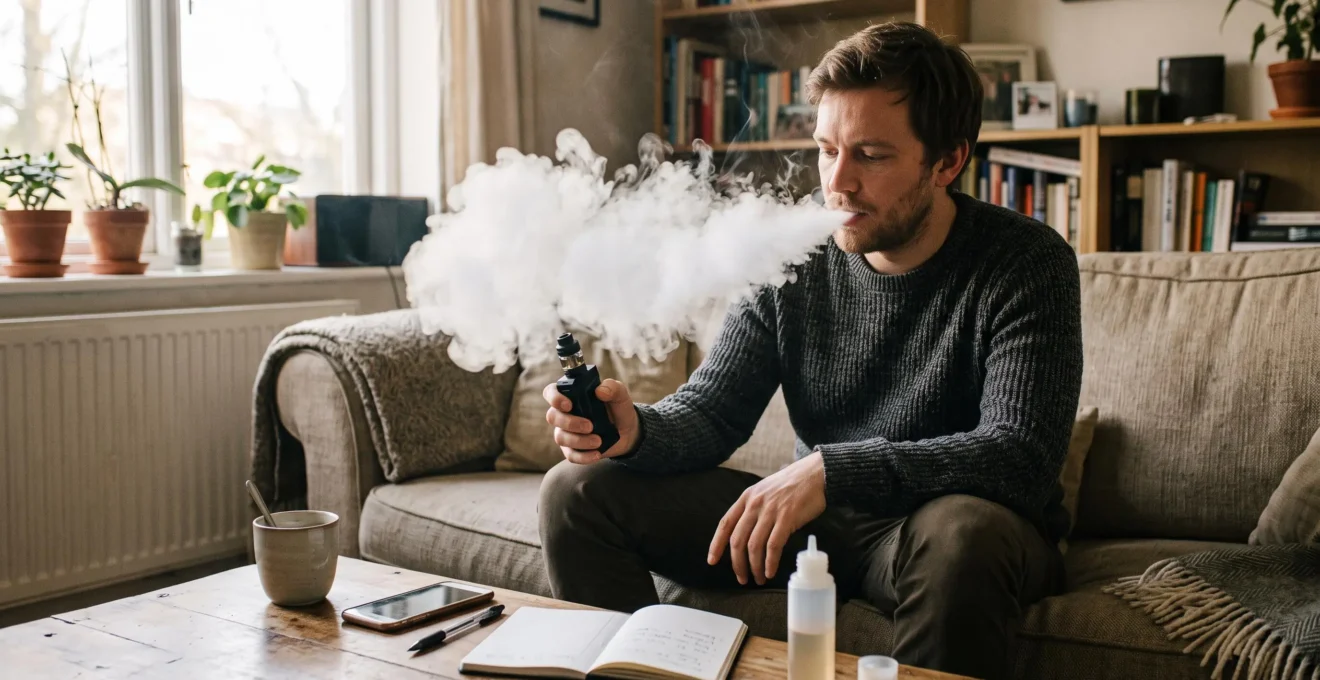
Low-nicotine e-liquids can make sense for adults using higher-output vaping devices or those who are ready to reduce their nicotine intake. However, a lower concentration does not automatically mean lower nicotine exposure. Device power, the amount of liquid vaporised and individual puffing behaviour all influence how much nicotine reaches the user.
For an adult who has switched from smoking, the appropriate strength is one that manages cravings without creating unnecessary nicotine exposure or encouraging a return to cigarettes. A liquid that feels comfortable in a direct-to-lung (DTL) device may be ineffective in a small mouth-to-lung (MTL) device, even when the concentration on the bottle is identical.
Choosing a lower strength therefore involves more than comparing milligrams per millilitre. It requires understanding the device, observing actual consumption and considering whether the current nicotine level continues to meet the user’s needs. These considerations are particularly important during smoking cessation or gradual nicotine reduction.
Low-nicotine e-liquids: the essentials
- Higher-output devices can deliver substantial nicotine even when the liquid contains only 3–6 mg/mL, because they typically vaporise more liquid.
- Persistent cravings, increased vaping frequency or rising liquid consumption may indicate that a nicotine reduction is not working as intended.
- Gradual reduction is generally preferable when someone feels ready, particularly if reducing too quickly could increase the risk of returning to smoking.
- Why Are Low-Nicotine Liquids Commonly Used in Higher-Output Devices?
- How Do You Use Low-Nicotine E-Liquid Without Constantly Chain Vaping?
- Low or High Nicotine: Which Better Matches Your Vape Device and Smoking Pattern?
- Which Signs Suggest Your E-Liquid Nicotine Strength May Be Too Low?
- When Should You Move to a Lower-Nicotine E-Liquid?
- High- or Low-Nicotine E-Liquid: Which Better Matches Your Device and Smoking Pattern?
- How Do You Use a DTL Vape Without Taking an Overly Forceful Draw?
- What Affects Nicotine Absorption When Using an E-Cigarette?
Why Are Low-Nicotine Liquids Commonly Used in Higher-Output Devices?
Low-nicotine e-liquids are commonly associated with higher-output devices because these devices can vaporise more liquid during each puff. Greater aerosol production can increase nicotine delivery even when the concentration is relatively low. As a result, a 3 mg/mL liquid in a powerful DTL setup may produce a substantially different nicotine experience from the same liquid in a compact MTL device.
The concentration printed on a bottle describes the amount of nicotine in each millilitre of liquid, not the amount absorbed during a vaping session. Actual exposure depends on the volume consumed, the device configuration and how the person inhales.
In an experimental study on coil resistance and nicotine delivery, researchers examined 32 experienced e-cigarette users across four conditions involving different nicotine concentrations and device configurations. The study compared 3 mg/mL and 8 mg/mL liquids alongside a 13.5 W, 1.5-ohm setup and a 40.5 W, 0.5-ohm setup.
The combination of 8 mg/mL nicotine and the higher-power, lower-resistance configuration produced the greatest nicotine delivery. The 3 mg/mL liquid in the lower-power configuration produced the lowest. Higher-output conditions also increased e-liquid consumption.
MTL devices generally involve drawing aerosol into the mouth before inhaling, with relatively restricted airflow and modest liquid consumption. DTL devices allow aerosol to be inhaled directly into the lungs through more open airflow, often producing considerably larger volumes.
This helps explain why 3–6 mg/mL is commonly encountered in sub-ohm vaping. It is a practical market convention, not a clinically validated universal range. Coil resistance alone also cannot determine an appropriate nicotine strength.
For smokers attempting to switch, choosing an extremely low concentration simply because a device produces large clouds can be counterproductive. If nicotine delivery does not adequately manage cravings, continued cigarette use becomes a concern.
A suitable choice should balance nicotine delivery, tolerability and smoking-relapse risk rather than rely on the bottle’s concentration alone.
How Do You Use Low-Nicotine E-Liquid Without Constantly Chain Vaping?
To avoid repeatedly vaping with a low-nicotine liquid, monitor whether each session provides sufficient satisfaction and whether vaping frequency increases after a strength reduction. If cravings persist or liquid consumption rises, the nicotine level may no longer match current needs. However, frequent vaping can also reflect established routines rather than insufficient nicotine.
Chain vaping generally refers to taking repeated puffs with little time between them. A person using weaker liquid may compensate by taking longer puffs, inhaling more frequently or extending sessions. Such changes can increase total liquid consumption, potentially offsetting some of the intended reduction in nicotine concentration.
The experimental research discussed earlier found that participants using the lower nicotine concentration generally took longer or larger puffs and increased puff frequency. This supports the possibility of compensatory behaviour, although it does not establish that everyone using low-nicotine liquid will vape continuously.
Three practical signals deserve attention: the number of vaping sessions or puffs, the amount of liquid consumed and whether throat sensation remains comfortable. If a previously satisfying routine becomes noticeably more intensive after switching strengths, the change deserves reassessment.
A simple self-observation exercise is to record approximate vaping frequency and daily liquid consumption over a typical week. This is a personal tracking method, not a validated clinical test. Comparing observations with the previous routine may help identify meaningful changes.
Nicotine is only one contributor to satisfaction. Flavour, throat sensation, the hand-to-mouth movement and familiar breaks throughout the day can also influence behaviour. Someone reaching for a device automatically during work breaks may be responding to habit, whereas someone experiencing persistent cravings may need to reassess nicotine delivery.
Repeated high-output use also consumes more liquid and can accelerate coil wear. Insufficient time for the wick to absorb liquid between puffs may produce unpleasant, overheated or burnt-tasting aerosol. A burnt taste should prompt stopping use and checking the equipment, not simply increasing nicotine strength.
The aim is not to enforce an arbitrary puff limit. It is to establish whether the new strength remains comfortable and compatible with staying away from cigarettes.
Low or High Nicotine: Which Better Matches Your Vape Device and Smoking Pattern?
The better nicotine strength depends on the device’s power, the user’s inhalation style and how effectively the current setup manages cravings. Higher concentrations are often more practical in low-power MTL devices, while lower concentrations are commonly used in higher-output DTL systems. Previous cigarette consumption provides useful context, but it cannot determine an ideal strength on its own.
A person’s former smoking intensity may suggest how important nicotine replacement will be during the transition. However, vaping devices differ substantially in aerosol output, and individual puffing behaviour changes the amount delivered. Two former smokers with similar cigarette histories may therefore have different experiences using the same e-liquid.
The following grid offers qualitative considerations rather than clinical dosing rules.
| User profile | Device and usage pattern | Considerations for nicotine strength |
|---|---|---|
| Recent quitter with persistent cravings | Low-power MTL, regular short sessions | A strength sufficient to control cravings may be more important than immediately reducing nicotine. |
| Former smoker comfortable without cigarettes | Low-power MTL, stable usage | Maintaining the current strength or considering a gradual reduction may both be reasonable. |
| Experienced DTL user | Higher-output device, larger aerosol volume | A lower liquid concentration may provide adequate nicotine, but actual consumption should be monitored. |
| Recent quitter still using cigarettes | Either device type, inconsistent satisfaction | Assess cravings, cigarette use and the overall setup before reducing nicotine. |
Higher nicotine is not automatically better protection against smoking relapse. In a device that vaporises substantial liquid, a higher concentration can produce uncomfortable throat sensation and excessive nicotine exposure. Nausea, dizziness or other unpleasant effects should prompt stopping use and seeking appropriate advice if symptoms persist or are severe.
Nicotine formulation also matters. Freebase nicotine and protonated nicotine, commonly associated with nicotine salts, can differ in aerosol characteristics and perceived harshness.
An experimental study of protonated nicotine and device power examined 45 participants, including cigarette smokers and established vaping users. It compared nicotine concentrations of 10, 15 and 30 mg/mL at power settings of 15 W and 30 W.
Higher nicotine concentrations and higher power increased measured nicotine exposure, while stronger combinations were generally perceived as harsher. Because this experiment did not test the 3–6 mg/mL range, its findings cannot directly establish an ideal concentration for low-nicotine sub-ohm vaping.
Nicotine salts are frequently associated with compact, lower-power systems, where smoother inhalation can make certain concentrations more tolerable. Nevertheless, formulation compatibility depends on the particular liquid and device, and smoothness should not be mistaken for low nicotine delivery.
Once those factors are considered, the next step is recognising whether a current strength is genuinely insufficient or merely feels different from a familiar routine.
Which Signs Suggest Your E-Liquid Nicotine Strength May Be Too Low?
A nicotine strength may be too low when a reduction is followed by persistent cravings, irritability, difficulty concentrating or a substantial increase in vaping frequency. Some users also report that vaping no longer feels satisfying. None of these signs proves that the liquid is too weak, but together they can justify reviewing the reduction and the risk of returning to smoking.
Nicotine withdrawal can affect mood, concentration, sleep and appetite. These symptoms are not specific to vaping and may have other explanations, especially during stressful periods or when daily routines change.
The NHS guidance on how to quit vaping recommends gradual nicotine reduction while monitoring individual responses. It identifies increased vaping after a reduction as a possible indication that nicotine concentration was lowered too quickly.
That distinction matters because a person might respond to an uncomfortable transition by taking more puffs without consciously recognising the change. A lower concentration per millilitre does not guarantee a proportionate decrease in nicotine intake when more liquid is used.
At the same time, behavioural satisfaction should not be confused with withdrawal. Someone may continue vaping during familiar activities even when cravings are absent. Increasing nicotine concentration to address boredom or ritual could reverse an otherwise successful reduction.
Several observations help separate these possibilities:
- Cravings: Is there a clear desire for nicotine or cigarettes between sessions?
- Timing: Did symptoms begin soon after lowering the nicotine concentration?
- Consumption: Has the volume of liquid used increased noticeably?
- Context: Is vaping concentrated around habitual breaks, or is it accompanied by discomfort throughout the day?
- Device performance: Is the equipment functioning normally, without burnt taste, leakage or an inconsistent draw?
If difficulties closely follow a reduction, discussing a return to the previously satisfactory strength with a pharmacist or stop-smoking adviser may be reasonable. Observing whether symptoms improve can provide useful personal information, but it does not establish a definitive diagnosis or prove that nicotine concentration was the only cause.
For someone who recently stopped smoking, renewed cigarette cravings deserve particular attention. Persisting with an uncomfortable reduction solely to reach a lower number can undermine the broader goal of remaining smoke-free.
If the current strength is comfortable and cigarette cravings remain controlled, there may be no immediate reason to change it.
When Should You Move to a Lower-Nicotine E-Liquid?
Moving to a lower-nicotine e-liquid is generally more appropriate when vaping has become stable, cravings are manageable and the individual feels ready to reduce. A gradual change allows time to observe whether consumption or withdrawal symptoms increase. For former smokers, maintaining protection against a return to cigarettes is more important than reaching zero nicotine according to an arbitrary deadline.
Successful smoking cessation and nicotine reduction are related but different goals. Someone who has only recently replaced cigarettes with vaping may benefit from maintaining a satisfying routine rather than making several changes simultaneously.
Periods of relatively stable daily routines can make a reduction easier to evaluate. A person dealing with strong cravings or substantial stress may prefer to postpone the change, although there is no universally required stress level or waiting period.
A practical approach is to reduce by one available strength increment, keeping the device and usual routine consistent where possible. For example, someone using a higher concentration could consider the next lower commercially available concentration rather than making an abrupt large reduction. No single reduction schedule is appropriate for everyone.
The response matters more than the planned timetable. Increased consumption, renewed cravings or reduced comfort may indicate that the change needs revisiting.
For adults who switched from cigarettes, smoking relapse risk should remain central to the decision. UK cessation guidance recognises that continuing to vape may be appropriate when it helps prevent a return to smoking. This does not mean vaping is risk-free or that nicotine use must continue indefinitely.
Five practical checks before reducing nicotine
- Record the starting strength. Write down the current nicotine concentration in mg/mL and the date of the observation.
- Establish typical consumption. Note approximate daily liquid use and vaping frequency, producing a simple personal baseline.
- Review smoking-related cravings. Record whether cigarette cravings are absent, occasional or persistent before changing strength.
- Choose one manageable adjustment. Identify the next lower available nicotine concentration while keeping the usual device unchanged where suitable.
- Review the outcome. Compare cravings, comfort and consumption with the baseline, then record whether maintaining, reconsidering or discussing the change with an adviser is appropriate.
This checklist is a self-monitoring framework rather than a medically validated reduction protocol. A pharmacist or qualified smoking cessation adviser can help when nicotine withdrawal or relapse risk makes the decision difficult.
Remaining at a stable nicotine concentration can be a reasonable temporary or longer-term decision for someone who would otherwise be at risk of resuming cigarettes.
High- or Low-Nicotine E-Liquid: Which Better Matches Your Device and Smoking Pattern?
The most appropriate choice is the nicotine concentration that works with the device while adequately managing cravings and remaining tolerable. Begin by identifying whether the device is low-power MTL or higher-output DTL, then assess current satisfaction. Only after those checks should the decision be made to maintain, increase or gradually reduce nicotine strength.
This sequence avoids a common mistake: treating every unsatisfactory vaping experience as evidence that the nicotine concentration is wrong. A device with an unsuitable airflow setting, worn coil or poor liquid compatibility may feel ineffective even when nicotine delivery is adequate.
Three questions can guide the decision.
- What device is being used? Identify the manufacturer’s recommended operating range, airflow characteristics and intended inhalation style. Do not assume that every sub-ohm or low-resistance device produces identical nicotine delivery.
- Is the current routine satisfying? Consider cigarette cravings, unpleasant symptoms, liquid consumption and whether the device performs consistently.
- What problem would a strength change solve? A reduction may be appropriate for someone ready to decrease nicotine use; an increase may warrant consideration when cravings remain uncontrolled; no change may be preferable when the current routine is stable.
A recently quit smoker who continues to crave cigarettes has a different priority from an established DTL user choosing to reduce nicotine. Likewise, someone still smoking and vaping simultaneously should focus on understanding why cigarettes remain part of their routine rather than automatically following low-nicotine advice intended for experienced vapers.
Device problems should be addressed separately. Weak flavour, for example, does not necessarily mean insufficient nicotine. Checking coil condition, airflow and compatibility with the manufacturer’s instructions may reveal the cause without changing nicotine concentration.
Users should also avoid assuming that a smoother nicotine salt liquid delivers less nicotine. Throat sensation is only one subjective characteristic and cannot be used as a reliable measure of absorbed dose.
When the chosen strength is comfortable and cravings are controlled, maintaining that arrangement may be more useful than making an unnecessary adjustment.
How Do You Use a DTL Vape Without Taking an Overly Forceful Draw?
A DTL device is generally designed for a comfortable, steady inhalation through relatively open airflow rather than a sharp, forceful pull. Draw technique should follow the manufacturer’s operating instructions and the user’s comfort. Excessive inhalation effort is not a reliable way to improve nicotine satisfaction and may make an unsuitable device setup feel harsher.
Direct-to-lung vaping differs from the restricted draw familiar to many cigarette smokers. A DTL device usually allows more airflow, making a steady inhale more suitable than trying to create strong suction through a narrow opening.
Someone accustomed to cigarettes may initially pull too sharply or use an airflow setting that feels unnatural. However, harshness, gurgling and liquid spit-back have multiple possible causes. They should not automatically be attributed to inhalation force.
Gurgling can be associated with excess liquid in the coil or airflow pathway. Spit-back may occur when heated liquid droplets escape through the mouthpiece. Harsh or burnt-tasting aerosol may indicate inadequate wicking, an unsuitable power setting or a coil requiring replacement.
Practical checks include:
- Use the device within its manufacturer’s recommended operating conditions.
- Adjust airflow only within the intended range and avoid forcing an uncomfortable draw.
- Allow adequate time between puffs for the wick to absorb liquid, particularly when using higher-output equipment.
- Check the coil, filling procedure and liquid compatibility if gurgling, leakage or harshness occurs.
- Stop using a device that produces persistent burnt taste or excessive heat until the issue is resolved.
Longer or larger puffs can affect aerosol generation and nicotine delivery, but an aggressive inhale does not guarantee greater nicotine satisfaction. The relationship depends on device design, liquid characteristics and puffing behaviour.
A person who finds DTL inhalation persistently uncomfortable may be better suited to a different approved device configuration rather than trying to compensate with stronger inhalation or a different nicotine concentration.
Once the device operates consistently, changes in cravings and consumption are easier to interpret without confusing them with equipment-related discomfort.
Key takeaways before assessing nicotine absorption
- Nicotine concentration describes the liquid, while actual exposure also depends on the device and vaping behaviour.
- Higher aerosol production can change nicotine delivery, but it does not establish a universal ideal strength for every user.
- When reducing nicotine, personal response and the risk of returning to cigarettes matter more than achieving a particular number.
What Affects Nicotine Absorption When Using an E-Cigarette?
Nicotine absorption from an e-cigarette depends on several interacting factors, including liquid concentration, nicotine formulation, device power, aerosol production and puffing behaviour. Individual physiology also influences nicotine exposure. Consequently, two adults using the same 3 mg/mL liquid can experience different nicotine effects, especially when their devices and inhalation patterns differ.
Nicotine concentration establishes how much nicotine is present in the liquid, but it does not determine the total amount aerosolised, inhaled or absorbed. Device settings affect aerosol generation, while puff duration and frequency influence the amount of aerosol encountered during a session.
Nicotine form is another variable. Freebase and protonated nicotine formulations differ in chemical characteristics, including factors related to pH and perceived harshness. These differences can affect user behaviour and nicotine delivery in combination with device power.
In the laboratory research involving protonated nicotine, higher power and higher nicotine concentrations were associated with greater increases in plasma nicotine. Participants also changed their puffing behaviour across experimental conditions, demonstrating why technical variables and individual responses cannot be considered independently.
The relationship between vaping and cigarette nicotine delivery is particularly important. It would be inaccurate to claim that nicotine absorption from every e-cigarette is always slower or less efficient than absorption from cigarettes. Delivery varies across generations of vaping products, formulations, device settings and user experience.
Likewise, plasma nicotine measurements collected during controlled experiments cannot directly predict a person’s daily nicotine intake. Short laboratory sessions are useful for studying mechanisms, but they do not establish long-term exposure or an ideal concentration for every adult.
Visible vapour volume and throat hit are also imperfect indicators. A large cloud does not specify how much nicotine entered the bloodstream, while a smooth draw does not establish that exposure is low.
The practical consequence is straightforward: liquid strength, actual consumption and individual response should be assessed together. A concentration that feels sufficient in one device may be inappropriate in another, even for the same user.
If considering a lower strength, first document current consumption and cigarette cravings, then review the proposed change with a pharmacist or smoking cessation adviser when appropriate. For adults who have stopped smoking, avoiding a return to cigarettes remains a central consideration.
Does using 3 mg/mL e-liquid always mean low nicotine intake?
No. A concentration of 3 mg/mL indicates the amount of nicotine in the liquid, not the total amount absorbed. A higher-output device may consume substantially more liquid than a small low-power device. Puff frequency, duration and individual absorption also affect nicotine exposure, so daily intake cannot be inferred from bottle strength alone.
Can an adult former smoker stay on the same nicotine strength for a long time?
Yes. There is no universal requirement to reduce nicotine concentration on a fixed timetable. Someone who uses vaping to avoid returning to cigarettes may reasonably prioritise maintaining smoking abstinence while considering whether and when further nicotine reduction is appropriate. Vaping is not risk-free, and professional cessation support remains available.
Is nicotine-free e-liquid necessarily the best next step after low nicotine?
Not necessarily. Nicotine-free liquid eliminates nicotine from that particular formulation, but it does not eliminate exposure to vaping aerosol. For someone at risk of returning to smoking, reducing to zero too quickly may be counterproductive. Readiness, cravings and the person’s broader cessation goals should guide the decision.
Are nicotine salts suitable for all sub-ohm devices?
No. Nicotine salt formulations differ, and compatibility depends on the particular device, operating power and liquid concentration. Some high-concentration formulations can produce substantial nicotine exposure at greater power. Follow the device manufacturer’s compatibility guidance rather than assuming that smoother inhalation makes a formulation suitable for every setup.
What should someone do if cigarette cravings return after reducing nicotine?
Renewed cigarette cravings suggest that the reduction deserves reassessment. Review when symptoms started, whether vaping frequency increased and whether the device is working properly. A pharmacist or stop-smoking adviser can help evaluate whether the reduction was too rapid and discuss appropriate nicotine replacement or cessation support without increasing the risk of returning to cigarettes.