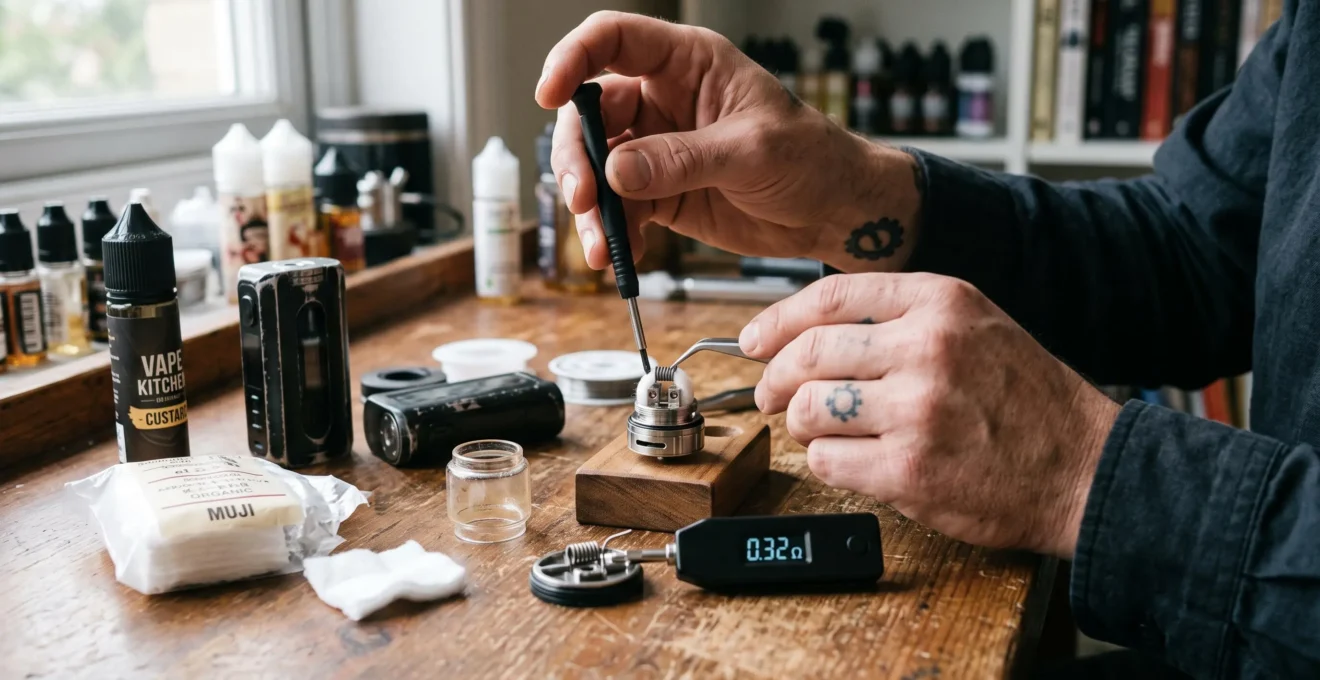
A rebuildable tank atomizer (RTA) combines a user-built coil and replaceable wick with an integrated e-liquid reservoir. For experienced adult vapers who want to control their builds without repeatedly dripping liquid onto exposed cotton, that combination can make an RTA a practical everyday option.
The advantage is conditional. A reservoir reduces the need for manual dripping, but it does not guarantee fewer refills than a standard tank. Capacity, liquid consumption, coil configuration and the tank’s particular design all influence how frequently refilling becomes necessary.
RTAs also move responsibility for liquid delivery onto the user. Cotton placement, coil resistance, filling technique and power settings must work together. A well-maintained build can provide repeatable performance, while small setup errors may cause leaks, gurgling or dry hits.
For UK users, compatible tank capacity and product requirements also matter. The relevant decision is therefore not simply whether an RTA holds liquid, but whether its maintenance demands fit the user’s skills and daily routine.
RTA practicality at a glance
- Fewer interruptions: An integrated reservoir removes the need to drip liquid directly onto the wick repeatedly, although refill frequency depends on capacity and consumption.
- Greater control: Rebuildable coils and replaceable cotton allow adjustments, but poor wick placement can interrupt liquid supply or cause flooding.
- A maintenance trade-off: RTAs replace disposable coil-head changes with hands-on inspection, rewicking and occasional rebuilding.
- Why Does Wick Placement Matter So Much in an RTA?
- How Do You Wick an RTA to Reduce Both Leaking and Dry Hits?
- RTA or Standard Vape Tank: Which Better Suits Users Who Value Easy Maintenance?
- Which RTA Mistakes Most Often Cause Flooding Through the Airflow?
- When Should You Rewick or Rebuild an RTA Instead of Adjusting the Settings?
- RDA or RTA: Which Better Fits Frequent Flavour Changes and Daily Convenience?
- How Do You Set Up a Standard Vape Tank Without Flooding the Coil?
- How Should Adjustable Wattage Be Set for Consistent Coil Performance?
Why Does Wick Placement Matter So Much in an RTA?
Wick placement determines whether an RTA delivers e-liquid to its coil at the rate required during use. Unlike a standard tank using a factory-fitted coil head, an RTA relies on cotton installed by the user to bridge the reservoir and heating element. Excessive restriction can cause dry hits, while inadequate coverage of liquid openings can cause flooding.
The reservoir does not feed the coil simply because liquid surrounds the chamber. E-liquid must travel through the atomizer’s liquid channels into the wick, then reach the heated coil through capillary action.
The Vaping360 guide to RBA, RDA, RTA and RDTA atomizers describes this relationship and the consequences of blocking or inadequately covering liquid-feed openings. These are general operating principles rather than evidence that every RTA uses the same wick arrangement.
Two separate variables govern the installation:
- Wick density: Cotton compressed too firmly can restrict liquid transport. Too little cotton may leave gaps through which liquid passes into the deck.
- Wick length: Tails that do not reach their intended feed positions can fail to control liquid entry. Excessively long tails may bunch together and obstruct the channels.
Long cotton is therefore not automatically safer than short cotton. What matters is the relationship between the ends of the wick and the particular atomizer’s juice wells, ports or chamber openings.
The Taifun GT II manufacturer documentation illustrates why this varies by design. Its liquid-channel dimensions influence the usable wick size, and its instructions describe positioning cotton relative to the evaporation chamber openings.
Before filling, users can inspect whether the wick covers the required openings without being heavily compressed. A small amount of e-liquid can then be applied to the cotton to confirm that it absorbs liquid. This is a preliminary visual check, not a reliable test of sustained liquid delivery under operating conditions.
Resistance should also be checked with a suitable regulated device or resistance reader before use. An unstable reading or suspected short circuit requires correction before any firing.
Once that relationship is understood, the next challenge is translating it into a repeatable wicking procedure without overlooking differences between single-coil and dual-coil decks.
How Do You Wick an RTA to Reduce Both Leaking and Dry Hits?
To reduce leaking and dry hits, install cotton that fits the coil without distorting it, trim the tails according to the RTA’s feed-channel geometry, and position them without excessive compression. Prime the wick before operation, then verify that the liquid openings are adequately covered. Single-coil and dual-coil tanks follow the same principles but may require different tail arrangements.
The first reference should always be the instructions for the exact atomizer. Some RTA decks need cotton extending into liquid wells; others are designed for the tails to rest near feed openings. Cutting every wick level with the deck floor is not a universal method.
The RDA and RTA wicking guide from The Vaper’s Guide recommends assessing cotton quantity by fit, adjusting tail placement to the deck and avoiding excessive packing.
A practical inspection sequence starts with the coil fully installed, its terminals secure and its resistance verified. Cotton should pass through the coil with moderate resistance rather than requiring enough force to shift the wire or deform the wraps.
After trimming, gently separate compressed fibres at the tail ends where the design permits. Position the tails so they cover their intended feed openings while preserving enough space for liquid movement.
For dual-coil RTAs, check both coils and their liquid-feed areas independently. One adequately wicked coil does not compensate for poorly positioned cotton around the other.
E-liquid composition adds another consideration. Higher-VG liquids are generally more viscous than higher-PG formulations, so liquid-feed restrictions can become more noticeable. However, the supplied technical sources do not establish a numerical cotton-density adjustment for a particular PG/VG ratio. Nicotine strength alone is not a reliable guide to wick density.
During priming, apply enough liquid to wet the cotton without unnecessarily filling the chamber with free liquid. Do not fire a dry wick. Nor should excess liquid be removed by heating the installed cotton: this can overheat or scorch the fibres. If over-priming occurs, clear excess liquid mechanically and inspect the assembly before use.
Five checks before filling a rebuilt RTA
- Confirm coil security: Check the installed coil and record a stable resistance reading on a suitable device.
- Check cotton fit: Move the cotton gently through the coil and confirm that the coil remains correctly positioned.
- Inspect both tail positions: Verify that all required liquid-feed openings are covered according to the model instructions.
- Prime the cotton: Confirm visible wetting throughout the accessible wick without allowing excess liquid to pool in the deck.
- Check the assembled tank: Verify that seals, threads, filling components and liquid controls are correctly positioned before operation.
Even when a careful installation takes longer initially, the ability to reproduce a suitable wick arrangement can reduce unnecessary rebuilding. Whether that becomes convenient depends on how much routine maintenance the user is willing to perform.
RTA or Standard Vape Tank: Which Better Suits Users Who Value Easy Maintenance?
A standard vape tank is generally easier to maintain for users who prefer replacing a worn coil head rather than diagnosing a build. An RTA suits experienced users comfortable inspecting resistance, replacing cotton and adjusting coil placement. The RTA offers greater control and potentially lower recurring consumable costs, but it requires more technical involvement.
Convenience depends on which type of effort matters most. With a standard tank, maintenance largely consists of replacing a compatible coil head, cleaning the tank and ensuring correct filling. An RTA makes the coil and wick accessible, but requires the user to assess their condition.
| Consideration | RTA | Standard tank |
|---|---|---|
| Routine coil maintenance | Inspect and maintain a rebuildable coil | Replace a compatible coil head |
| Wick replacement | Usually performed separately | Normally included with a new coil head |
| Technical knowledge | Coil installation, resistance checks and wicking | Primarily compatibility, priming and filling |
| Failure diagnosis | Requires identifying wick, coil or assembly problems | Often begins with checking or replacing the coil head |
| Consumable costs | Wire or coils and cotton, plus tools and maintenance | Recurring replacement coil heads |
| Build customisation | Greater control within device specifications | Limited to compatible manufactured coils |
Potential savings should not be treated as guaranteed. Rebuildable equipment may require an initial investment in suitable tools, measuring equipment and replacement parts. The total also depends on how often components are replaced and whether the user already owns the necessary equipment.
Another advantage is the ability to reproduce a preferred configuration without depending entirely on a particular batch of replacement coil heads. However, repeating a build does not guarantee identical performance if cotton placement, liquid composition or coil condition changes.
An RTA is unlikely to feel effortless to someone who cannot confidently check electrical resistance or recognise an installation fault. Experienced users with those skills may find routine cotton replacement straightforward, particularly when the same setup is used consistently.
For users who accept that responsibility, the next important question is how readily an RTA can be returned to normal operation when liquid starts escaping through the airflow.
Which RTA Mistakes Most Often Cause Flooding Through the Airflow?
RTA flooding commonly results from inadequate cotton coverage around liquid-feed openings, excessive liquid entering the evaporation chamber, or incorrect filling procedures. Damaged seals, loose components and unsuitable wick positioning can also contribute. True flooding usually involves liquid accumulating in the airflow pathway, whereas minor moisture around an air inlet may simply be condensation.
Liquid should reach the coil through the wick, not bypass it and collect in the airflow chamber. The most useful diagnosis begins by identifying how liquid could have crossed that boundary.
- Wick tails too short: Open feed passages may allow liquid to enter the deck without sufficient cotton controlling its movement.
- Wick tails too tightly packed: Restricted liquid delivery can cause dry hits rather than flooding. This requires a different correction.
- Excessive filling: Insufficient headspace and changes in tank pressure during closure may force liquid into the evaporation chamber.
- Incorrect filling sequence: Tanks with liquid-flow control may require that control to be closed before filling.
- Assembly defects: Damaged O-rings, improperly seated glass or loose components can create leakage independently of the wick.
Some guides recommend closing airflow during refilling, but this cannot replace the device’s actual filling instructions. Airflow control and liquid-flow control are different mechanisms, and not every RTA has both.
Flooding and condensation can produce superficially similar moisture around an air inlet. Condensation generally accumulates gradually during use. Flooding is more likely when pronounced gurgling, liquid spitting or visible leakage accompanies the moisture. These symptoms are useful clues, not definitive proof of a particular cause.
When flooding occurs, stop operating the atomizer. Remove it from the power device if appropriate, contain any leaked liquid with absorbent tissue and inspect the airflow, seals and wick arrangement. Gentle clearing of residual liquid may help, provided the manufacturer permits the method and the tank is securely assembled.
Do not attempt to burn away pooled e-liquid by firing a wet or flooded assembly. Heating cannot repair a defective seal or an open liquid-feed channel, and it can cause spitting or wick damage.
The Spica Pro MTL rebuildable atomizer user manual gives a model-specific example: it instructs users to close liquid control for filling, then reopen it according to the prescribed sequence. Other RTAs may require different procedures.
If the leakage returns after correct reassembly, the cause needs to be identified before further use. Persistent flooding should not be treated as a normal characteristic of rebuildable tanks.
When Should You Rewick or Rebuild an RTA Instead of Adjusting the Settings?
Rewick an RTA when cotton shows persistent off-flavours, visible deterioration or unreliable liquid delivery despite appropriate settings. Rebuild when the coil is damaged, deformed or electrically unstable. Adjustments to wattage or airflow are more appropriate when the hardware is sound and the problem clearly relates to operating conditions rather than failing components.
Understanding the distinction prevents unnecessary coil replacement and avoids using power adjustments to disguise a physical fault.
The following diagnostic grid separates symptoms from potential responses. None of these symptoms alone establishes a definitive cause.
| Observed symptom | Possible cause | Appropriate response |
|---|---|---|
| Muted flavour after changing liquid | Residual flavour or degraded cotton | Inspect and consider rewicking |
| Persistent burnt taste | Damaged wick or inadequate liquid delivery | Stop firing; inspect and replace damaged cotton |
| Fluctuating resistance | Loose connection, damaged coil or electrical fault | Stop use and inspect; repair or rebuild before operation |
| Weak performance with stable resistance | Power setting, airflow or liquid-feed limitation | Check wick condition and permitted settings |
| Visible coil deformation or damaged insulation | Physical or electrical defect | Replace defective parts and verify safety |
| Repeated dry hits at a previously suitable setting | Wick deterioration, restriction or change in liquid supply | Inspect the cotton and liquid-feed system |
Cotton life has no reliable universal replacement interval. Sweetened or dark liquids may leave more visible residue, but the exact effect depends on the formulation, coil temperature and usage conditions.
Inspection is more useful than following a fixed calendar. Discoloured cotton, a persistent unwanted taste, or deterioration in liquid delivery can justify replacement. Visible colour change alone, however, does not identify the full condition of the coil.
Rewicking without rebuilding is an important distinction. A serviceable coil can sometimes be retained while only the cotton is replaced, subject to the coil manufacturer’s maintenance instructions. A coil with damaged wraps, unstable resistance or other physical defects should not be kept in operation merely to avoid a rebuild.
Any coil cleaning must follow material and manufacturer guidance. In particular, dry firing is not an appropriate universal cleaning procedure for all coil types or materials.
Users who can distinguish these maintenance tasks may find RTAs more manageable for everyday use. Their suitability becomes clearer when compared with rebuildable dripping atomizers, which solve liquid-delivery needs differently.
RDA or RTA: Which Better Fits Frequent Flavour Changes and Daily Convenience?
An RTA generally provides greater everyday convenience when the priority is avoiding repeated manual dripping, because it stores e-liquid in an integrated reservoir. An RDA is more adaptable to frequent flavour changes because it has no comparable tank of liquid to empty. The better option depends on whether uninterrupted liquid supply or quick flavour switching matters more.
Both are rebuildable atomizers, but their liquid-delivery systems are different. An RDA typically relies on liquid being applied directly to its wick and deck, while an RTA supplies its wick from a reservoir through dedicated channels.
An RTA can therefore reduce interruptions during everyday use, especially compared with an RDA that requires repeated manual replenishment. This does not establish that its reservoir outlasts every standard tank, nor that an RTA is inherently leak-proof.
| Priority | RDA | RTA |
|---|---|---|
| Avoiding frequent dripping | Requires repeated liquid application in typical use | Uses an integrated reservoir |
| Changing flavours frequently | Usually simpler without a stored tankful | May require emptying and cleaning the reservoir |
| Carrying between locations | Liquid can remain on the exposed deck or wick | Reservoir can simplify transport, but leakage remains possible |
| Cleaning after a flavour change | Deck and wick can be accessed directly | Tank and liquid-feed areas may also need cleaning |
| Coil customisation | Available within design limits | Available within design limits |
The flavour-switching disadvantage of an RTA becomes more noticeable when moving between strongly contrasting liquids. Residual liquid in the tank or cotton can affect the next flavour even after refilling.
Depending on the extent of flavour carryover, a user may empty and clean the tank, change the wick or maintain separate compatible setups. Dry firing is not inherently necessary for a flavour change and should not be treated as a universal cleaning step.
Claims that RDAs always deliver stronger flavour are also too broad. Coil placement, airflow design, liquid composition and operating conditions affect the experience in either format. No comparative flavour-performance measurements are provided by the source material used here.
For travel and use away from home, an RTA’s integrated tank may be easier to manage than carrying an RDA that requires frequent dripping. Nevertheless, reservoir seals and liquid-feed openings must remain sound.
Users who rarely change flavours and already understand rebuildable maintenance may favour the RTA’s reservoir. Those who prioritise the simplest possible component replacement should also consider how a conventional tank compares.
How Do You Set Up a Standard Vape Tank Without Flooding the Coil?
To set up a standard vape tank without flooding its coil, use the correct replacement head, follow its specified priming procedure, fill through the designated port without overfilling and allow the wick to saturate before operation. Avoid directing e-liquid into the central airflow chimney. The manufacturer’s instructions take precedence over any general filling sequence.
Standard coil heads contain a factory-installed heating element and wick. Their sealed construction reduces the need for users to position cotton manually, but it does not eliminate filling mistakes or defective components.
A typical setup involves checking that the coil is compatible with the tank, ensuring it is properly seated, wetting any accessible cotton areas as directed, and allowing sufficient time for the wick to absorb liquid before use.
Do not add liquid indiscriminately into the central bore of a coil head. In many tank designs, that central space forms part of the airflow route rather than the intended filling pathway.
Flooding may occur when liquid is introduced into the airflow chimney during filling, when a seal is incorrectly seated, or when the coil head does not fit securely. An excessively saturated wick may also allow liquid to collect in the airflow pathway.
Using an unsaturated wick is a different problem: it primarily creates a risk of overheating or burning the cotton. Immediate use after filling is therefore not a reliable flooding-prevention technique.
Users should also respect the coil’s specified wattage range where one is provided. Increasing power to compensate for a poorly primed coil can damage the wick rather than improve liquid delivery.
The maintenance benefit of a standard tank is straightforward: a defective or worn coil head can usually be replaced with a compatible part without rebuilding the heating element or threading new cotton.
Its trade-off is dependence on the availability and compatibility of replacement heads. An RTA shifts that dependence towards the user’s coil-building knowledge, materials and equipment.
Whichever system is chosen, consistent operation depends on matching the power setting to the coil and its ability to receive liquid. That final relationship is especially important for rebuildable tanks.
Key takeaways before adjusting wattage
- Stable coil resistance and correct assembly must be confirmed before changing power settings.
- Wattage cannot compensate safely for damaged cotton, blocked feed channels or electrical faults.
- A setting that previously worked may become unsuitable when wick condition, e-liquid or coil configuration changes.
How Should Adjustable Wattage Be Set for Consistent Coil Performance?
Adjustable wattage should be set within the safe operating limits of the coil, atomizer and regulated device, with the wick fully saturated and electrical resistance stable. There is no universal wattage suitable for every RTA build. Power demand depends on coil construction, material, resistance, airflow and how effectively the cotton supplies liquid.
Before adjusting wattage, confirm that the build is suitable for the device and that its resistance falls within the manufacturer’s supported range. A resistance reader or regulated device can help identify an unstable installation, but it does not guarantee that a build is mechanically sound.
For compatible wattage-mode coils, beginning at a conservative setting within the permitted range and making gradual adjustments allows the user to assess performance without immediately applying excessive power.
Wattage and wicking must be evaluated together. A coil can only vaporise liquid consistently when fresh liquid reaches it fast enough to replace what is consumed.
If power demand exceeds the rate of liquid replenishment, the cotton near the heating element may become insufficiently saturated. This can cause harsh flavour or a dry hit even if the wick initially appeared correctly positioned.
Conversely, weak performance at a low power setting does not automatically justify increasing wattage. Restricted airflow, unsuitable coil placement, incorrect resistance or an ageing wick may be involved.
Coil material also matters. Not all materials are suitable for the same operating modes or maintenance techniques. Temperature-control materials must be used according to device specifications, and wattage settings should never override manufacturer safety restrictions.
As residue accumulates and cotton deteriorates, performance may change at a previously satisfactory setting. A modest power adjustment may sometimes alter the immediate experience, but repeatedly reducing wattage to avoid burnt or unpleasant flavour can delay necessary inspection.
Persistent harshness, visible cotton damage, electrical instability or repeated dry hits call for stopping use and checking the build. Power should not be increased to clear liquid from a flooded deck or compensate for a failing wick.
For an experienced user, repeatability comes from recording the build configuration, confirming component condition and using settings compatible with both the device and the liquid-feed system.
Before committing to an RTA for everyday use, review the manufacturer’s coil and tank specifications, verify the electrical setup and assess whether the time needed for safe maintenance is justified by the convenience of its integrated reservoir.
Does an RTA always need fewer refills than a standard vape tank?
No. An RTA eliminates frequent manual dripping compared with a typical RDA, but its refill frequency relative to a standard tank depends on reservoir capacity and liquid consumption. In the UK, relevant capacity restrictions can also affect the choice of compliant equipment.
Can an RTA be maintained without replacing the coil every time?
Yes. Provided the coil remains mechanically sound, electrically stable and suitable for continued use, replacing only the cotton may be sufficient for routine maintenance. Damaged or unstable coils require appropriate repair or replacement before further operation.
Are single-coil RTAs easier to maintain than dual-coil RTAs?
A single-coil deck generally involves fewer coils and wick ends to install and inspect. However, maintenance difficulty also depends on access to the deck, liquid-channel design and assembly requirements. A well-designed dual-coil deck may still be straightforward for an experienced user.
Can an RTA leak even when the cotton is correctly installed?
Yes. Faulty seals, incorrectly seated components, damaged glass, filling mistakes or liquid-control problems can cause leakage independently of the cotton. Replacing the wick will not necessarily solve a structural or sealing defect.
Should a rebuilt RTA be used if its resistance reading keeps changing?
No. Unexpected resistance fluctuations may indicate a loose connection, damaged coil or another electrical fault. Stop using the assembly and inspect it with appropriate equipment. Do not resume operation until the fault is corrected and the build is verified as compatible with the device.